Afghan

Afghan closed following a fire in January 2020. I’ve kept the review up for posterity.

My dining companion this week is Martijn Gilbert, the outgoing (in every sense) CEO of Reading Buses. I realised Martijn wasn’t going to be your usual dining companion relatively early on in our meal at Afghan, just after we took our seats in one of the booths at the back of the room and began looking at our menus. I was looking at the menu, anyway: Martijn, on the other hand, was peering intently through the big windows out on to the Wokingham Road.

“What’s that doing there?”

“What do you mean?” I said, assuming he was talking about the presence of houmous on the menu of an Afghani restaurant.

“That bus that just went past. It’s a 14 – they go to Woodley – and this is the 17 route. If there’s a diversion in place I don’t know about it.”

“Is that a problem?”

Martijn gave me a kindly, indulgent look, as if he’d just heard something crashingly stupid but was far too nice to correct it, and said something about low bridges. It all sounded very convincing, although my mind was also whirring with other thoughts, mainly about how many main courses we could snaffle between the two of us. After all, Martijn had specifically told me he only had a salad for lunch to ensure he was in peak dining condition.

“If you don’t mind, I just need to phone the control room.”

So he did, and it turned out it was a known diversion and not some bus driver having a funny five minutes or, worse still, about to recreate Speed just outside the Early Café. But even that incident gave me an idea about what Martijn was like in work mode, and it was impressive stuff: the sort of perfectionism I also see in some restaurant owners, where they know everything about everything when it comes to their business. I aspire to that, which is why I re-read my reviews countless times before they are published on the blog – scanning for typos and needless commas, mostly – but I’m small time compared to this.

The irony about Martijn’s intervention was that I’d deliberately chosen Afghan to review with him because it was on the 17 bus route; just like the tote bag they sell in But Is It Art? says, the number 17 route is the backbone of Reading. Sometimes it seems like all human life joins and leaves that great thoroughfare at some point – whether it’s the leafy gentility of the Earley borders, the icon that is Cemetery Junction or the fleshpots of the Oxford Road. I used to commute to work on the 17, many moons ago at the dog end of the 90s, from a shared house on Talfourd Avenue where I was the only person not doing drugs, and I’ve always had a big soft spot for it; to me, as much as the River Thames, it defines the town.

It pleased me, too, that Martijn caught the number 17 to the restaurant – as did I. Martijn told me previously, during a boozy night in the Retreat, that if the number 17 route hadn’t already existed, nobody would have invented it: it simply made no sense to join up the far East and West of Reading in this way, and in any other town it would have been two separate routes. But Reading had it, and it worked, and people seemed to like it, so nobody has ever messed with it. “Our data shows us it isn’t always heavily used during the day” said Martijn, “but we’re not changing the timetable. It goes every seven minutes, without fail. That’s the 17 for you”. I loved that, another of many things to love about Reading.

Of course, I don’t just pick restaurants because of their public transport links and Afghan had come highly recommended by a number of people in the run up to my visit. One friend told me they had a real talent for cooking lamb, another friend enthused about her trip there a couple of days before my visit. My regular reader Mansoor – an expert in these things – recommended one dish in particular, telling me his wife had ordered it three times in two weeks. All that and independent and in an area somewhat lacking in decent restaurants: how could I not give it a whirl?

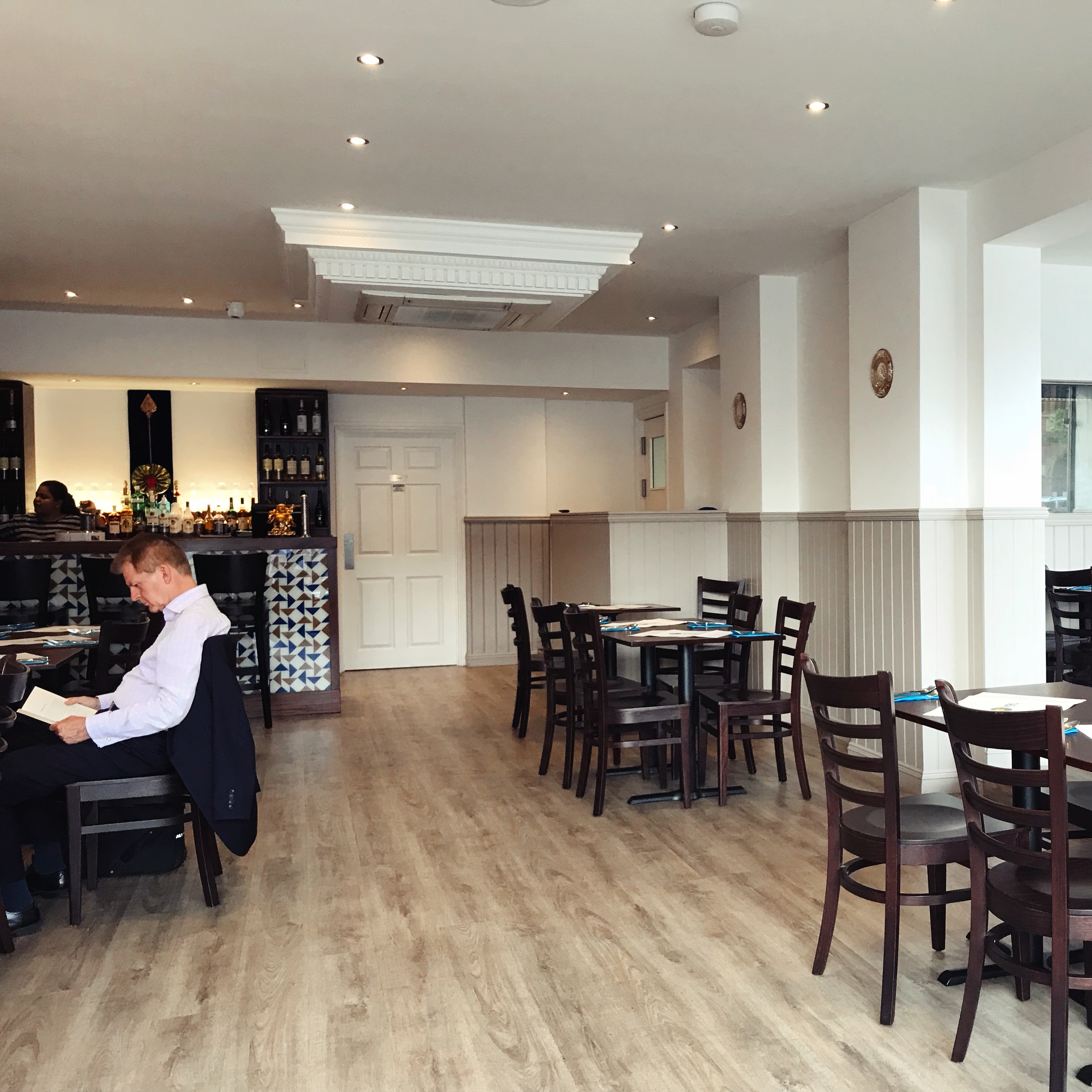
The room was pretty much unchanged from its previous incarnation as Lazeez – a big square, booths and banquettes around the edge and tables in the middle (I know that, because I looked up the old review for Lazeez and was struck by how much of it I could have just copied and pasted). Martijn and I were at one of the booths, which could have generously seated four but turned out to be just right for the quantity of food we ordered. The menu reminded me very much of the menu at Kobeda Palace, the Afghan restaurant at the other end of the 17 route, only a little wider and far more polished-looking: at Kobeda Palace you could be forgiven for thinking you were in a kebab house, with the preparation and cooking front and centre, whereas Afghan was more obviously a restaurant. Some dishes were more expensive, but many weren’t.

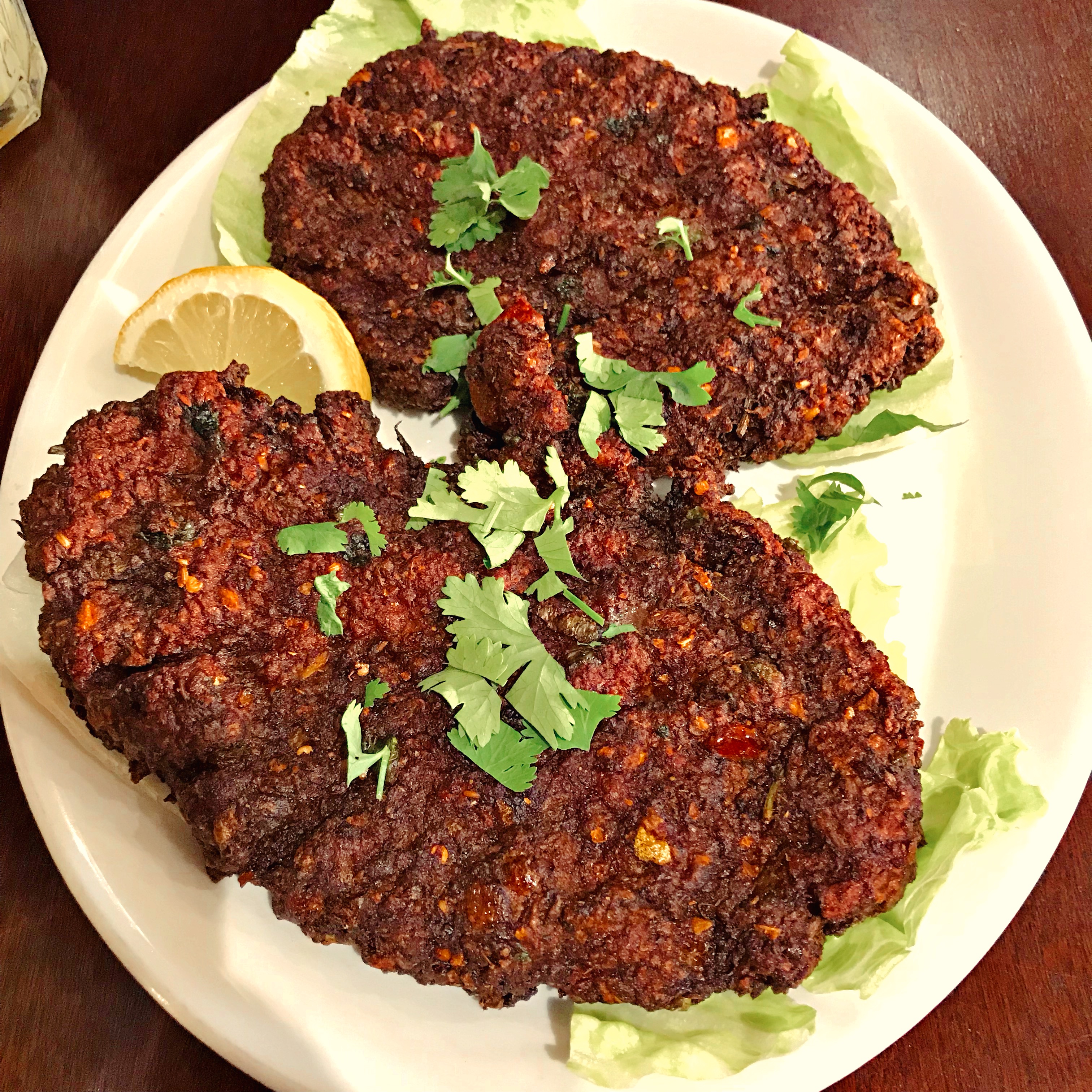
I managed to persuade Martijn to order a starter and three mains to share, and as nobody at Afghan tried to deter us I assumed that our order was deemed plucky rather than foolhardy. The first thing to arrive was a dish I’d been very excited about trying, the chapli kebab. This was the dish Mansoor’s wife had so admired, and it’s been described as the best thing to come out of the Khyber. As a die hard Carry On fan I found this difficult to believe, so I was determined to see what the fuss was all about.

A chapli kebab is quite hard to describe, but here goes: it’s sort of like a spiced lamb kofte but instead of being in your traditional cylindrical shape it comes as a flat patty more like a burger, cooked in fat and packed with onion and green chillies. When it arrived I thought it looked rather like a pair of smokers’ lungs, but from the very first mouthful I knew this was a dish to be reckoned with. How did they get the contrast between the almost crunchy outside and the juicy inside so bang on? It went beautifully with all three dips at the table – a green one full of coriander, a red number which looked like it would be diabolically hot but was more like a sweet chilli sauce, and a cooling yoghurt with mint.
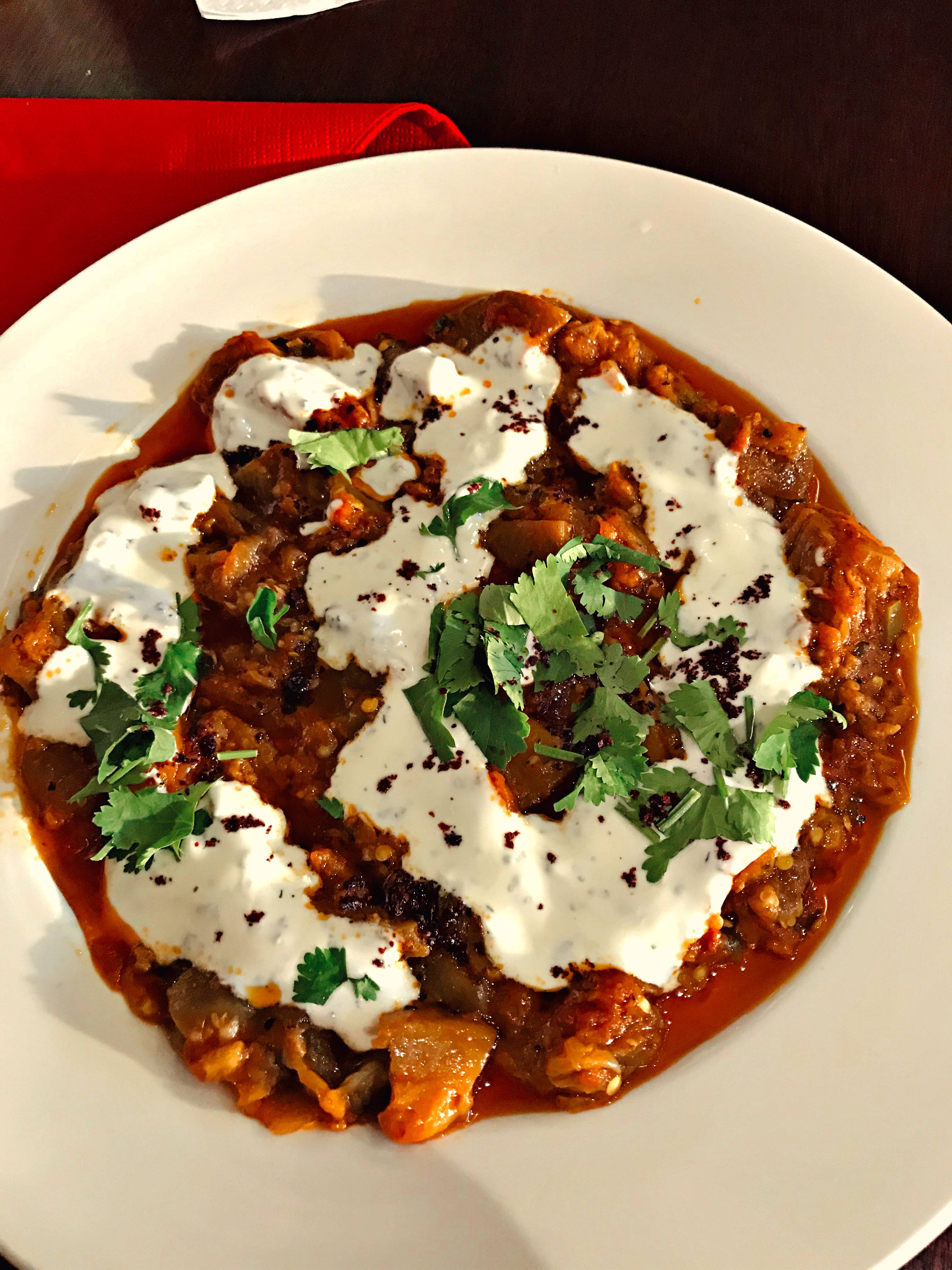
“This is good” said Martijn, wasting no time setting out demolishing one of the kebabs, and I couldn’t disagree. The naan it was supposed to come with didn’t arrive until later, one of many oddities about the timing which slightly marred matters. Instead, we got the only conventional starter we’d ordered: bourani banjan, aubergine with tomato and yoghurt. Aubergine isn’t everybody’s cup of tea – often it isn’t mine – but this was a properly lovely dish and astonishingly good value at three pounds. The aubergine was sweet, sticky and beautifully cooked with none of that spongey boredom it all too often presents.
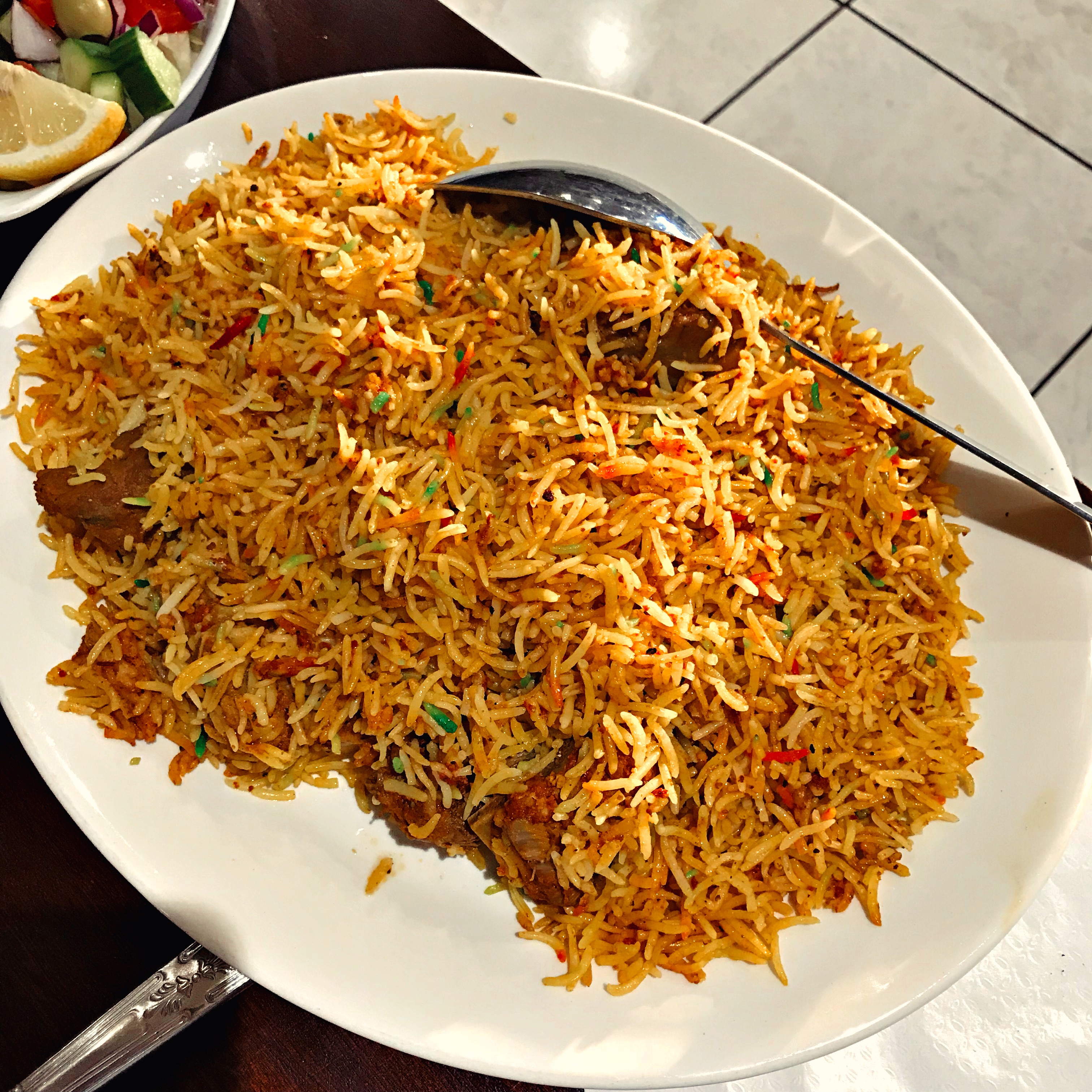
In an ideal world we’d have been left to finish that little lot before more food turned up, but that was not to be. Instead, a groaning dish of lamb biryani was brought over when we were barely halfway through. How much you’ll like Afghan’s biryani, to some extent, will depend on how you feel about meat on the bone – most of it slid off, but there was a bit of a variation in texture. I didn’t mind it, and I know that lamb on the bone is far more authentic for these things, but it wouldn’t be for everyone. The rice was well spiced (if not the best example I’ve tasted) but there was a lot of it, so the ratios felt a little off. On the other hand, this dish was nine pounds, so that feels like a quibble.
At the risk of inducing déjà vu, in an ideal world we’d have been left to finish that (not especially) little lot before more food turned up, but that too wasn’t to be. So we were partway through pretty much everything we’d ordered when a big dish of charsi lamb karahi was deposited at the table, along with our naan bread which, by that point, I’d pretty much forgotten about. The lamb karahi is ordered in multiples of half a kilo, so we’d ordered the entry level five hundred grams. When it arrived, I told myself it was okay because much of it would be bone: and, again, how you feel about this dish will partly depend on where you stand on meat on the bone. I found this a little trickier and less enjoyable – the sauce was deep, thick and peppery but lacked some of the spice and fragrance of, say, Kobeda Palace’s quite extraordinary karahi.

We had an ordinary-sized naan bread (which was meant to arrive at the same time as the chapli kebab) but we’d also ordered an “Afghan naan”, because I’d been told these were quite the talking point. And it really was – a huge thing which turned up vertically, impaled on some metal stand and brought to the table. It was so big it blotted out some of the remaining daylight outside, so big in fact that Martijn took a selfie with it for sheer novelty value. But the novelty value was the main value, I think. Getting it off its makeshift gallows was a faff, and it was a little rigid and crispy rather than soft and yielding – you could load stuff onto it, but it was much more difficult to use it for scooping. That said, the karahi was a relatively dry curry, so perhaps scooping was a bit hopeful anyway.

“It’s great that Reading has independent restaurants like this and not just lots of chains” said Martijn, grabbing another mouthful of the karahi and I sensed, not for the first time that evening, perhaps a little bit of regret at leaving his adopted town. I could see why – I mean, he might be able to actually buy a house in the North East but would he ever find an equivalent of the Maiwand Lion, or Smelly Alley, or the Nag’s Head?

“That’s the whole point” I said, pontificating on as usual before returning to more important matters. “Try some more of the chapal kebab now it’s cooled down. If anything, it’s even more delicious.”

Like quite a few of Reading’s more interesting restaurants Afghan is unlicensed, so Martijn had something fizzy and I ordered my beloved mango lassi. It was three pounds for a glass or six pounds for a jug, so I got a jug and Martijn helped me out with it, although we left a little. It never disappoints, but it did have the slightly gloopy and sweet taste of stuff that might not have been freshly made.

Dinner for two came to fifty-two pounds, not including tip, which really isn’t half bad when you consider that what we ordered probably would have easily fed three less gluttonous people. I haven’t mentioned the service, but that’s because it was pretty unobtrusive: pleasant enough, just attentive enough but nothing to write home about. The restaurant wasn’t busy on the night we went, but there were a few families and bigger groups. As so often, I was struck between the contrast of the quieter, more polished interior of Afghan and the scruffy, more boisterous Kobeda Palace. Your mileage may well vary, but I think I prefer the latter.

That comparison has weighed on my mind a lot since my visit because if you’re comparing like for like, for me at least, I think Kobeda Palace would win every time. With the exception of the chapli kebab – a delicious, intriguing dish I could gladly revisit – I thought Kobeda Palace won on points at every level. I preferred the ambience, I preferred the karahi, I preferred the naan. In fairness, Martijn was a big fan of Afghan, but I did wonder if that was because he just hadn’t been to Kobeda Palace. Perhaps just using that comparison isn’t fair, because Afghan is also in competition with Miah’s Garden Of Gulab a few doors down, or Vel, or any of Reading’s countless Indian restaurants. And on that level perhaps it fares a little better – the food I had was good, and interesting, and I saw enough on the menu to want to go back, to try the samosas, or something else from the grill.

And, of course, you also have to bear in mind that East Reading has a dearth of good restaurants: Garden Of Gulab is no great shakes, the Hope & Bear is another Mitchell & Butler pub, “Smokey’s House” looks best avoided and I Love Paella has, perhaps sensibly, left the Fisherman’s Cottage. In the kingdom of the blind, the one-eyed man is king and Afghan is very far from one-eyed. Maybe it has a bit of a squint, but it’s still possibly the best option in that neck of the woods.

After the meal Martijn and I wandered to the Hope & Bear for a gossip and a debrief, which gave me the opportunity to confirm my suspicions that the facelift it received when it rebranded from the Abbot Cook largely consisted of painting the whole thing green and putting new furniture in the garden. On our walk there, Martijn spotted a bus stop which wasn’t to his satisfaction, and took a photo.

“Do you think your staff will miss you randomly sending them photos of bus stops on your travels?” I said. He smiled.

“They know I keep them on their toes.”

The employees of Reading Buses might not miss it, but actually I will, and I suspect Reading might too: it’s nice to have somebody in charge who cares. We sat in the garden, pretending it was warm enough for a couple of pints, and discussed Martijn’s plans to get through all ten of the dishes on my list of Reading’s most iconic meals. I don’t think anything from Afghan will make the second edition, although the chapli kebab might scrape an honorary mention.

At the end of our evening we took the 17 together from outside the pub.

“This timetable is wrong too!” said Martijn, taking another photo. “It lists every single departure time from the stop, when our new timetables say they go every seven minutes. That’s the whole point, because we can’t be precise about exactly when a bus will go past.”

“And the newer timetables will look much cleaner, too.” I said, finally feeling like I was getting the hang of it. Martijn’s enthusiastic reaction suggested that maybe I was.

The bus pulled up and the driver let us both on, and if he was anxious about the prospect of driving the head honcho into town he kept a magnificent poker face. “I like to think they see me as one of the gang” Martijn told me, as we sat at the back and watched the Kings Road hurtle past, riding Reading’s greatest thoroughfare again. How many times have I taken this bus in my life? I wondered. It felt like the 17 had always been there, and I found myself hoping it always would be. And best of all, I got to travel back to the Village for nothing because I was taking the bus with the boss. I reflected later that it might be the only freebie I’ve ever received on duty: a freebie of which I’m strangely proud.

Afghan – 7.2
146 Wokingham Road, RG6 1JL
0118 9668802
https://www.facebook.com/afghanrestaurantreading/

Vel

Vel suffered a fire in August 2024 and has not reopened. I’ve left this review up for posterity.

I was on holiday in Bologna, buying a gigantic wedge of Parmesan in a food market of all things, when I got a message telling me that Matt Farrall had died. For those of you who didn’t know him, Matt was a raconteur, rambler, writer for the Whitley Pump and possibly the proudest Reading resident you could hope to meet.

He was one of the very first people ever to persuade me to give up my anonymity. He interviewed me for the Pump last year – we went to the Turk’s Head (back when it was good), ate food by Georgian Feast and just chatted and chatted. I kept waiting for the interview to start, and it never did – Matt seemed far more interested in speculating on the relationship status of the couple at the table next to us. Were they just splitting up? Just getting together? Not even a couple at all? It occupied us for much of the evening, as did the meatballs, the khachapuri and Matt’s inexhaustible supply of anecdotes, none of them less than uproarious.

But of course, Matt’s sly genius was that he still managed to get me to talk, the way curious people and natural writers do, and I told him many things I wasn’t expecting to: about my past, my family, all manner of information. He was smart like that. I still have the recording of that interview, and it’s more a document of a lovely evening than an interview at all; we were nearly a podcast waiting to happen.

Our paths crossed several times after that. We were both at the Hop Leaf celebrating the landlord and landlady’s tenth anniversary; to his credit, he didn’t reveal my secret identity to his pub buddies that night, at least not in front of me. We were at the same table for the first ever Saperavi Party at the Island, where he charmed the socks off my mother while eating more of the Georgian food he had come to adore. Matt was nothing if not charming: to know him was to love him, and even if you never met him you got that feeling from his writing. Good writers do that. You feel like you know them; you wish you could beetle off to the pub with them.

I went to his funeral, on a gorgeous sunny May afternoon, and the crematorium was so packed that tons of us were just standing outside, taking in the speeches, listening to the impeccable selection of music and, in my case, fanning myself with the programme. It was almost like being at a rock concert, and – not for the first time since I got the news – I found myself wishing Matt had known just how much he was missed. Matt had packed many different lives into just shy of fifty years, and I wonder if anybody knew the whole person or whether we all just got one fascinating facet. It was definitely hard to imagine a more eclectic crowd – colleagues, family, friends from way back. Glen, who runs Blue Collar. Adam from the Whitley Pump. Claire from Explore Reading. Afterwards we all went to the Back Of Beyond and drank until chucking out time, old friends and new. I like to think Matt would have approved.

I planned to put together a tribute to Matt but, for reasons I won’t go into here, it never quite happened. Nevertheless I wanted to do something to mark his passing, and I couldn’t think of a better way than to visit the venue of one of his last ever reviews for the Whitley Pump, Vel, a South Indian restaurant in his beloved Katesgrove. I took my mum, who remembered him fondly, although I did have to point out to her in advance that no, a dosa wasn’t basically a posh Findus Crispy Pancake.

Vel is described on its website as a “South Indian Kitchen & Bar” and I think what that means is that it’s made up of two rooms, with a view of the kitchen from one and the bar from the other. It’s actually quite a handsome, neutral, uncluttered restaurant – bare wood floors, tasteful bare walls, attractive muted wood panelling, nice tables and sturdy chairs. The bar is a fetching tiled affair and the kitchen – open and visible through the glass – might make for an interesting spectacle if you had a view of it (I saw a couple of the chefs putting long skewers on the grill at one stage, but that was about all I managed to catch). We took a table in the first room with the bar, close to the window so I could make the most of the natural light.

“It makes such a difference” I told my mum, herself no photographic slouch. “My food photos in winter are no good to man nor beast.”

“It’s not a bad table” my mum responded. “Good view of the wheelie bins.” I sometimes forget that my mum is more leafy Bath Road than downtown Katesgrove.

The place was almost completely empty when we arrived, but we had plenty of time to review the menu before we were approached by the waitress. They’ve made some effort to walk diners through it by breaking it up into sections – interestingly named ones, actually, from “Get Tempted” (starters) to “Get Fired” (starters from the grill or tandoor) and onwards to “Keep Calm Curry On” (which rather screams “get help”) and “Rice Rice Baby” (which is verging on “delete your account” territory).

That’s all well and good, but the next level of detail about what the dishes actually are was missing in action. For instance, the section covering dosa (or “thosai” on this menu) – entitled “Get Girdled” for reasons which escape me – had a plethora of bases and toppings or special dosa without really explaining what they all meant. Never mind, I thought. We’ll ask the waitress, that’s the whole point. What could go wrong?

“What’s the difference between a plain dosa and a ‘paper roast’?”

“One paper roast. What else would you like?”

“Err, no, we’d like to know a bit more about the paper roast.”

This went on: every time I asked about a dish I had to then explain, sometimes in excruciating detail, that I wasn’t ordering the dish but simply asking for more information. I don’t know whether it was a cultural thing, or a language barrier, or Vel having a bad day but whichever way it was I didn’t like it. It made me feel difficult, patronising or ignorant and none of those are how you want your customer to feel. I was tempted to get my mother involved, but the benefits of her cut glass diction would have been easily offset by the gathering storm of waspishness, so I thought better of it.

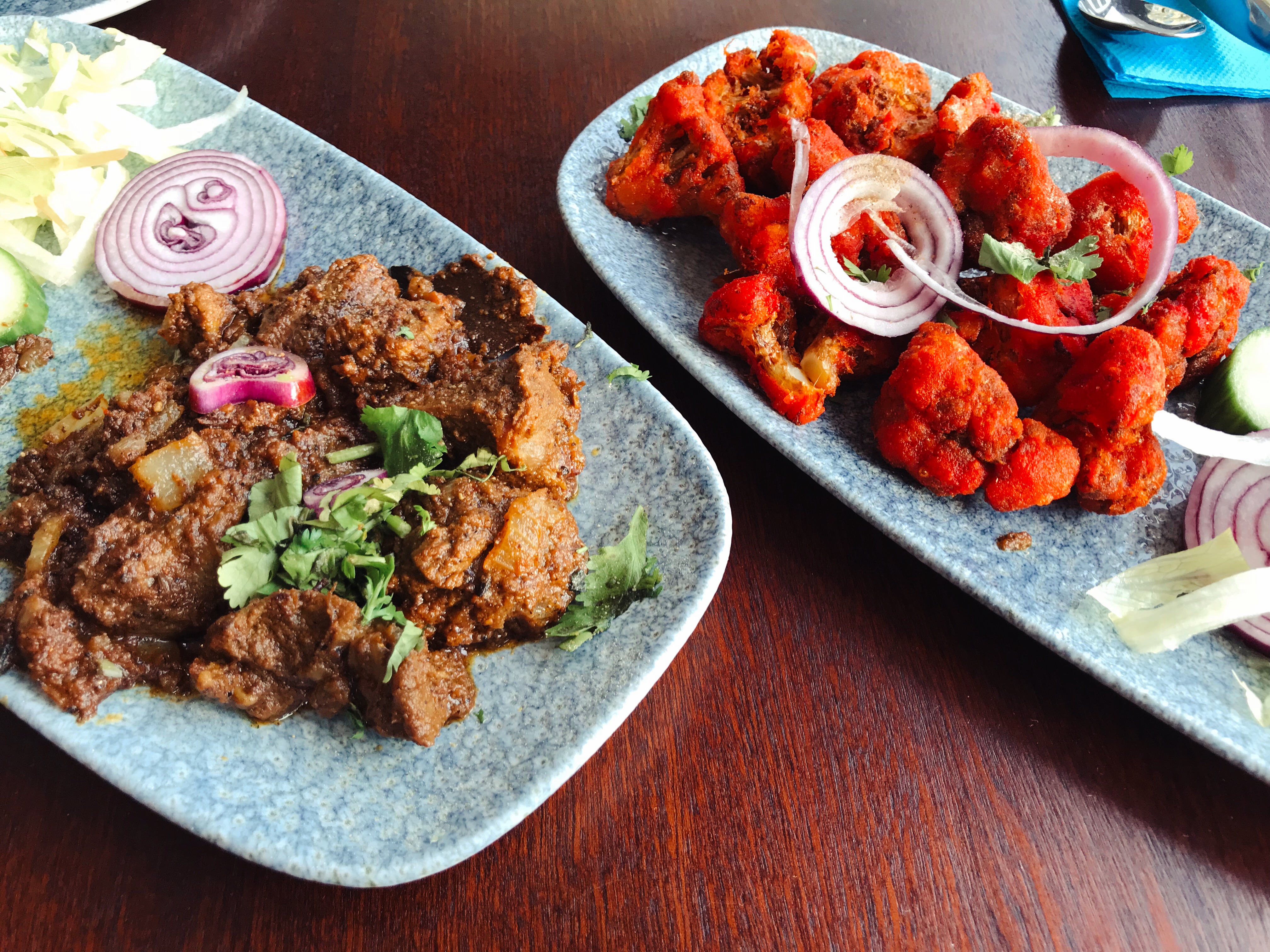
We got there in the end, drank our Kingfishers and, once the starters arrived things were positive. Gobi 65 is one of my go-to starters and Vel’s version was close to spot on. The bright red, almost scarlet colour was arresting and the coating was nicely spiced. The cauliflower underneath was lovely and firm and the florets were all a sensible size. But six pounds fifty felt ever so slightly on the steep side for a plate of veg and if you’re going to charge that they have to be crisp and absolutely piping hot and these weren’t quite that.

The mutton pepper fry was delicious – tender pieces of mutton in a lovely peppery sauce with just the right level of heat. But again, this was eight pounds and there wasn’t a lot of it and that did give me cause for thought. The crockery – and I don’t often talk about this in restaurant reviews – was attractive stuff with just a hint of sparkle in the glaze, but ultimately when they only put the mutton on half of a small plate and pad out the rest with iceberg lettuce I did find myself assessing the balance between style and substance.

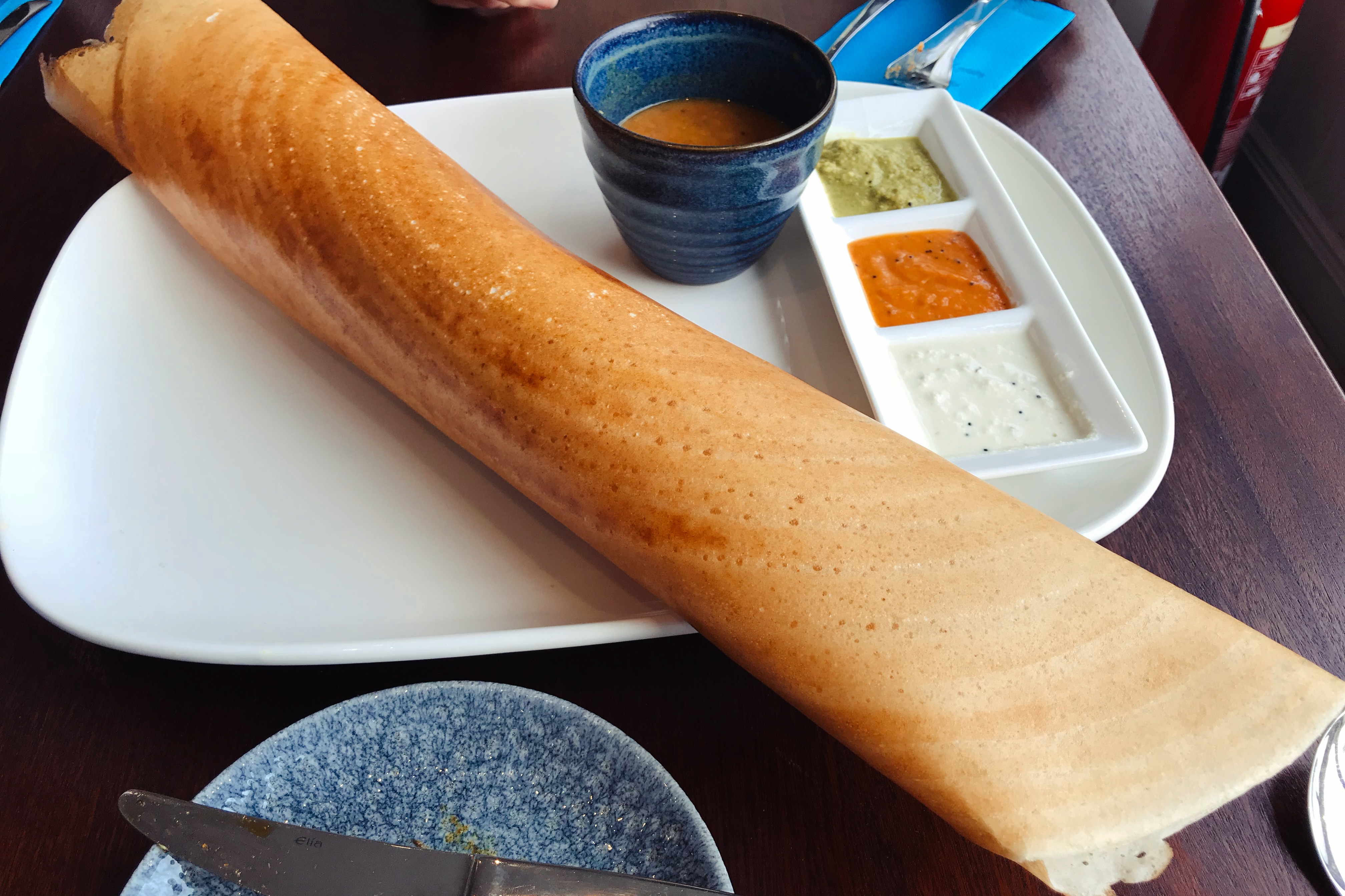
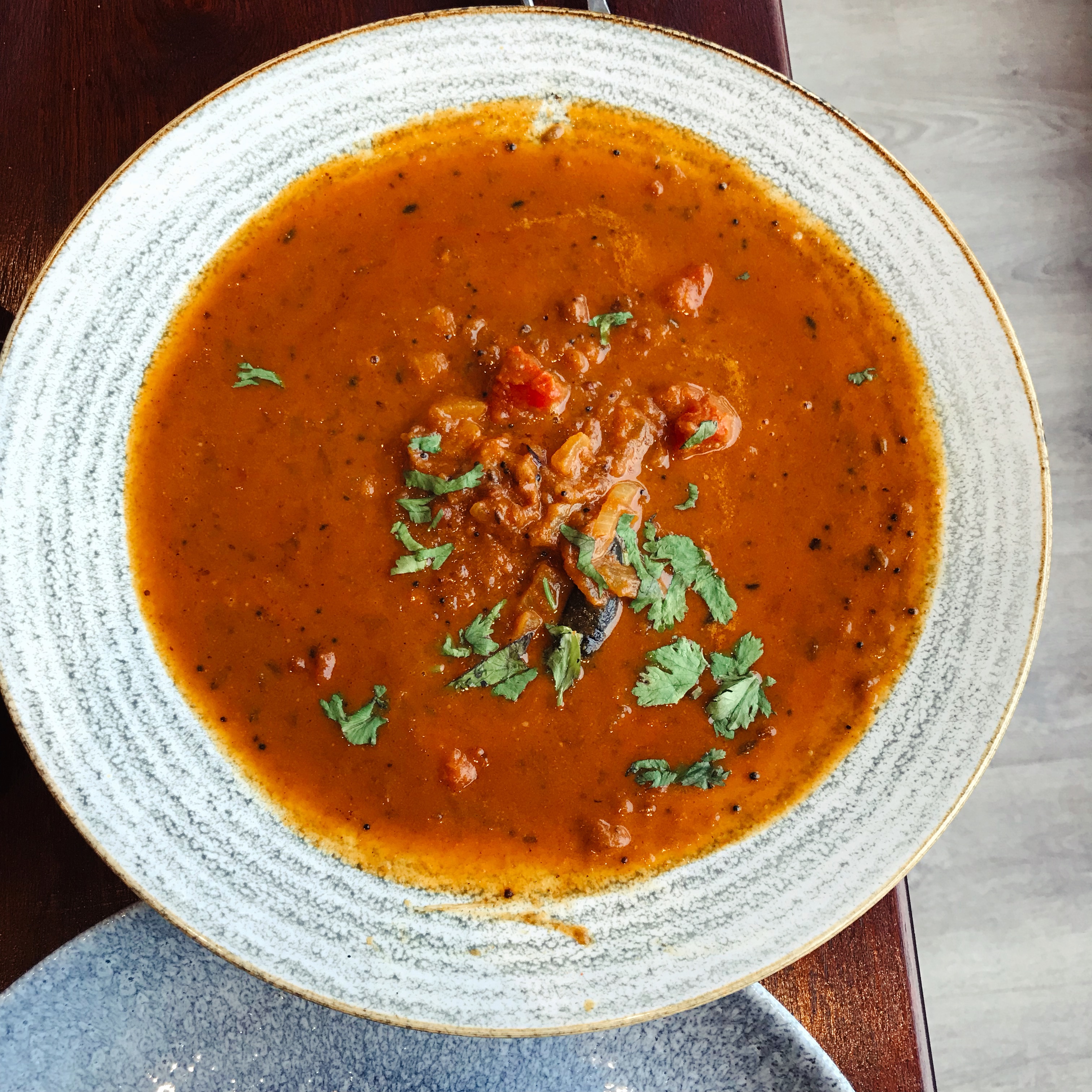
I’ve always found dosa a bit confusing, and I’m never sure when they’re meant to make an appearance in a meal. Are they a starter? A main course? A light lunch? You might know better than me: we wanted to try one but neither of us fancied having it as the feature attraction, so we ordered one in between our starters and mains to give it a try. It looked gorgeous – a giant burnished cylinder of wafer thin pancake wrapped round some potato masala. It came with a little bowl of sambar (a sort of curried lentil stew, for the uninitiated) and three chutneys, one with coriander, one with tomato and nigella seeds and what I think was a coconut chutney.

Never having excelled at dosa I asked our waitress for some advice on how to eat it. She came out with some words and gestures and lots of smiles, but I was left none the wiser. So my mother and I just had at it, tearing off pieces and dipping as best we could. It was lovely, in truth – the masala was warming with green chilli and spring onion studded through it, the potato just the right side of firm. I loved all the chutneys, especially the tomato one, and the dosa itself was paper thin and beautifully buttery. Again, though, the pricing seemed steep – eight pounds was an awful lot more than I ever remembered paying at Chennai Dosa.

This was the point when things started to go wrong for Vel – not in terms of the food, but because of everything else. By now, two other tables were occupied and it seemed the kitchen couldn’t cope with having three sets of customers at the same time. So we waited and waited, saw food arriving at other tables, and waited some more. Our waitress brought poppadoms to our table by way of apology – a lovely thought but, really, yet more food was the last thing we needed.

It also gave us time to order more drinks, which also didn’t go smoothly.

“I’d like a half of Kingfisher please, and a prosecco.”

“A Kingfisher and a second?”

“No, a prosecco.”

A blank look. I was forced to resort to pointing at the menu and trying to speak as clearly as I could, which again was an uncomfortable experience. She wandered off and eventually returned with my half and an individual bottle of prosecco.

“I didn’t realise you wanted presco” she said. I decided to leave it there.

All told it was easily half an hour until our main course arrived, and few main courses are worth that wait. My mother had ordered the Chettinadu fish curry, having been talked out of the milder Kerala fish curry by the waitress. That almost redeemed the “presco incident”, because the sauce it came in was splendid – all the heat coming from black pepper rather than spice, but if anything even more interesting for that. The sauce, again, had lots of nigella seeds speckled in it and I also caught a note of roasted onion. The fish, which was apparently kingfish, was a cutlet with the bone in the middle and I liked that too: it broke into firm meaty flakes like a swordfish rather than being the soft mushy white fish you sometimes get in Indian curries. My mother started out a little underwhelmed by the dish but by the end I think she too was won over, if a tad full.

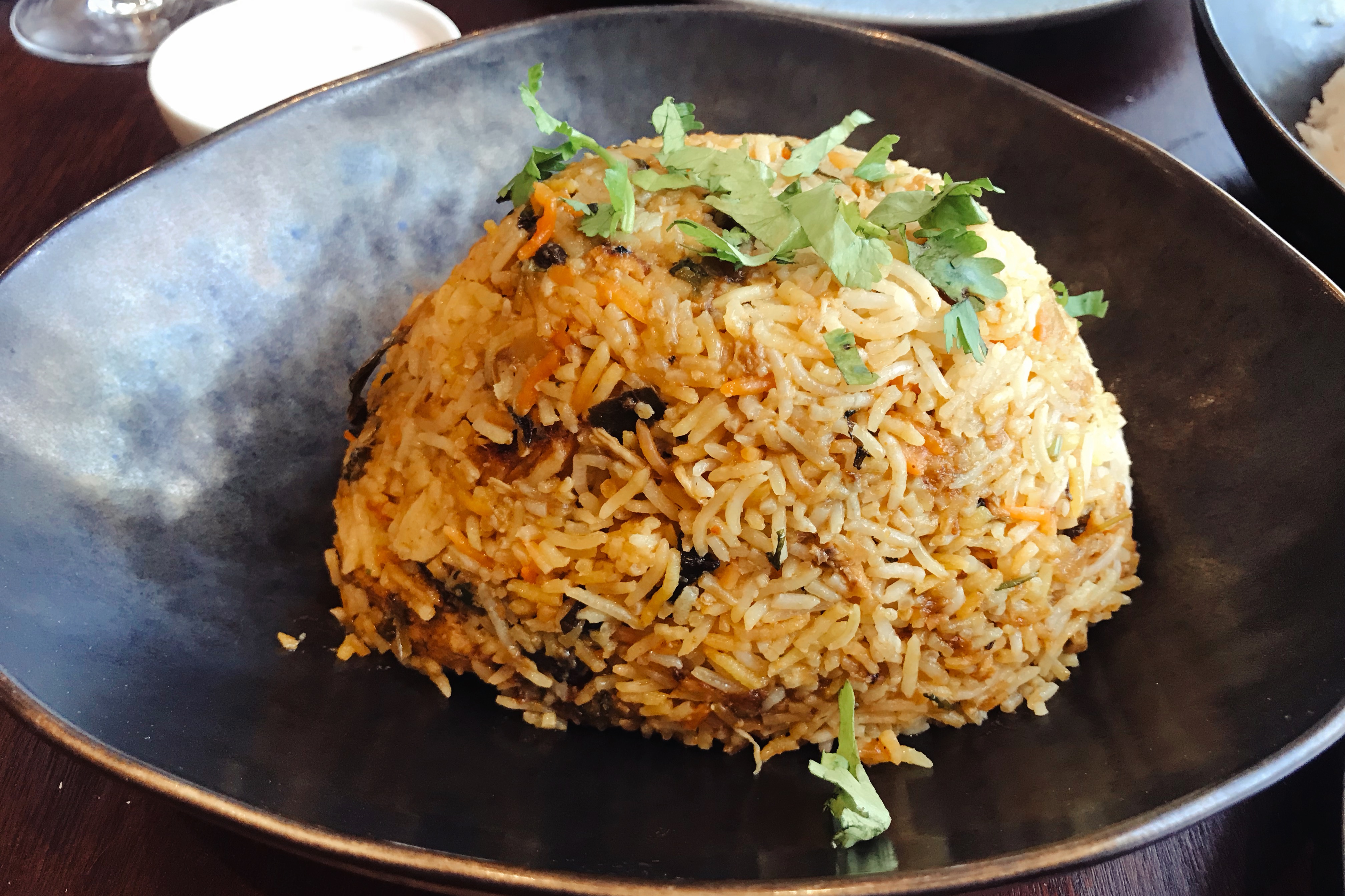
My chicken biryani was competent but not exciting. The pieces of chicken were well cooked and not dried out, and the rice had something about it but there were still a few bland clumps in there. There were plenty of cloves and cardamom and cinnamon, but they made the last bits of the biryani surprisingly difficult to eat as you were constantly sifting it for inedible bark and pods.

“It’s okay, but nowhere near as good as Royal Tandoori’s” said my mother. My mother is prone to compare all dishes with the best version she’s ever had, but I had to admit that she was right. The Royal Tandoori version has cashew nuts and just the right amount of mint and it did rather show this up. Even if it hadn’t, the following night I was lucky enough to get a sneak preview of the lamb biryani at Clay’s Hyderabadi and that – the rice fragrant with saffron and rosewater – blew this biryani squarely out of the water.

We didn’t investigate the dessert options (just as well, because looking at their menu I’m not sure there are any) so instead we settled up and moved on. Vel has been open for nearly four months, and I find it a bit dubious that it still only takes cash: for some that alone would be a deal breaker. Our meal came to sixty-two pounds, not including service. We could have spent less by ditching the dosa but, any way you cut it, this wasn’t a cheap meal for this kind of food in this kind of location. I’ve probably said enough about service already, but it would be unfair not to add that our waitress was lovely and friendly throughout, just a little wayward.

Is Vel worth a visit? You’ve probably formed your own view from reading this, and that will depend on how close you live to it, how important value for money is to you and whether you fancy paying cash and navigating some rather challenging service. Katesgrove and Whitley deserve good restaurants as much as anywhere else in Reading but, with the exception of Gooi Nara and the excellent Dhaulagiri Kitchen, I’m not sure there’s much to stop local residents making the trip into the town centre instead, despite all Vel’s interesting dishes (and, let’s not forget, attractive crockery).

Matt Farrall would tell you to give it another go if he was still with us, I’m sure, but that was Matt all over: a true local champion, a permanent optimist and a huge fan of the underdog. We saw eye to eye about a lot of things, but I never quite got his love of the likes of Sweeney Todd and Pau Brasil. The review over, my mother and I traipsed down Whitley Street behind a triptych of underdressed young ladies, their skin tone the kind of burnt orange that probably features on the Dulux colour chart as “Double Plus TOWIE”. I took her to the Hop Leaf for a pint and a debrief.

“It’s a nice pub, isn’t it?” said my mother, who – unsurprisingly – hadn’t been to the Hop Leaf before.

“Yes, I think so. It was one of Matt’s favourites.” I said.

My choice of venue had been deliberate. It’s what he would have wanted.

Vel – 7.0
73-75 Whitley Street, RG2 0EG
0118 9758551

https://eat-vel.co.uk/

Soju

One question I’m often asked is: why are your reviews so bloody long?

Well, it’s a reasonable observation. When I wrote a piece for the editor of Explore Reading, she gave me a word count of 800 words and expressed some scepticism about whether I’d be able to stick to it. “You normally haven’t even got round to talking about the food in one of your reviews by then” she said. A fair cop, I suppose: there’s always something to be said first about the context. There’s scene-setting to do, not to mention introducing the person you’re going to dinner with. And if all else fails, I can always get on my well-worn soapbox and pontificate about Reading (although not Caversham: heaven knows I’ve learned that lesson). The first eight hundred words fly by – to write, anyway, if not necessarily to read.

The problem is that, this week, that’s harder to do than usual. After all, Soju isn’t Reading’s only Korean restaurant. It’s not even the first: Gooi Nara up on Whitley Street opened before Soju (and I had a lovely time when I went there). It’s not necessarily that unique within the gastronomic Bond villain lair that is Atlantis Village – or whatever it’s called at the time of writing – because small chain Pho opened just across the way offering Vietnamese food (and I had an okay time when I went there). So where’s the angle? There probably isn’t one, but on the other hand Soju is a genuinely independent restaurant in a prime central spot in town, and it’s traded for a while without coming a cropper. That has to be worth a visit, I thought.

Subscribe to continue reading

Become a paid subscriber to get access to the rest of this post and other exclusive content.

Lusso, Newbury

I could go for weeks, months, years without eating Chinese food (the gloopy Westernised stuff anyway, rather than the eye-opening dishes served up by Memories Of Sichuan). I can take or leave a burger: they’re great when you’re in the mood, but they’d rarely be my first choice. I enjoy Indian food but, with the exception of Namaste Kitchen, I’ll eat it mainly when it’s suggested by somebody else. But one thing I do love – properly love – is a really good pizza.

It does have to be good: none of your deep pan gubbins with Day-Glo pepperoni please, and no ham and pineapple nonsense. I don’t want a stuffed crust, barbecue sauce drizzled over like chocolate sauce, or crispy duck weirdness. I want a light base, a bubbled crust, good tomato, great mozzarella and a simple, classic topping. Ideally anchovies, capers and black olives: I order it as a test the way curry fans might go for a butter chicken or a lamb bhuna, a reference dish.

I’m always on the lookout for the perfect pizza and, equally importantly, the perfect pizza restaurant. In Paris it’s Le Briciole, on the edge of the Haut Marais, dark and dissolute, frequently a tourist-free zone and perfect for a lunchtime carafe, pizza, burrata and a chance to observe Parisians being, well, exactly that. I go every time I visit the city. In Helsinki it’s Linko, in the residential district of Toolo, a tiny place with fewer than twenty seats full of people enjoying unfussy pizza and the relative novelty of grabbing a bottle of wine without having to flog a kidney first.

Closer to home, there’s Bristol’s Bosco, sleek, black and full of delicious charcuterie and cheese before the main attraction arrives. In the edgier part of the same city, there’s Flour And Ash, where you sit at what look like reclaimed pub tables and the base is spread with ox cheek ragu. Or Lewes’ sadly departed The Hearth, in a converted former greasy spoon above the bus depot, all formica tables and old music on the jukebox. Heaven, I sometimes think, would be like a long drawn-out lunch in such a place.

In Reading, for a long time it was Papa Gee or nothing (except the chains and – err – Zero Degrees), and then along came Franco Manca. Franco Manca, although it isn’t perfect, has enough going for it that you don’t much mind. It’s quick and convenient, sometimes quite good, sometimes excellent. If you sit in the right place you can’t see all the way through to Debenhams (the Reading branch of Debenhams was once voted the worst shop in the United Kingdom – by Daily Telegraph readers, no less).

Good though Papa Gee and Franco Manca are, they don’t quite match up to the ideal of that little, bustling place turning out brilliant pizzas, full of conversation and people-watching. That’s where Newbury’s Lusso comes in. It started out serving from a van in town, before graduating to permanent premises offering sourdough pizzas and gelato and not a lot else. I always warm to a restaurant that only wants to be very good at a few things, and I’d had good reports from a number of people. One was my friend Izzy, who ought to know because she works in Newbury, so I met up with her one evening to try it out for myself.

Newbury’s a lovely, quiet market town with much to recommend it. An excellent beer, wine and gin shop. A good sushi joint. A cracking butcher on the bridge, selling splendid sausages. A micro-pub and a number of snug, cosy boozers (the King Charles Tavern is a favourite of mine, especially in winter when the fire’s on).

I can confidently add the gin bar of the Catherine Wheel to that list. Izzy and I stopped there for a pre-prandial drink and discovered a gigantic selection of gins – over a hundred, I seem to recall – all at a single price that would (or should, anyway) make the Thames Lido blush. My black tomato gin was fresh and green with a sprig of thyme, Izzy had a classic bone dry gin from Berry Bros and we started to catch up on everything that had happened since I saw her last. I noticed that the Catherine Wheel did a full range of Pie Minister pies and was tempted to dally, but we headed out to Lusso only a gin to the good: pizza one, pie nil.

Lusso is in the quaintly named “Weavers Walk”, just off the main drag, facing on to a courtyard which will no doubt be lovely in summer. It’s a small, plain room with probably no more than 30 covers – tables for two and four down either edge, and tables and benches along the middle which can be put together for communal dining (a large group sat there not long after we began our meal).

Everything was tasteful – pastel but not twee – although the tiled walls and the lack of any soft furnishings meant the place got very loud. I wouldn’t have guessed that when it was just Izzy, me and a family of four at another table, but by the time we left all but one table was occupied and we’d gone beyond buzz to full-on hubbub. There was an open counter at the back which meant you could see your food being assembled and cooked: at first it was alarming to see nobody there, but before too long the chef wandered through with a tray of pizza dough, ready to be stretched and shaped for the orders that lay ahead.

I took against the menu by virtue of it being in Comic Sans – this can’t just be me – but it made all the right noises. A few nibbles, a handful of starters, a burger and some salads (presumably for those rare individuals who go to a pizza restaurant and say “not pizza again”) and the main attraction, nine pizzas and a range of toppings if you wanted to customise. Pizzas were twelve pounds, so expensive compared to the likes of Franco Manca but not far off Pizza Express. Nonetheless, font notwithstanding, it’s hard not to like a pizza menu which features nduja but doesn’t have pineapple anywhere to be seen.

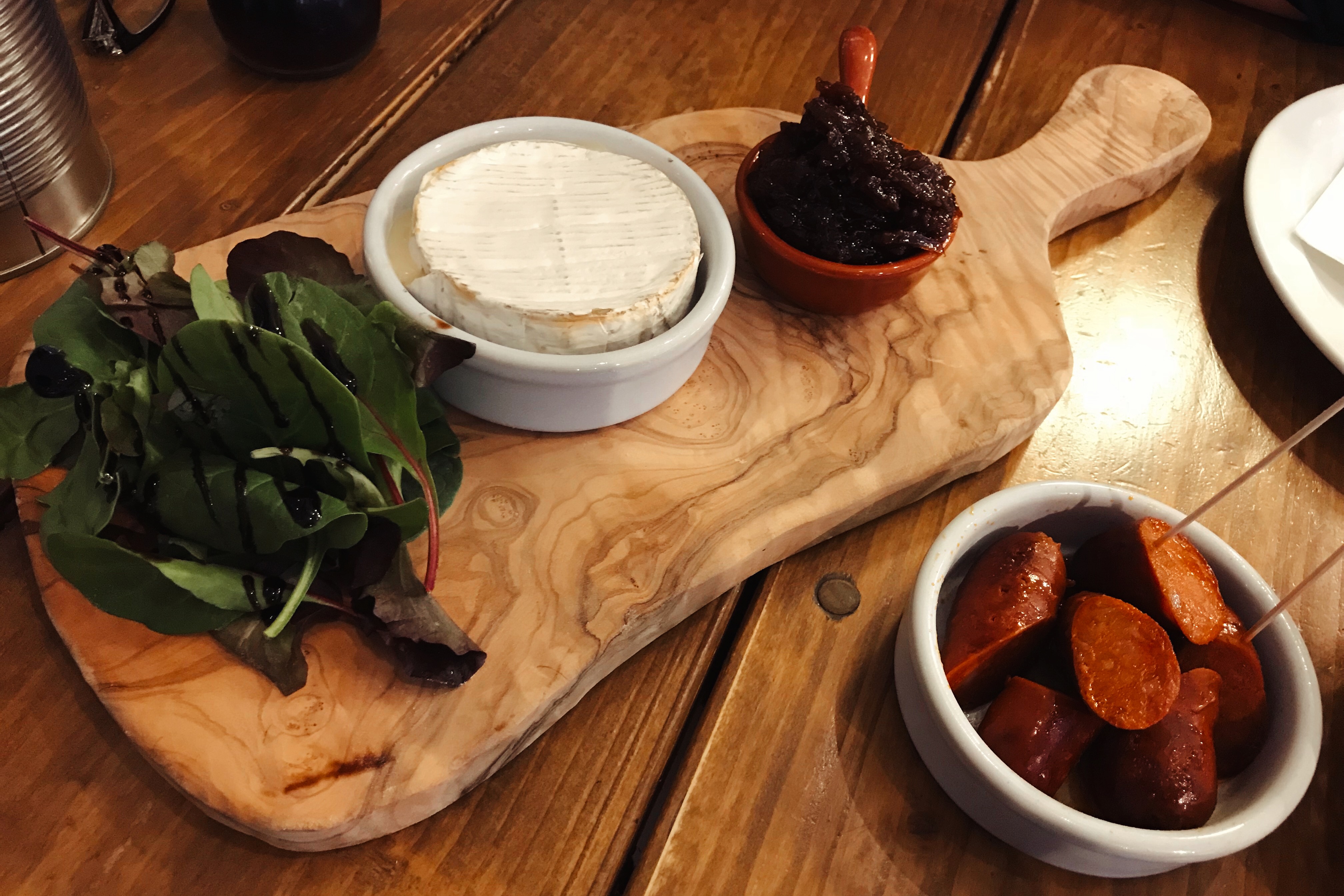
We started by sharing some nibbles, which gave me my first chance to see what Lusso was good at – and, as it turned out, less good at. A dish of grilled chorizo sausages was exactly that, nothing more and nothing less. It looked like it would be horrendous – three little sausages cut into halves and dished up with a couple of cocktail sticks – and I was relieved when I tried some that the chorizo was good quality, so what looked like it would be bouncy was in fact juicy. But I still had quibbles – they needed longer, and I’d have liked to see the chorizo in smaller slices. There was no caramelisation on the outside, and almost no oil – one of the best dips there is – had escaped into the ramekin. It didn’t feel like quite enough, for a fiver.

The baked Camembert had similar problems – it was on the small side for nine pounds, if nice to share, but it hadn’t been baked long enough to be properly gooey. No thyme, no garlic, no slashes across the top, no attempts at all to gussy it up. A pile of red onion chutney was nice but both literally and figuratively too much, and the salad was too easily knocked off the tiny plank onto the table (which, and I’m not telling tales here, is exactly what Izzy did). The sections of pizza bread it came with were a promising teaser for what was to follow, but it wasn’t the right bread for this kind of dish: you need something you can use to really get into the corners.

Our mains arrived with a speed which made me wonder whether Lusso was hoping to use our table again before the evening was out. It was a shame, because before that point I was starting to really enjoy the experience of eating there. We were having a good old chinwag about the things 2018 had thrown us so far, speculating on our fellow diners (“I bet that lot are from Vodafone” said Izzy, referring to the loud, self-satisfied bunch on the middle table) and enjoying our drinks – a very serviceable, fruity Nero d’Avola for me and a Diet Coke, the curse of the driver, for Izzy.

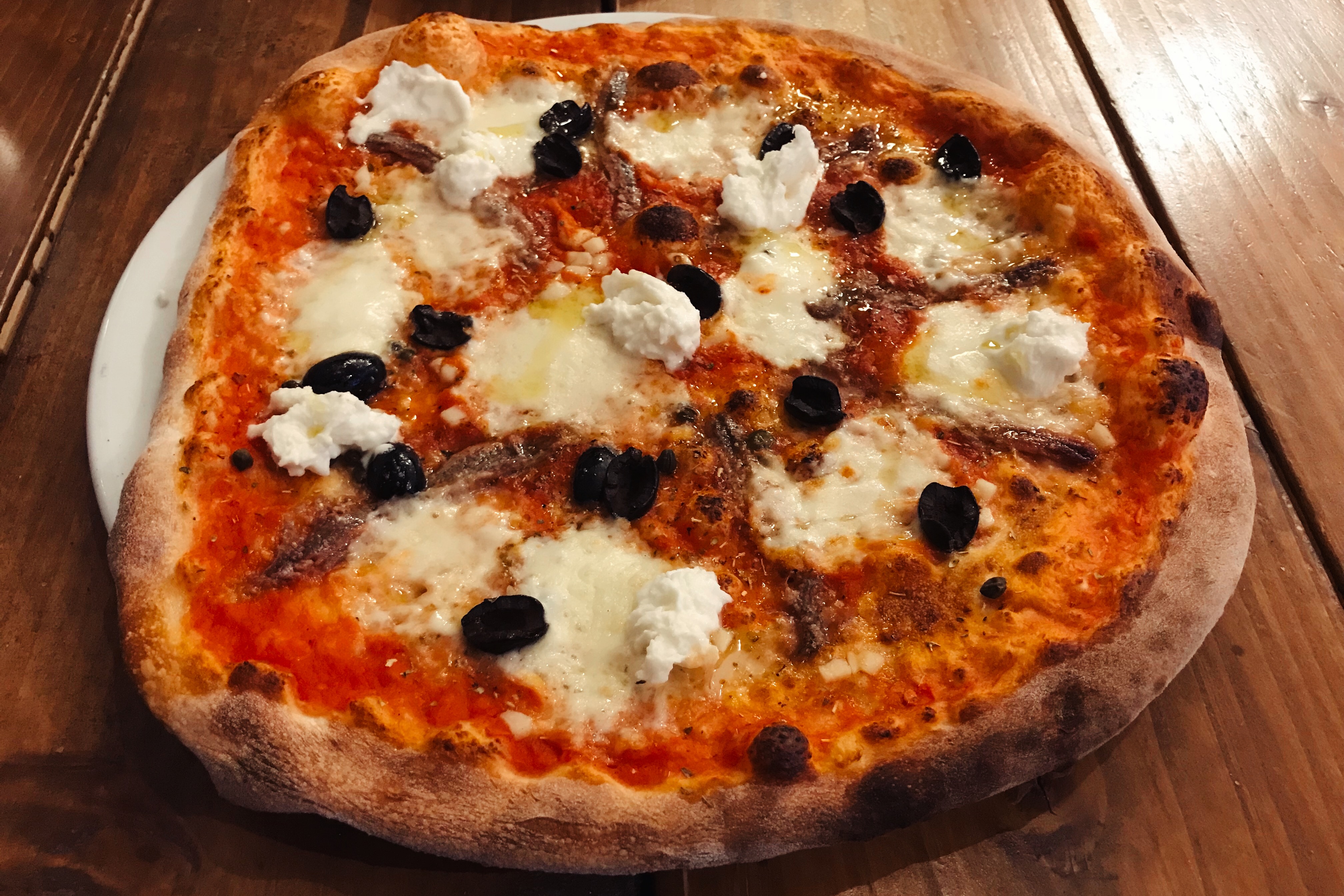
Between us we’d gone for traditional and off-piste pizzas – the Times New Roman and the Comic Sans, you could say. My pizza Napoletana, the gastronomic dragon I always chase in pizza restaurants, was extremely good. The base was beautifully irregular and blackened at the edges, although maybe not as bubbled as I’d have liked. I might have liked saltier, wrinklier olives, or bigger, fatter capers, but I couldn’t argue with the quantities. The anchovies were simply astounding, little savoury bombs, as deep and salty as Marmite, scattered across the whole pizza: no experience, like at Franco Manco, of picking which three or four mouthfuls to particularly enjoy. The mixture of melted mozzarella and torn pieces of cold, fresh mozzarella was a masterstroke: why don’t more places do this? I was delighted from start to finish, and even though this was Newbury and not Paris, Bristol or Helsinki, a little bit of me was happily transported.

“I normally have the margherita with pesto” said Izzy, “but it can make it a bit oily so I’ve gone for some chicken on there too.” I imagine purists are recoiling in horror at this – chicken on pizza is just below pineapple in Maslow’s hierarchy of crimes against pizza – but I couldn’t bring myself to be shocked. I didn’t try it, but Izzy enjoyed it from start to finish. It had the same great base, the same excellent mix of cooked and fresh mozzarella and the pesto was vivid, verdant stuff. The chicken impressed me less, being big thick uniform slabs that could have come from a catering pack. If I’d thought it had been cooked there, or torn by hand, I’d have been more convinced. But if you did happen to be in the mood for a chicken and pesto pizza – and I suppose some people are, sometimes – you could do far worse.

Dessert was compulsory, given that Lusso started life as a gelateria. I’d made the mistake of looking at the ice cream flavours online beforehand – Cotswold lavender and honey! Sicilian pistachio! – but they only stock ten at any one time in the restaurant and the ones on display smacked of playing it safe – chocolate, vanilla, mint choc chip and so on. Not for the first time, I missed Reading’s Tutti Frutti and Paul’s recurring bonkers project to create Barkham Blue ice cream (he never quite got it right).

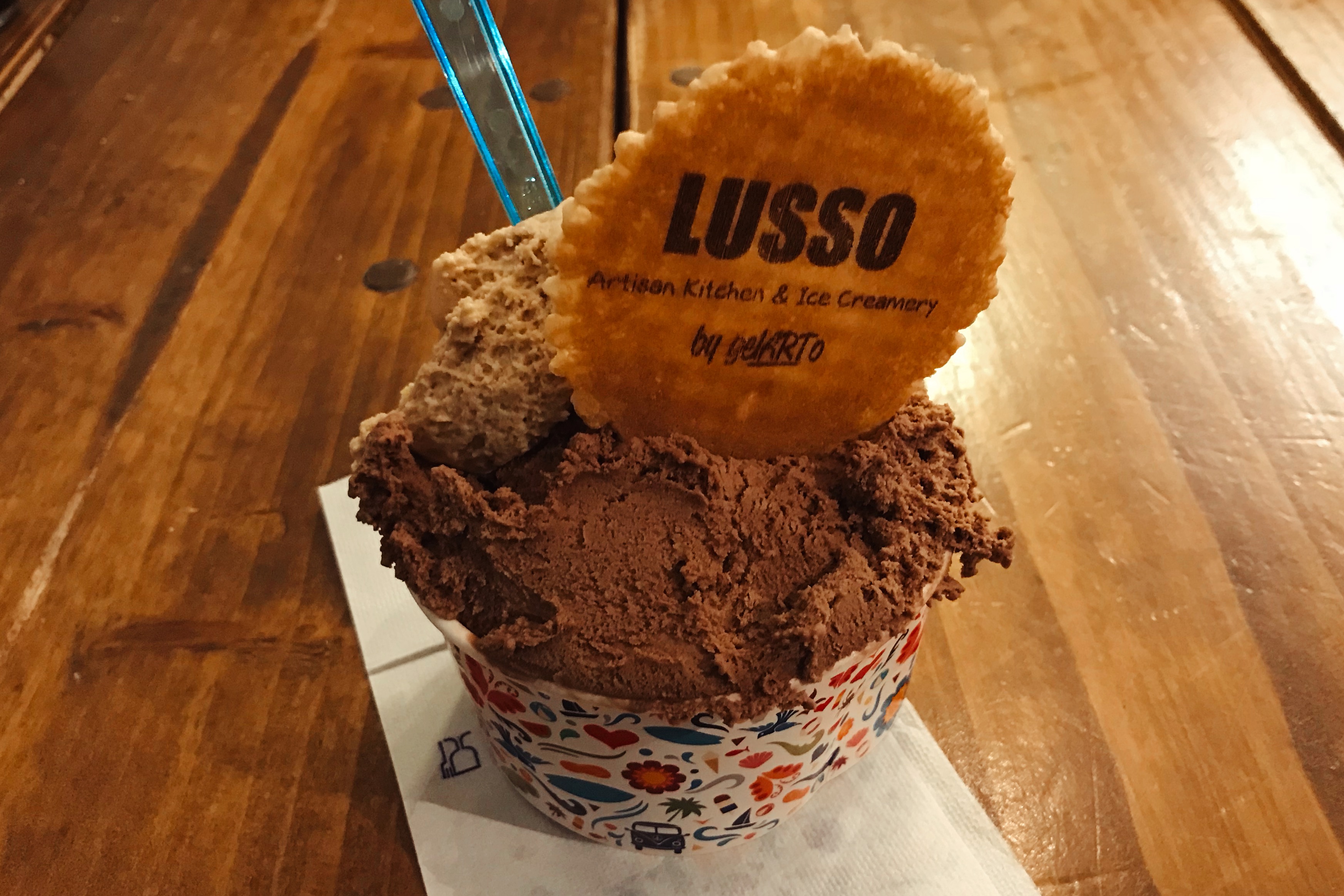
The menu doesn’t actually include the option to just have ice cream, which is a bit confusing, so when we ordered a couple of scoops each they dished it up into a cardboard tub which we took back to our tables, an odd way to conclude a meal in a sit-down restaurant. The salted caramel, as often happens, tasted more like butterscotch, without even a hint of salt: not bad, but not what I’d ordered. I couldn’t help comparing it with my recent visit to the Lido: better on price (£4.20 for two very generous scoops), better for texture, being far smoother and less gritty, but falling down on flavour. Fortunately, the chocolate was much better – pretty textbook, much closer to milk than plain. But ultimately, however good it was, it was still only chocolate ice cream. Izzy tells me her honeycomb ice cream was lovely: I didn’t get any.

Service was pleasant and friendly, if stretched towards the end, and any issues with timing in the kitchen really weren’t the fault of the solitary waitress working that night. Dinner for two came to fifty-four pounds, not including tip, and we were done in just over an hour.

“That pizza was lovely” I said as I walked Izzy to her car.

“I’m so glad you liked it, it would have been awful if you hadn’t. But, to be honest, I wouldn’t have gone with you if I wasn’t confident about it. And it’s great for kids – pizza and ice cream is perfect for them. You should mention that, you never talk about kids in your reviews.” (She’s right, to be fair, and the kids’ menu did look pretty good.)

When a restaurant is out of town, it’s hard to divorce it from its surroundings. Of course you might go there all the time if you lived there, but what if you didn’t? Lusso isn’t quite on a level with all those places I mentioned at the start of this review but, perhaps crucially, it is slightly better than pizza restaurants in Reading. So whether you go probably depends on how much you fancy a trip to Newbury – and, of course, how much you like pizza. That renders the rating almost irrelevant, but for what it’s worth I liked Lusso. I can see myself going back, probably at the weekend for a nice amble round the food markets, more bubbled crust, mozzarella and salty anchovy, a bottle of gin from Inn At Home to add to my collection and a pint or two in the King Charles Tavern before taking the train home. It doesn’t sound like a bad Saturday, does it?

Lusso – 7.5
11 Weavers Walk, Newbury, RG14 1AL
01635 32128

https://www.gelartoicecream.co.uk/lusso

Thames Lido

Click here to read a more recent review of Thames Lido, from December 2024.

Here’s something that happens quite a lot: I have friends who read the blog and some have been known to put in a request to accompany me on particular reviews. “Anyone coming with you to Taberu?” one will say, or “Next time I visit you for lunch, shall we go to Comptoir Libanais? You could write it up for your blog.”

Not that I mind: it’s nice that people take an interest, and better to be spoiled for choice with dining companions than to have to ask nicely or, worse still, beg. But some reviewing opportunities are more prized than others, and none more so than Thames Lido. It opened last year, after years of money-no-object, it-takes-as-long-as-it-takes restoration work, extensively catalogued online in a series of beautiful pictures (whatever else you might think of Thames Lido, they get social media right in a way which puts other Reading restaurants to shame).

In the run-up, there were glossy pictures and features in the broadsheets, and after it opened it received a blandly positive review in the Guardian (which described it as “just off the Reading ring road” – thanks for that). This is no surprise – the original Lido in Clifton is well-established and well-reviewed and has impeccable connections – but the overall effect is that Thames Lido is probably Reading’s first ever destination restaurant. Just don’t tell anybody it’s in Reading, is the implication, in case it puts them off.

So who to take? The decision was made for me when Kat told me, in no uncertain terms, that she was accompanying me. I said yes, because I owe Kat a favour, but she was – on paper at least – an unlikely candidate. Kat has an interesting diet which involves eating sweet and sour chicken balls in the bath, and she’s partial to a battered sausage or a Tesco all day breakfast sandwich.

“Are you sure the Lido is for you?”

“Don’t be silly, I’ve eaten at hoity-toity places before.”

The way this was said reminded me of Rizzo The Rat from Muppet Christmas Carol. Oh well, I had my angle: the irresistible force meets the immovable object, Reading’s destination restaurant meets one of Reading’s most unreconstructed diners. What could possibly go wrong?

My misgivings were exacerbated in the run-up to the visit when Kat sent me a message.

“I’ll also be packing a Gregg’s sausage roll, in case the portions are too puny” she said. “I won’t whack it out on the table or anything, don’t worry. Although, practically speaking, a Ginsters chicken and mushroom slice is more appropriate. A sausage roll doesn’t have the necessary structural integrity.”

What have I let myself in for? I thought to myself as I approached the restaurant with Kat, emergency pasty presumably stowed away in her handbag for later.

When I say “approached the restaurant” that makes it sound like an easier process than it was, on foot on a gloomy March evening. It’s a little tricky to find an entrance – down the side road without signposts or the main road without pavement? – and one of the entrances takes you in to the restaurant while the other one, the main one I suppose, takes you in to the Lido proper. Even picking the right entrance, it was a bit confusing finding our way to the restaurant (and that flair for signposting, or lack thereof, extends to the bit partway through the meal where you try to find the loo). A minor thing, I know, which only applies the first time you go, but first impressions and all that.

The restaurant itself was – as so often – a long thin room, a shape that’s mandated by its position running alongside the pool. The view was spectacular, with steam rising from the heated pool, the fetchingly retro changing booths beyond. The occasional intrepid swimmer bobbed past and, like no doubt everybody who has visited Thames Lido, I was very impressed by the quality of the restoration. It carried through into the furniture – sturdy, handsome tables, generous and roomy for two people, and the kind of chairs you could imagine settling into. It’s a high-ceilinged, airy space and thought had even been put into that, with fabric panels hanging from the ceiling to absorb noise.

If you get a table alongside the pool, that’s great. The other tables – like the one we were given – feel far less special and force one of you to forego the view and stare at the bare brick walls. We asked to move as a poolside table came available and they moved us without complaint. The menus didn’t come with us and it took a fair amount of flagging down staff before they reappeared at our table.

We started by hitting the gin menu, which is divided up on the good/better/best principle with some at £7, some at £9 and some at £11.50. Yes, you read all those right, and tonic is extra. Only two tonics are available, so you get Schweppes for £1.50 or Fever Tree for £2. That makes most of the gins more expensive than the Lido’s cocktails, and some of the gins are also very oddly priced. I was surprised, for example, to see Gin Mare, readily available in supermarkets and pubs like the Fisherman’s Cottage, on sale for £11.50. Each of the gins had modish tasting notes made up of three adjectives, although how Gordon’s tastes of “historic” is anybody’s guess.

Do I sound cross? It’s probably because I was, a little. I’ve been to lots of establishments with gin lists, from pubs to Michelin starred places, and they all make great effort to pair the gins with different mixers, different garnishes, serve them in big balloons so you can almost breathe in the botanicals. Not so at the Lido, where both gins turned up in a highball with ice and lime, nothing more. The Jinzu with Fever Tree (total cost thirteen pounds fifty) was pleasant, light, sweet and floral, but the main thing I thought with each mouthful was just how expensive it was. “Hotel prices”, murmured Kat disapprovingly. The Psychopomp Woden with Schweppes was punchier, a brutal mixture of fennel and grapefruit, and a relative snip at ten pounds fifty. You only got 125ml of Schweppes as opposed to 200ml of Fever Tree, another thing the menu neglected to mention.

The gin took a while to arrive, so we grazed on the complementary bread with olive oil. Again, I had heard great things but this was tough going – nicely seasoned but dense and heavy with no light, crispy crust, more murder weapon than appetite whetter. “I was here for the set lunch earlier in the week and the bread was so much nicer” said Kat. “It was warm, soft inside and the crust was brilliant.” I couldn’t help wondering if this was the same loaf, a few days later.

The menu managed that rare feat of being interesting and nice to look at without having anything on it that you absolutely had to order. I was expecting some kind of plea bargaining with Kat (and if they’d still had the slow cooked ox cheek in Pedro Ximenez on the menu that might have happened) but as it was, neither of us had a first choice to go into battle for. We eventually placed our orders with the waiter, a rather disengaged man who spent much of his time serving us looking around, as if hoping to speak to someone more interesting (“he’s like a really rude date” was Kat’s observation).

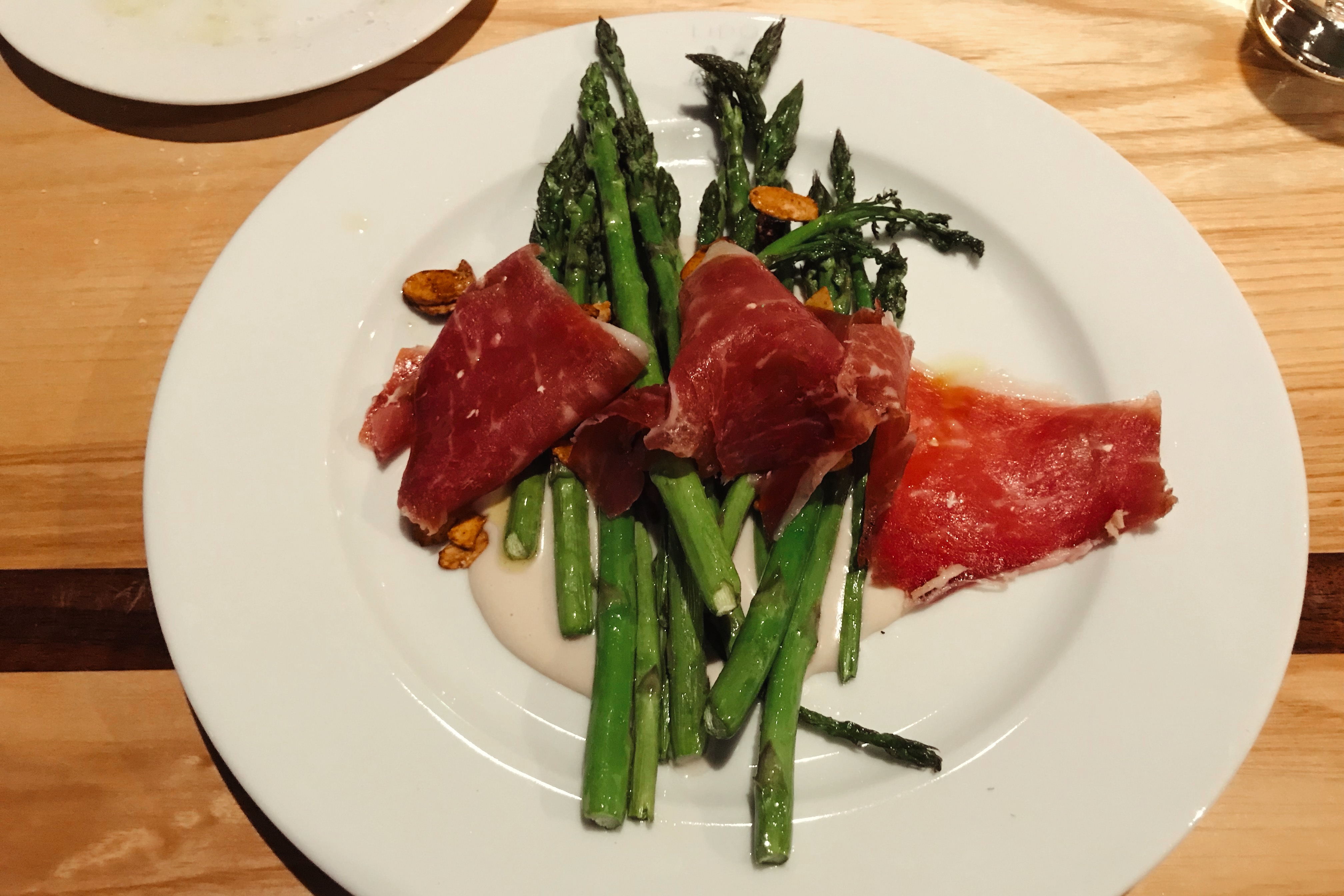
I was in the mood for a leisurely evening, but even so I was pleased when the starters made their way to our table. They represented the high water mark of the meal. Kat’s wood roasted asparagus with almond sauce and cecina looked like the kind of dish to provoke full-on food envy: a generous sheaf of asparagus, thinnish spears, with the almond sauce and what looked like jamon, and a hoard of toasted almonds, little grenades of flavour, hidden underneath. I assume the asparagus was very early season – although it was odd that the menu didn’t mention this – and it was terrific stuff. Kat waxed lyrical about the almond sauce, saying it was salty but with a sweet edge, in a manner which suggested I might have misjudged her after all. If I was being pedantic, I’d say that cecina is normally beef rather than ham, but that hardly detracted from how delicious the dish was.

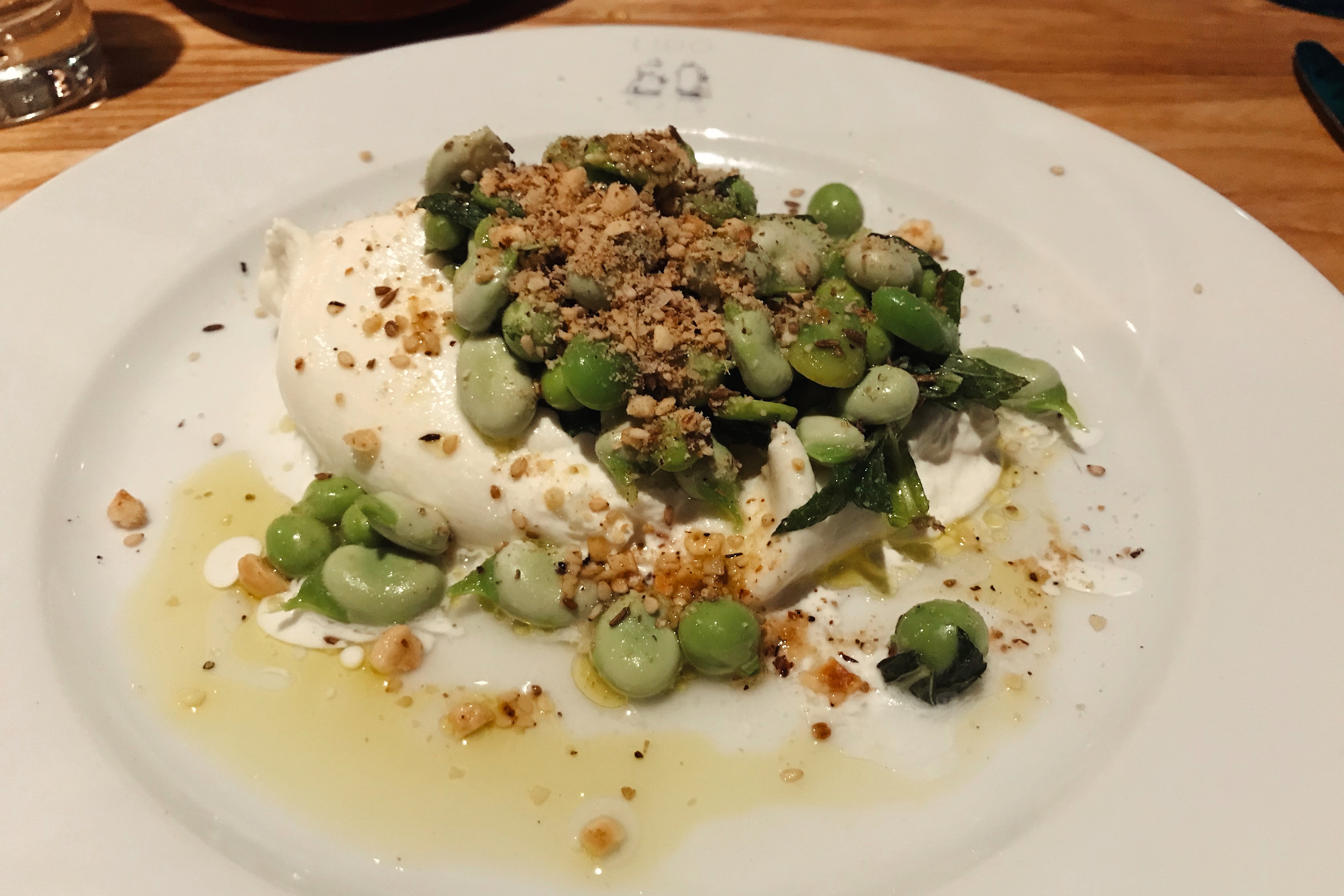
Burrata, if not as good, was still thoroughly enjoyable. Serving it with heaps of broad beans and peas, if anything, made it even cleaner and fresher, a little reminder that spring was just round the corner, even if it didn’t quite feel like it yet. A slightly funkier note was introduced with the liberal dusting of dukkah, which added spice and edge and saved the whole lot from being just a little too nice. I didn’t get the promised yuzu, but it didn’t feel like the end of the world.

Our wine arrived almost immediately after I uttered the words “do you know what, I’d really like my wine now” to Kat. The gins were nearly finished (well, you want to take your time on something that expensive), the starters had long since been dispatched and the main courses were about to turn up. It felt truly odd that the wine hadn’t materialised by that point. The waitress who brought them – and served us from that point forward – was considerably more likeable, chatty, knowledgeable and clued up than the chap we’d been talking to before, a clear reminder of the difference between being served and being looked after. We’d gone for a Jeune Musar, a pretty entry level Lebanese red at £33 (although still about a three times markup from retail price) – I liked it, it was nicely balanced and although it started out a little tannic it opened out nicely given a little time. A shame it wasn’t given more time, really.

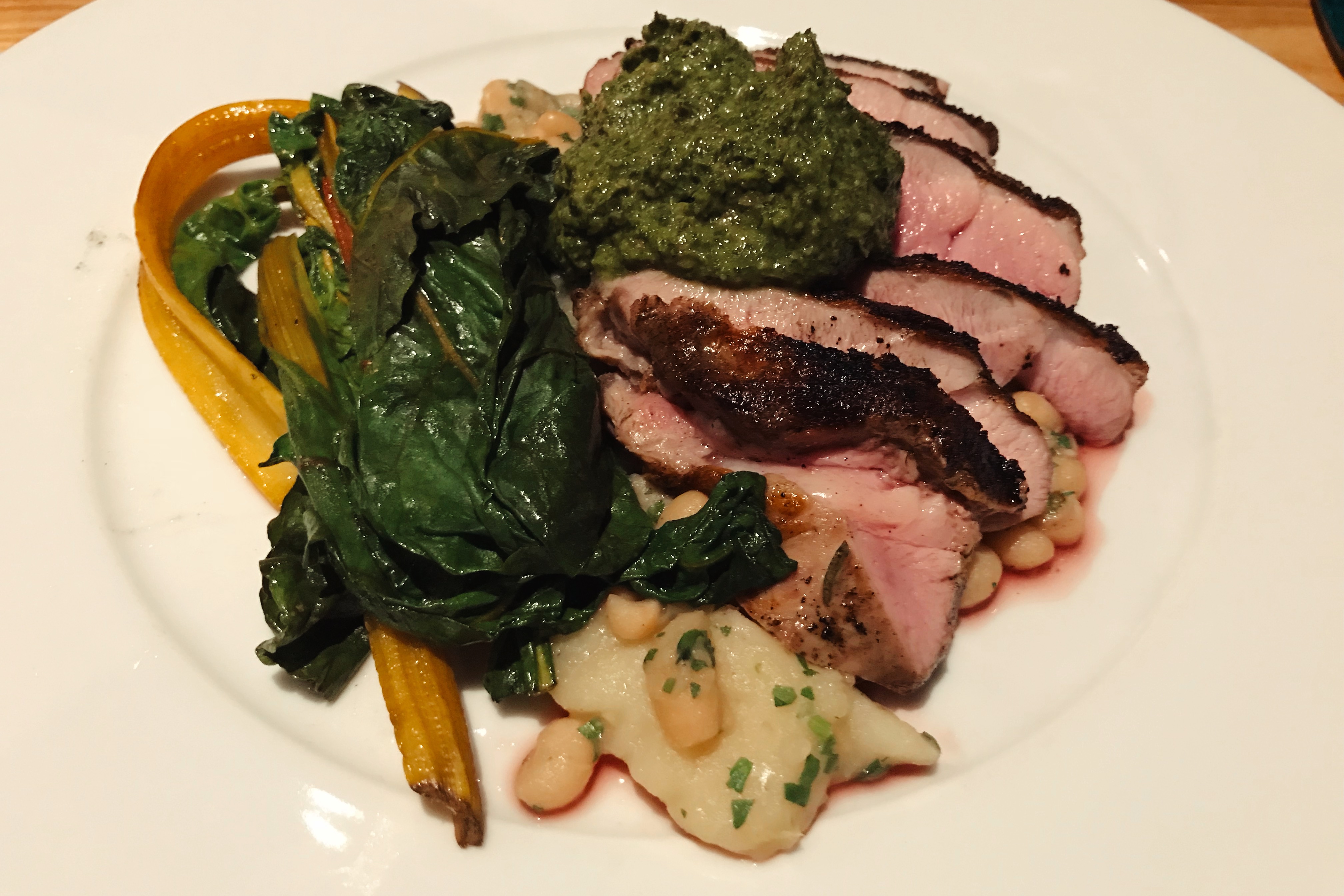
I’d gone for the lamb leg (Pyrenean, no less) and was generally pleased with my choice. The lamb was cooked beautifully – I could have stood it a little pinker, but it was close enough – with a lovely layer of fat and a beautiful salty char on the outside. The beans, some of which I think were pureed or mashed, added a nice earthiness. The salsa verde was packed with parsley and mint and absolutely made the meal; I could have eaten it with pretty much anything. Only the rainbow chard – pretty but tough going – misfired, it felt like it had been added for betterment rather than enjoyment.

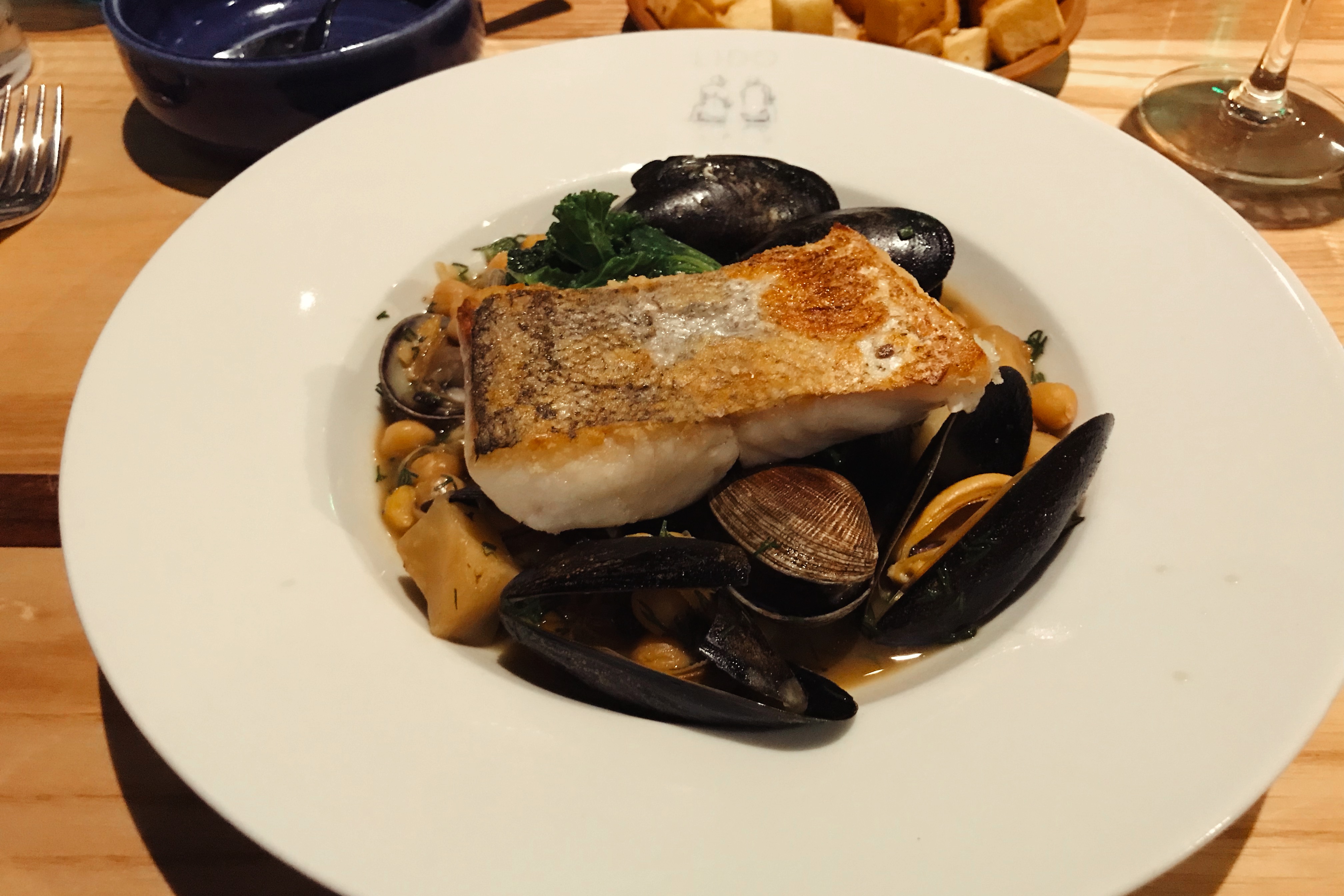
Kat, on the other hand, picked the dud: hake, with mussels, celeriac and saffron broth. The fish was a nice piece but it was underseasoned, with only half the skin crispy. “It’s all a bit bland except the broth”, she said “and that just gets saltier the more you have of it”. I had a taste and couldn’t disagree. Weirder still was the marriage of chickpeas – which you’d absolutely expect in this kind of dish – and lashings of dill, which you just wouldn’t. Dill is a distinctive enough taste that you’d expect it to be mentioned in the menu, but no joy. Kat left some, and Kat – as you can probably tell from the emergency pasty – is not someone to leave food.

The side dish I really fancied – cauliflower with lemon and zata’ar – was sold out so we went for the crispy fried potatoes with rosemary and garlic. The taste was good, but the texture felt neither crispy nor fried. It was almost like someone had just lobbed them in a baking tray for half an hour, and there was certainly no evidence that they’d ever seen hot fat. I couldn’t help thinking how much better Honest’s rosemary fries were. I couldn’t even be sure these were significantly better than Café Yolk’s fried potatoes, and they came out of a packet. Again, we didn’t finish them. “If they’d actually been crispy you’d have had to fight me for them” said Kat.

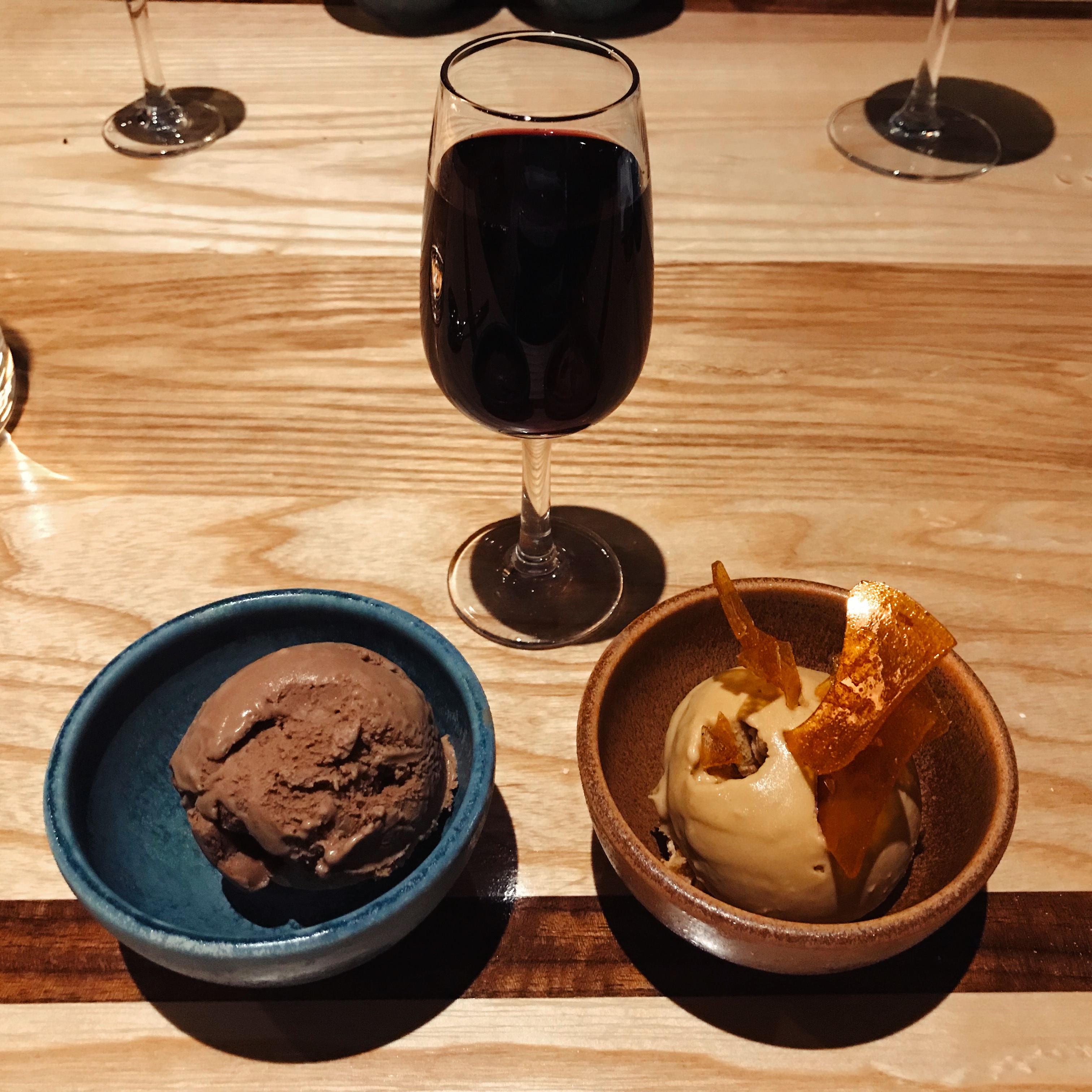
The reputation of the Lido’s ice creams precedes it – they make up most of the dessert menu, after all – so it felt almost compulsory to order some to round off the meal. It’s six pounds for two scoops, and although many of the flavours were tempting Kat and I fancied the same ones so we decided to just go for it (with hindsight, the tasting flight to share would only have cost a little more and would have made a better option). They came in beautiful little bowls, and bringing each flavour in a separate bowl was a lovely little touch, because this is an area where you really don’t want to cross the streams.

Of the two, the chocolate and beer ice cream was by far the best, a clever thing where the chocolate hit you first and then the malty darkness of the Estrella “Black Coupage” snuck in at the end. The salted butter caramel I found less impressive – it seemed to lack much in the way of salt. Kat liked the caramel shards, I found them a tad unnecessary. Overall I quite liked the ice cream although I wasn’t entirely sure whether I six pounds liked it. The texture, although free of crystals, was gritty rather than smooth and maybe not quite special enough.

“It’s okay” said Kat, “but, like everything else, it feels about a couple of pounds too expensive. Also, and I know this sounds silly, my ice cream is too cold.”

“I know the way to fix that. You just wait.”

The glass of dessert wine we had with it – a Banyuls, like a slightly sweeter take on port – was terrific. Lovely, if a little pricey, and consequently both an excellent and fitting way to bring the meal to a close. Dinner for two, including an optional ten per cent service charge, came to one hundred and sixty-six pounds. It’s possible to eat for less, but even if you skipped the gin and the dessert wine it would still have clocked in at over a hundred pounds.

This has been a tricky review to write, and it’s a particularly difficult review to conclude. It can’t be denied that the Lido is a fantastic restoration project. What they’ve done with the building is amazing, it looks beautiful and it does make you feel a little prouder of Reading just to see it. And I can easily see that it’s an expensive labour of love, and those costs need to be recovered somehow – whether that’s through swimming, or massages, or packages, or through the restaurant.

I’m also aware that practically everything I’ve read about the Lido has been glowing praise, so I stick my head above the parapet with no great enthusiasm to say that, good though it is in places, it’s not quite good enough. The building has a wow factor the food can’t live up to, and everything feels just a little bit too expensive. The service didn’t match the surroundings either. Maybe it would have been different on a night where the dream team of Matt Siadatan (previously of Mya Lacarte) and James Alcock (from London Street Brasserie) were on duty, but as it was everything felt patchy. The restaurant was far from packed, but from the wayward service you’d think they were run ragged.

I might consider going again for the set lunch, and I can see that jumping off the train on a summer afternoon and having tapas at the poolside bar could be hugely enjoyable, but as a standalone restaurant it didn’t leave me in any hurry to return. “It’s a real pity, isn’t it?” said Kat. “I was hoping to find THE place in Reading, and I really thought the Lido could be that, but it isn’t.” Let’s not leave the last word to Kat though, let’s leave it to Kat’s pasty. I have it on good authority that she consumed it for a late breakfast at around half-ten the next morning. As a review of the Lido it’s a lot more succinct than what you’ve just read, but it’s as good a summary of the verdict as the number at the bottom.

Thames Lido – 6.9
Napier Road, RG1 8FR
0118 2070640

http://www.thameslido.com/