As a restaurant reviewer, however assiduously you do your research, however good you think you are at reading the runes of a menu to try and figure out whether a Brakes lorry regularly pulls up outside the crime scene, however much you trawl through Tripadvisor or other blogs – good luck finding those, by the way – restaurants always retain the capacity to surprise.
You can expect somewhere to be good, all the signs can say it will be, but there’s always a possibility that you’ll wind up with an underwhelming meal if you’re lucky, an out-and out-duffer if you’re not. This is especially the case when hype is involved. Or plain gratitude that a place has opened at all, either because a big name is gracing a town with its presence or because the town in question is a wasteland for decent places to eat.
The more refreshing phenomenon is when it happens the other way round, when you go to an unspecial-looking restaurant with no particular expectations only to discover that you have a proper find on your hands. That realisation that dawns gradually throughout the meal, that sense of hold on, this is really good, is one of my favourite things about restaurants, and about reviewing them. It’s happened to me a fair few times, but one that’s always stayed with me was the March evening over seven years ago when I crossed the threshold of Papa Gee.
Papa Gee, back in 2015, was an Italian restaurant on the Caversham Road, on the ground floor of the Rainbows Lodge Hotel. I’d never heard of anyone who had been to Papa Gee, and at the time I knew people who lived in Little Wales, the maze of streets on the other side of the Caversham Road named after Cardiff, Swansea, Newport. Every time I walked past Papa Gee, probably en route to a booking at Mya Lacarte, the place seemed closed.
Inauspicious was putting it lightly. So nobody was more surprised than me when I found Papa Gee wasn’t some kind of white elephant but was instead a hugely creditable little restaurant doing belting pizzas, rather nice pasta and antipasti, a family business with owner and Neapolitan Gaetano Abete, the eponymous Papa Gee, in the kitchen. I had a splendid evening, although arguably the cherry on the cake was not having to stay in the hotel upstairs afterwards.
I walked away with my faith in the world somewhat restored, and it turned out to be one of the most delightful curveballs of the very early days of this blog. And the weird thing is, people definitely went to Papa Gee before I reviewed it. It’s not as if I discovered the place: it had decent writeups on TripAdvisor and had been trading for over ten years. It’s just that I’d never met a Papa Gee customer, back then. Maybe they didn’t want the rest of us finding out.
I was worried about Papa Gee after that, because the owners of Rainbows Lodge sold the building to the Easy Hotel chain a couple of years later and the restaurant was out on its ear. But then they announced what, with the benefit of hindsight, was a perfect move – and in October 2017 they took over the old Mya Lacarte site on Prospect Street, closer to the action in Caversham.
It was a brave move to open slap bang opposite Quattro, Caversham’s long-serving Italian restaurant, and the conditions got even tougher a couple of years later when the Last Crumb, also offering pizza, opened at the top of the road where the Prince Of Wales used to be. And yet here we are in 2022 and, post-pandemic, Papa Gee is still going.
And that’s partly why they’re the subject of this week’s review. The thing is, I’d never visited them in their new home and I was starting to feel bad about that; I didn’t want them to be continually on my to do list only to find, one day, that they’d closed before I’d got round to visiting. So I made my way there with Zoë on a Friday evening, post work, the weekend stretching out ahead waiting to be filled with units and calories. Like the very first time I visited Papa Gee, a lifetime ago, I wasn’t entirely sure what to expect.
Subscribe to continue reading
Become a paid subscriber to get access to the rest of this post and other exclusive content.
No blethering preamble for you this week, talking about the history of Reading’s food scene and putting things In Context (because there always has to be a Context). Things are much simpler this time around, because by the time you read this I’ll be off on my holidays and I just wanted to eat somewhere really nice the weekend before I went.
There’s something magical about the weekend before you go away, right from the moment you close the work laptop on a Friday afternoon: the knowledge that the weekend you’re about to have won’t be bookended by opening the sodding thing again on Monday morning, knowing that instead you’ll be at the airport, putting your phone and house keys in the plastic tray at security, browsing the duty free fragrance, daydreaming about that first holiday beer or glass of wine.
That’s why I found myself in Wallingford on Saturday afternoon with a reservation for Five Little Pigs that evening. Five Little Pigs received national attention earlier in the year when it got a rave writeup in the Observer. And whatever you think of Jay Rayner, his review of the place talked about deep-fried olives, a burnished toastie with cheese from nearby Nettlebed Creamery and a deep, savoury venison ragu. Reading that was enough of an incentive.
And besides, it’s not as if I had to go there with Rayner. Like most people, I have an infinitely better option: in fact, Five Little Pigs was on the list of restaurants I wasn’t allowed to review with anybody but Zoë (or, as she puts it, “not without me you fucking aren’t”).
Wallingford is a sleepy place, although remarkably easy to reach on the evocatively named River Rapids bus. It’s a very agreeable forty-five minute amble through Oxfordshire, out past Cane End, Gallowstree Common, Stoke Row. I expected Wallingford to be a little like Henley, or Witney, but it’s smaller than either with a couple of main streets, a pretty pub by the green and a really lovely wine shop, the neatly named Grape Minds. There’s also one of those antiques centres which is a succession of rooms full of tat and treasure in indeterminate proportions, and a Scandi interiors shop which mostly sells Farrow & Ball. The craft beer scene there is one bar with a fridge full of Phantom and Arbor Ales. That’s not to say I didn’t like Wallingford, but by the time our table was ready I was very much ready for it.
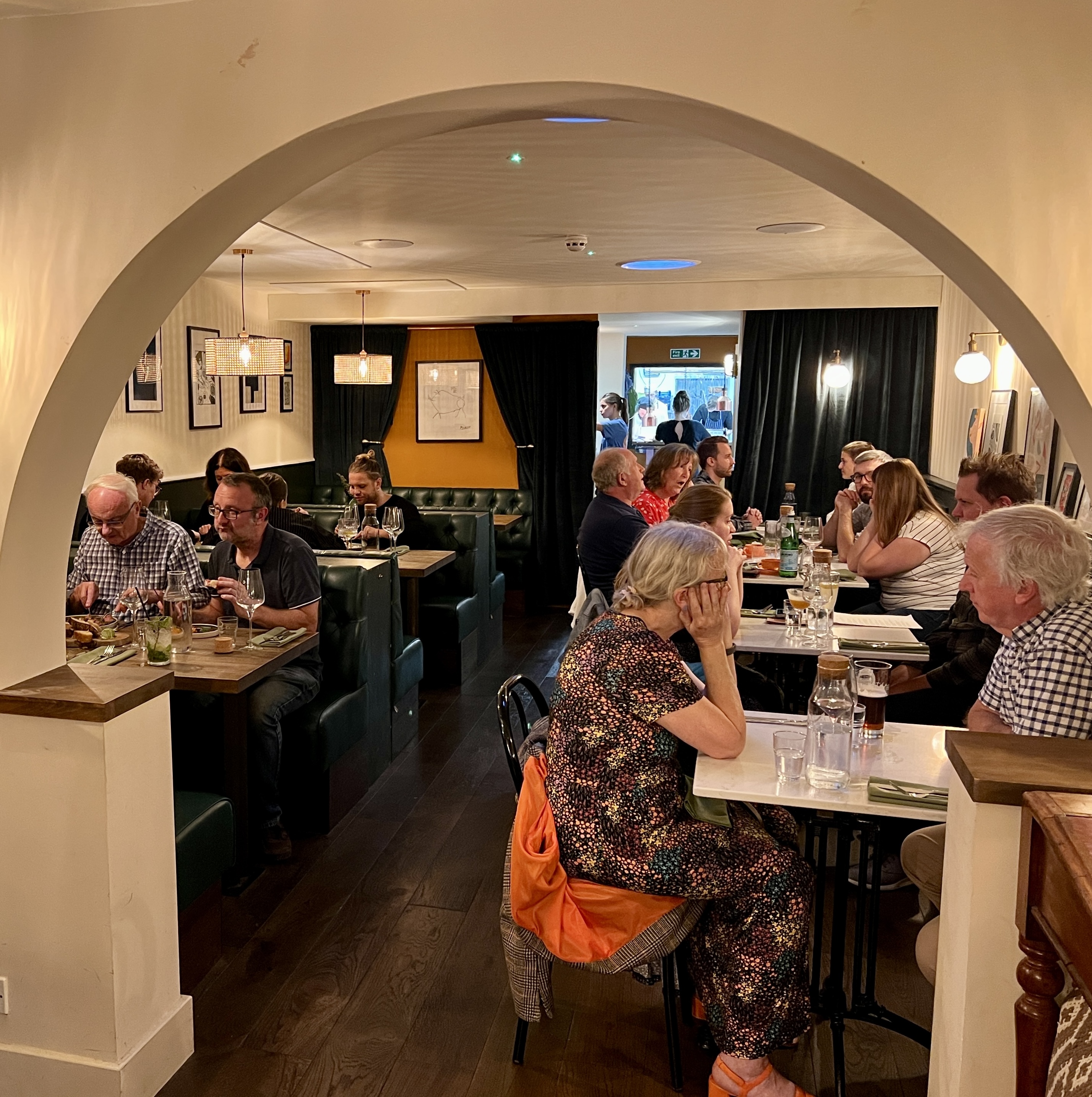
From the review I’d read I thought Five Little Pigs would be small but actually it was much larger than I expected. The front room, with the full length windows out onto St Mary’s Street, was a chic (if slightly chilly) space which was very tastefully done, an interesting mix of deep blues and golds and pastel shades from the art on the wall. It reminded me of places like Coppa Club, which isn’t necessarily a compliment. Further back was a longer, plainer room with banquetted booths. It’s a surprisingly hard space to photograph (as you can probably tell) but it was packed at seven o’clock on a Saturday night: a good review in the Observer will do that for you.
The menu read well and had plenty on it to appeal. Starters clustered around eight or nine pounds, and only a couple of mains were north of twenty. Plenty of it was local, too, with nearby cheesemakers, growers and butchers all namechecked. “We don’t have the pigs cheeks at the moment” said one of the wait staff, “but they may come in later.” I found that a bit confusing – were they being delivered by drone? – but decided it was best not to ask.
By that point a bottle of red had been opened, a really enjoyable organic Rioja, and I was about to reach that happy place where the food has been ordered and you know you’re safely in somebody else’s hands for the next few hours. Every table was full – with date nights, family gatherings and, in one case, an elderly couple who seemed to spend most of the evening glowering at each other. We were all going to have an enchanting evening. The Observer said so.
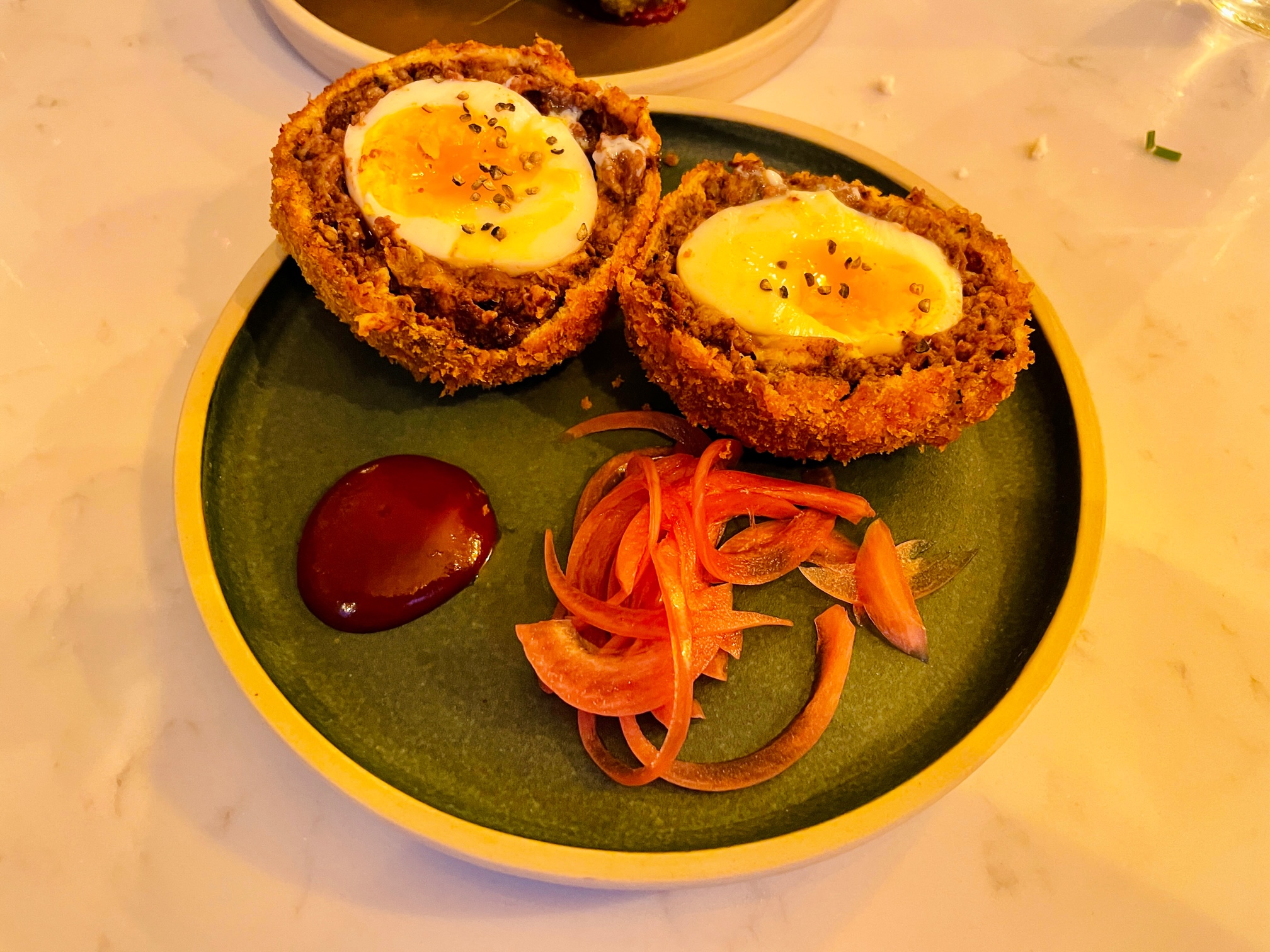
I felt a bit basic ordering the Scotch egg, but I can’t remember the last time I had one so it was calling to me from the menu right from the outset. It was one of the nicest things we ate all evening, so proved to be a happy choice : the sausagement was nicely coarse, with black pudding adding a little earthiness. And if I’d have liked the outside a little crisper, or the whole thing slightly less crumbly, the presence of a small pool of superbly tangy rhubarb ketchup mostly made up for that, as did the pickled pink onions.
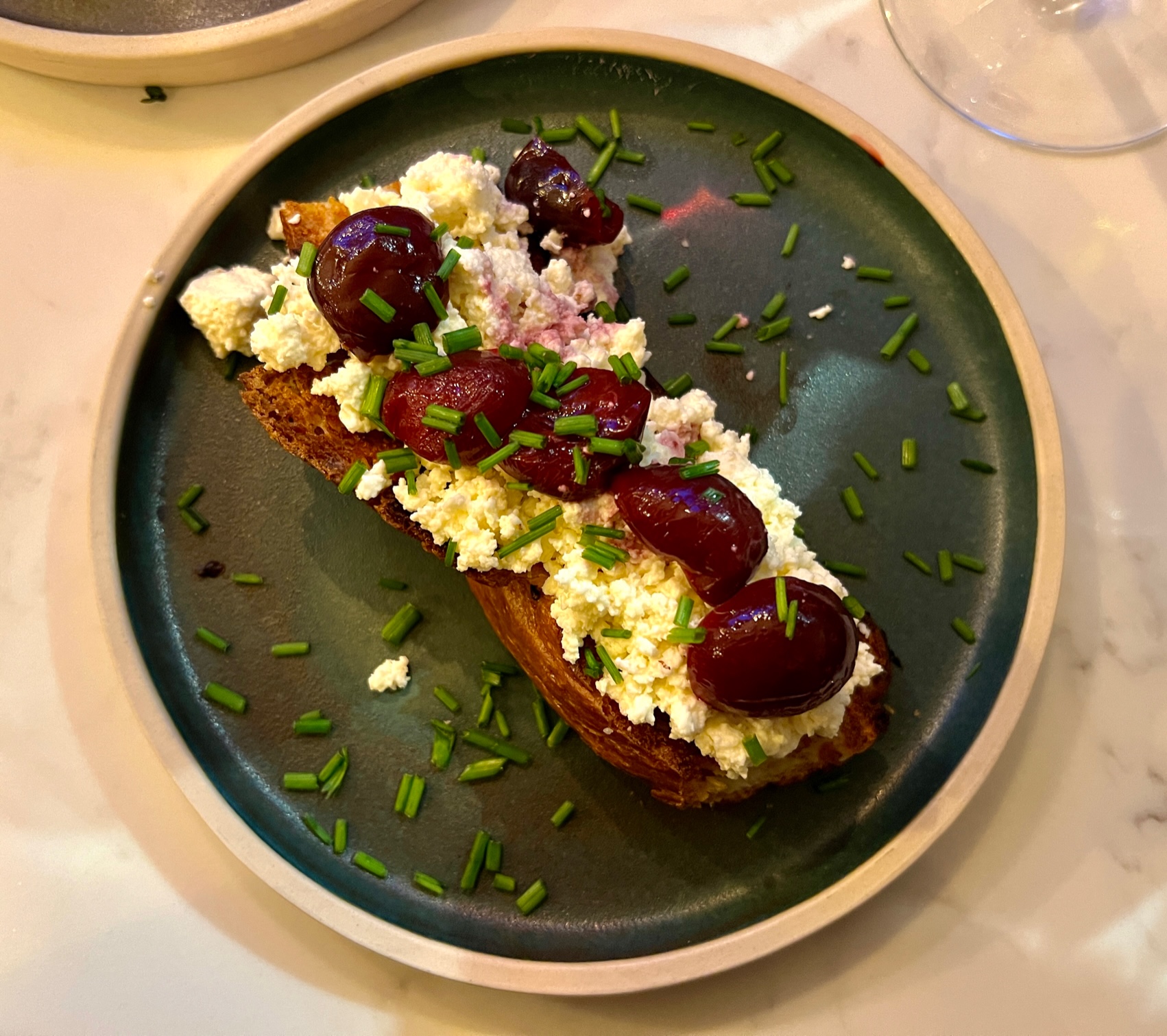
“You win” said Zoë, tackling her ricotta on toast, which sounded great on paper but in reality was disappointing. “It’s all a bit dry” she said, and this is a woman who’s listened to me talking about my favourite Bob Dylan records, so she knows what she’s talking about. For what it’s worth I agreed – the ricotta was dry and anaemic, the cottage cheese of the Chilterns, and although the roasted cherries were an interesting idea they didn’t add enough of the moisture this dish needed. Literal cherries on top, yes, but sadly not figurative ones. “This could have been really nice with honey” was Zoë’s take.
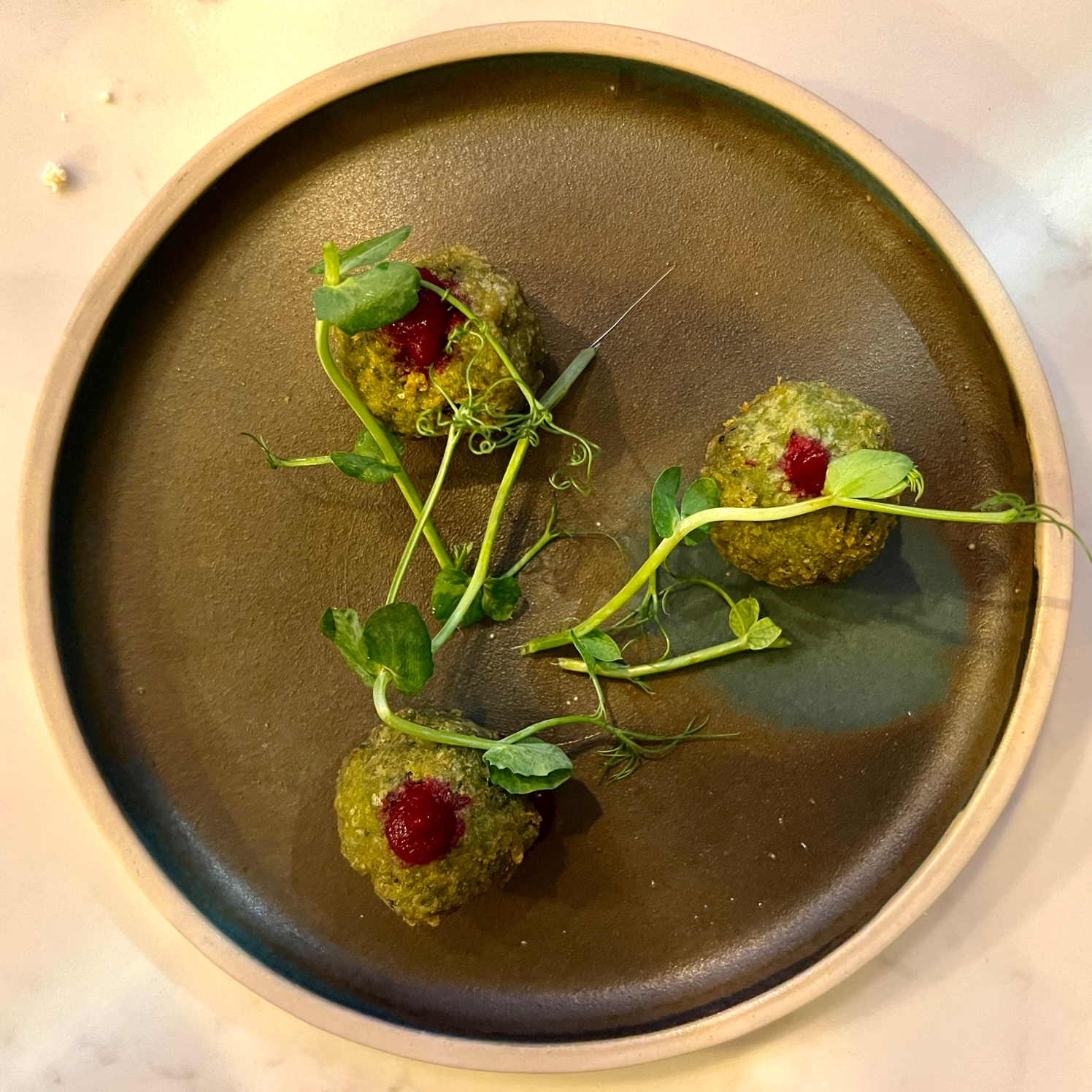
We’d also ordered a third starter, broad bean fritters, because they sounded so magnificent. And they tasted gorgeous, with huge amounts of freshness from the mint and a dab of deep whipped beetroot on top. But plating it up with pea shoots and plenty of negative space couldn’t really conceal the most obvious thing about this dish, which is that it was minuscule; it was one of those times when I wish I’d popped a twenty pence piece on the plate before I took the photo so you could see just how small they were. We had this as an extra dish, but if this had been my starter I’d have been looking at everybody else’s, feeling profoundly robbed.
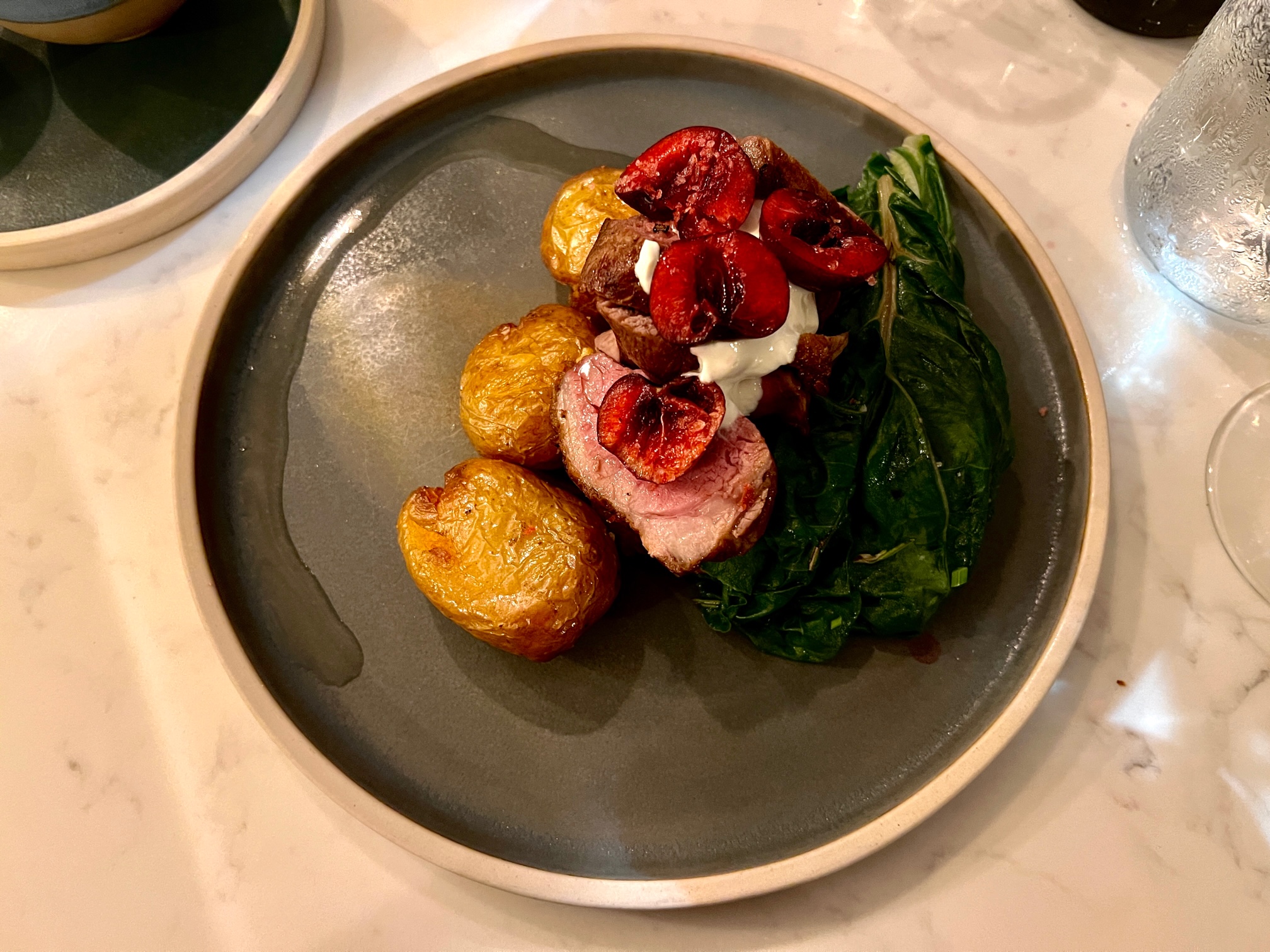
Things were well paced at Five Little Pigs, possibly because it was so busy, because our starter and our mains were about half an hour apart, for me close to the optimum interval between the two. I think Zoë chose better with the mains and her lamb rump with yoghurt, more of those roast cherries and what the menu calls “crispy potatoes” was the pick of the two. But even here, it wasn’t perfect. “Again, it’s dry” said Zoë. “The yoghurt is really good, but if anything it needs more of the cherries. They work better here than they did with the starters.” I agreed with that, although I thought the crispy potatoes were a standout, with a lot more texture than met the eye. But for me, the lamb rump was a little overdone. I found it odd, too, that they brought me a steak knife but not Zoë, when her dish needed it every bit as much as mine.
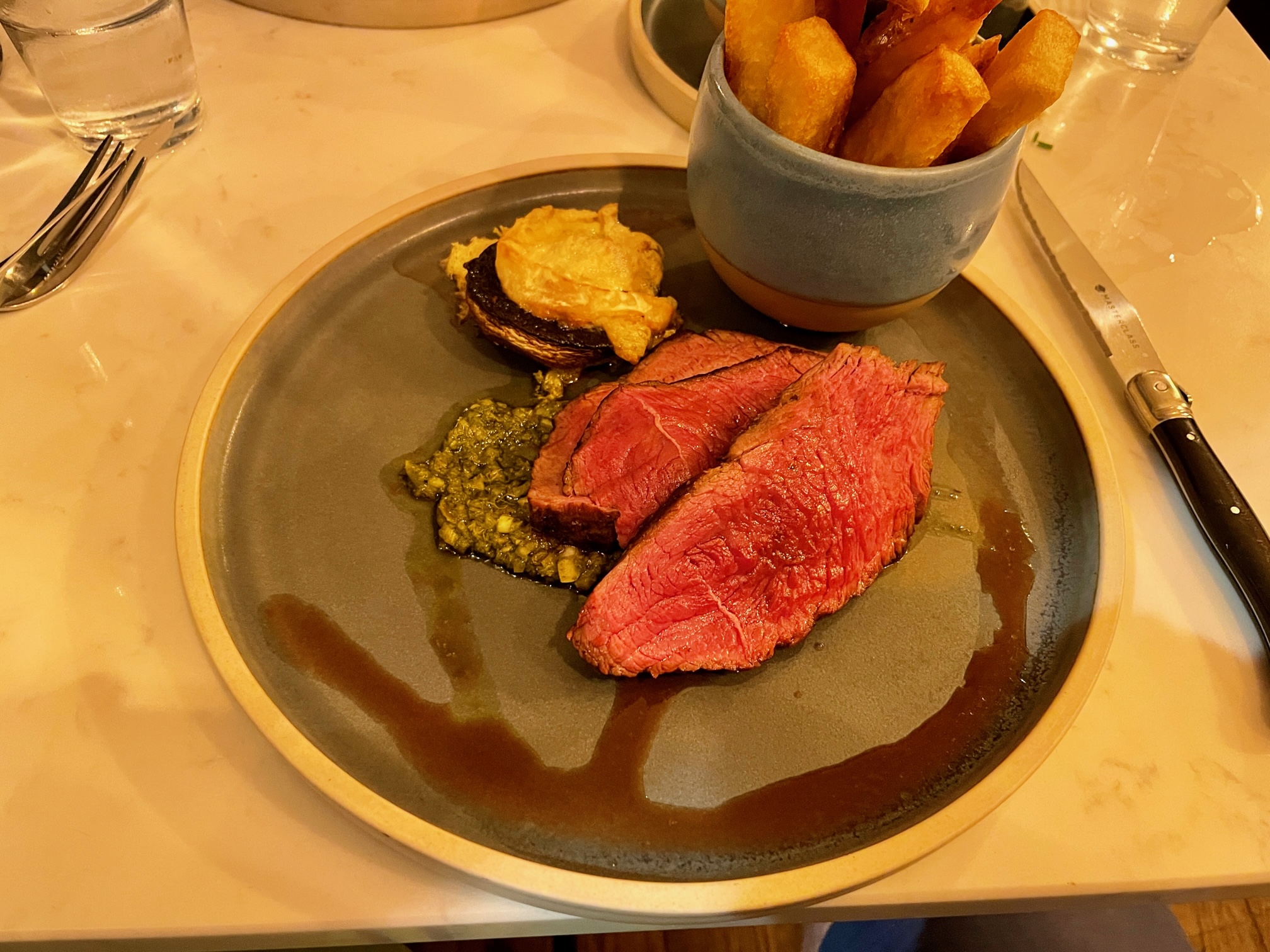
My rump steak was the most expensive dish on the menu, which always adds the potential for it to be the most underwhelming. It was a beautiful piece of beef and the cooking couldn’t be faulted – pretty much medium-rare throughout with beautiful caramelisation outside. But it was underseasoned, and surprisingly bland. The chimichurri underneath it had a pleasing zing, but ran out very quickly indeed. And after that the whole thing became a bit of a slog. There was some kind of puddle of juices at the edge of the plate, but it would be pushing it to call it a jus or a sauce. The best thing on the plate was a solitary mushroom cooked with cheese (again from Nettlebed) until it was salty and crispy, but when the star of the show plays such a brief cameo role, you’ve got problems.
Just to add to the onslaught of dryness, my triple cooked chips had decent texture – and were huge – but, again, they came without anything to add moisture. We’d ordered another portion separately, not knowing that we wouldn’t really need them, and I think in a restaurant with sharper service they might have talked us out of doing that. They came with a very good aioli but, as with the chimichurri or the beetroot ketchup, there was nowhere near enough of it. We asked for some more from a passing member of the wait staff. Five minutes passed and it didn’t materialise. We asked again and some time later, when the chips were nearly at an end, it finally arrived.
We looked at the dessert menu because our bus wasn’t for another forty-five minutes, or at least that’s what I told myself. By this point the couple at the next table had both ordered the hake – which looked nicer than either of our mains – and there was a certain mesmeric quality to watching them push it round the plate in that way that people who don’t really enjoy food seem to do.
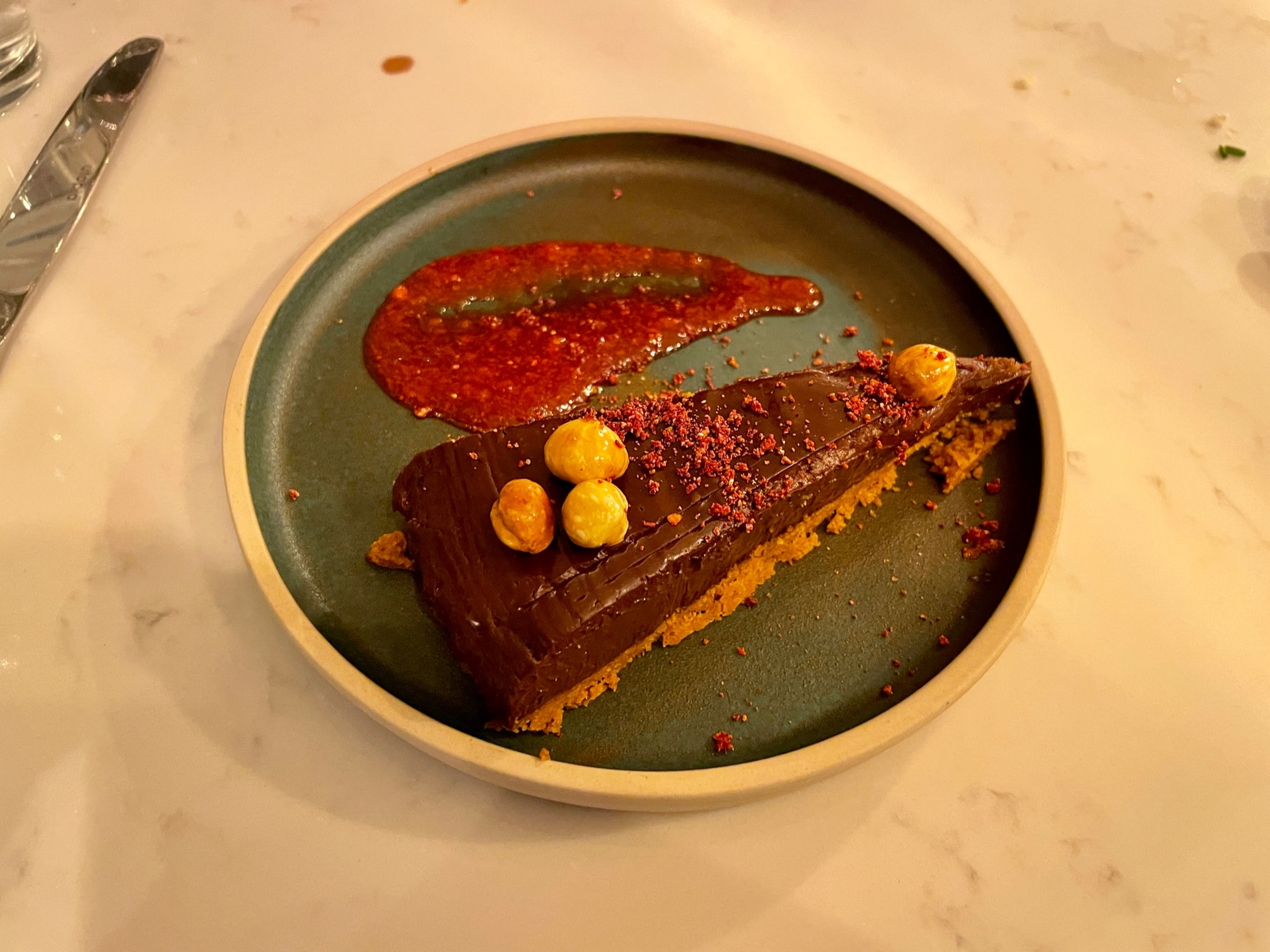
Anyway, desserts represented a slight recovery. My chocolate delice was a brilliant wodge of deep, gooey chocolate with a sweet, almost-sharp smear of bright strawberry purée to cut through. The biscuit base underneath was so crumbly that it barely stayed in one piece, but I didn’t mind that at all. Zoë’s key lime pie had a similarly short base and I thought it was pleasant, but I’d probably describe it as “subtle”, which really isn’t what you’re looking for in a dessert.
Zoë had her dessert with a Cotswold cream liqueur (although it turned up on the bill as Bailey’s, so Christ knows which it really was) and I had a dessert wine – from Graves of all places – which went beautifully. And well done if you’ve made it this far, because the truth about Five Little Pigs is that, sadly, by this point I’m even slightly boring myself. Our bill came to a hundred and forty-six pounds, including service, and then we went outside, got the penultimate bus out of Dodge, got home, had a cup of tea and went to bed. The end.
Last week somebody commented on my Facebook page about the review I did of Sauce And Flour. “I wish you’d stop doing reviews of places outside Reading” he said. “I prefer the Reading reviews. And after all, this blog is called Edible Reading”. I always find it interesting when people pipe up to tell me that this entirely free blog is somehow not delivering value for money, and after I politely told him that I’d review wherever I bloody well liked he deleted his comment. But there’s an important point here, believe it or not. I think it’s good to review places outside Reading because it gives you that all-important context (like I said at the start, there’s usually a Context). Otherwise how do you know if a place is good, or just good for Reading?
And it goes beyond Reading. If I hadn’t been to the likes of Marmo and Caper & Cure maybe I’d have thought about Five Little Pigs very differently. But at the same price point, making similar noises, and even with some similar dishes, the difference is stark. There are better ways to spend a hundred and fifty pounds eating out than to go to Five Little Pigs. One is to go to Marmo, or Caper & Cure. Another, to be honest, is to eat at Tasty Greek Souvlaki four times. Five Little Pigs is probably an absolute boon to Wallingford, and on another night I might well have had a meal there I’d have enjoyed better. But in truth, I can’t see myself going back.
So there you go: it turns out that restaurant reviewers aren’t always right. But as a regular reader of this blog you knew that already, didn’t you?
Five Little Pigs – 7.1 26 St Mary’s Street, Wallingford, Oxfordshire, OX10 0ET 01491 833999
One of my oldest friends lives in Swindon. Someone has to. Whenever he comes to Reading he enjoys our street food, our craft beer and our shopportunities and he complains to me – at length – that it didn’t have to turn out like this. He reckons that there was a time, back in the Nineties when all that money hadn’t decided where to coalesce, when it Could Have Been Swindon. They had a House Of Fraser, well before the Oracle opened, and that designer outlet everyone used to get so excited about. And Reading – Heelas aside, of course – was a bit of a wasteland in the mid-Nineties. Things could have been very different.
But the retail and hospitality gods smiled on Reading and, like many of us, they sneered at Swindon. We got the big names and the investment and Swindon, over the few decades, withered and died. It’s not all terrible: Darkroom Espresso is a great place to grab a coffee, Los Gatos in the old town is a tapas restaurant Reading would be lucky to have and a few doors down Rays does thoroughly likeable ice cream. But there’s a reason people who live in Swindon go to Bath, Oxford or Cirencester at the weekend, just as people from those places don’t pop over to Swindon of a Saturday.
The reason I’m starting a review of a place in Maidenhead talking about Swindon is that lately I’ve been looking at what’s going on in Maidenhead and starting to wonder if we might find ourselves in the Swindon role at some point in the coming years. Because although it’s early days, the businesses beginning to come to prominence in Maidenhead are the kind that you’d want to see in Reading instead of – hooray – a branch of Popeyes or our twentieth Costa Coffee.
Take A Hoppy Place, a credible, nicely fitted out craft beer bar a five minute walk from the train station with close to twenty beers and ciders on cask and keg. Last time I went it was doing a roaring trade and making the most of its outside space, and it was a wonderful place to while away a few hours. And although Reading has a brilliant craft beer scene – bolstered by the new addition of the Grumpy Goat’s upstairs bar – there’s nothing on that scale in the town centre.
And then there’s Seasonality, which recently got a rave review in The Guardian. It started in lockdown as a deli also selling heat at home meals, and has since morphed into a restaurant offering an interesting and inventive menu. It’s tasteful, gorgeous looking and independent: you could count the number of restaurants like that which have opened in Reading in the last couple of years on the fingers of one stump. With the winter we have looming, and the town’s famously charmless landlords, can you imagine one trying their luck here in the next twelve months?
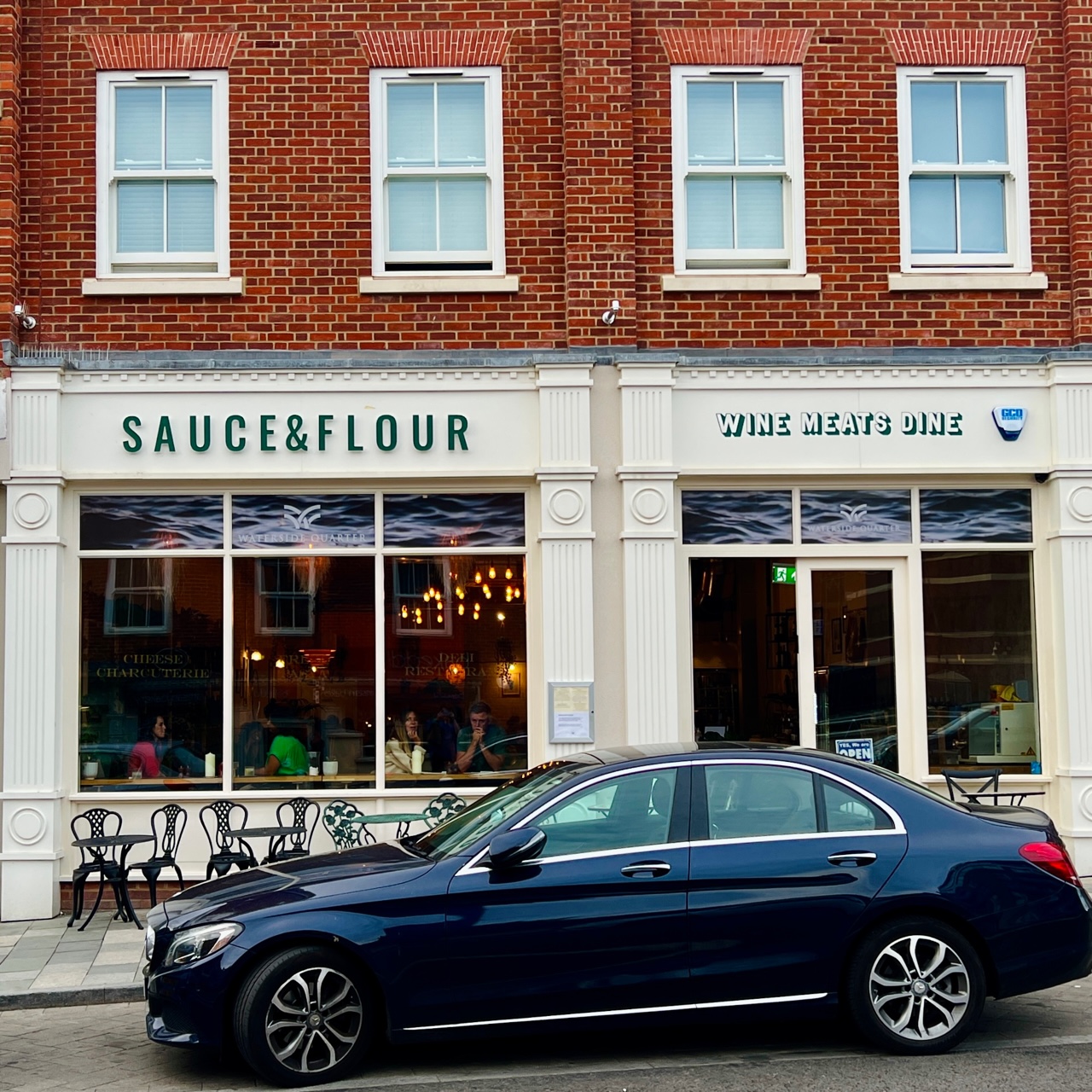
Finally, the subject of this week’s review which might be the most interesting of the lot. Flour and Sauce opened in March as part of Maidenhead’s Waterside Quarter and seems, on paper at least, to be an example of a London trend that hasn’t so far made it this far west, the pasta restaurant. And by that I mean that, from a look at the menu, it seems to be modelled on Borough Market’s famous Padella and the hugely influential Bancone along with more recent imitators.
Those places – offering starters, a selection of pasta and not much else – have been one of my favourite trends of the last few years. They’ve given dishes like silk handkerchiefs with confit egg yolk or bucatini cacio e pepe iconic status and at their best they make for fantastic mid-priced casual restaurants. Throw in a negroni to start and a decent dessert at the end and you have the blueprint for a marvellous lunch or dinner: I’ve eaten at the original Bancone in Covent Garden a few times and never had a meal there that was less than splendid. So was Maidenhead boasting an example of this very London trend by virtue of its place on the Elizabeth Line? I wanted to find out.
It looked gorgeous from the outside, all white columns and full length windows. And it had the feeling of a fully realised concept, with clear branding, although something was niggling and bringing out my inner Mary Portas. Was it the name? Somehow it felt like it should be Flour And Sauce, both in chronological and alphabetical order. And the slogan – Wine Meats Dine – might have worked as a pun, but it didn’t seem to descibe what they actually did.
Going inside and taking my table brought out my inner Michelle Ogundehin. It was a big deep room but everything was somehow disconnected. The furniture didn’t match, but not in a charming way or even a calculated one, more as if they’d run out of stuff. I saw three different types of chair, one of which was the ubiquitous Tollix I associate with far cheaper food and greater discomfort.
Likewise the lampshades didn’t match, but not in a way that made sense – including the ones over the window seats which looked like grass skirts humping a lightbulb. There were some cheap shelving units from Ikea along one wall and a completely incongruous pine Welsh dresser at the back. It all felt thrown together, as if they’d opened in a hurry – and of course it might well have been. The faux marble wallpaper along one wall, already slightly peeling at the joins, might have gone on in a hurry too.
“It’s funny” said Zoë. “You walk in and think ‘this is nice’ but then the longer you look at it the more jarring it gets.”
I don’t think it helps that we got arguably the worst table in the place. The restaurant wasn’t really broken into zones, and we had the last free table – right at the front, near the open door. It was a bit chilly, and with people traipsing past in either direction it felt like eating in a corridor – especially when at one point a large group decided to stand right next to our table and chat to a couple eating up at the window for the best part of ten minutes. The window seats, by the way, are probably the best place to sit if you’re in a pair: the counter is lovely and deep, and you get a great view (and, therefore, superb people watching opportunities).
The menu was a little like the room – superficially attractive, but the closer you looked the more you wondered. At places like Bancone, the array of pasta dishes all involve different types of pasta which gives you a much wider range of choices. By contrast nearly all the pasta dishes at Sauce And Flour revolved around relatively similar shapes, and not too many of them, so you had multiple permutations of pappardelle, tagliatelle, linguine and bucatini which made up all but one of the pasta dishes on offer (the exception was a penne dish: what kind of a monster orders penne from choice?). I was hoping to see some ravioli, something like trofie or orechiette, a little more variety.
And while I’m whinging, the drinks list was irksome too. A reasonable selection of wine, but only one of each colour available by the glass. Come in a group or don’t bother, that seemed to say. And the pricing of the solitary red, white and rosé were absolutely nuts: the menu sold wine in 125ml and 250ml glasses with no option in between. And if you did decide you wanted a small glass of wine they stung you, with most of them costing only two pounds less than the large glass (I mean, you could say the large glasses were a relative bargain, but I suppose I’m a bit more large-glass-half-empty).
The irony wasn’t lost on me: I’ve moaned for years that not enough restaurants sell wine in 125ml glasses, and here I was in a place where it was one of the only options. But it felt badly thought out. There were two beers on offer, those ubiquitous macro lagers Peroni and Moretti. I took another look, thought fuck this and ordered a large bottle of San Pellegrino.
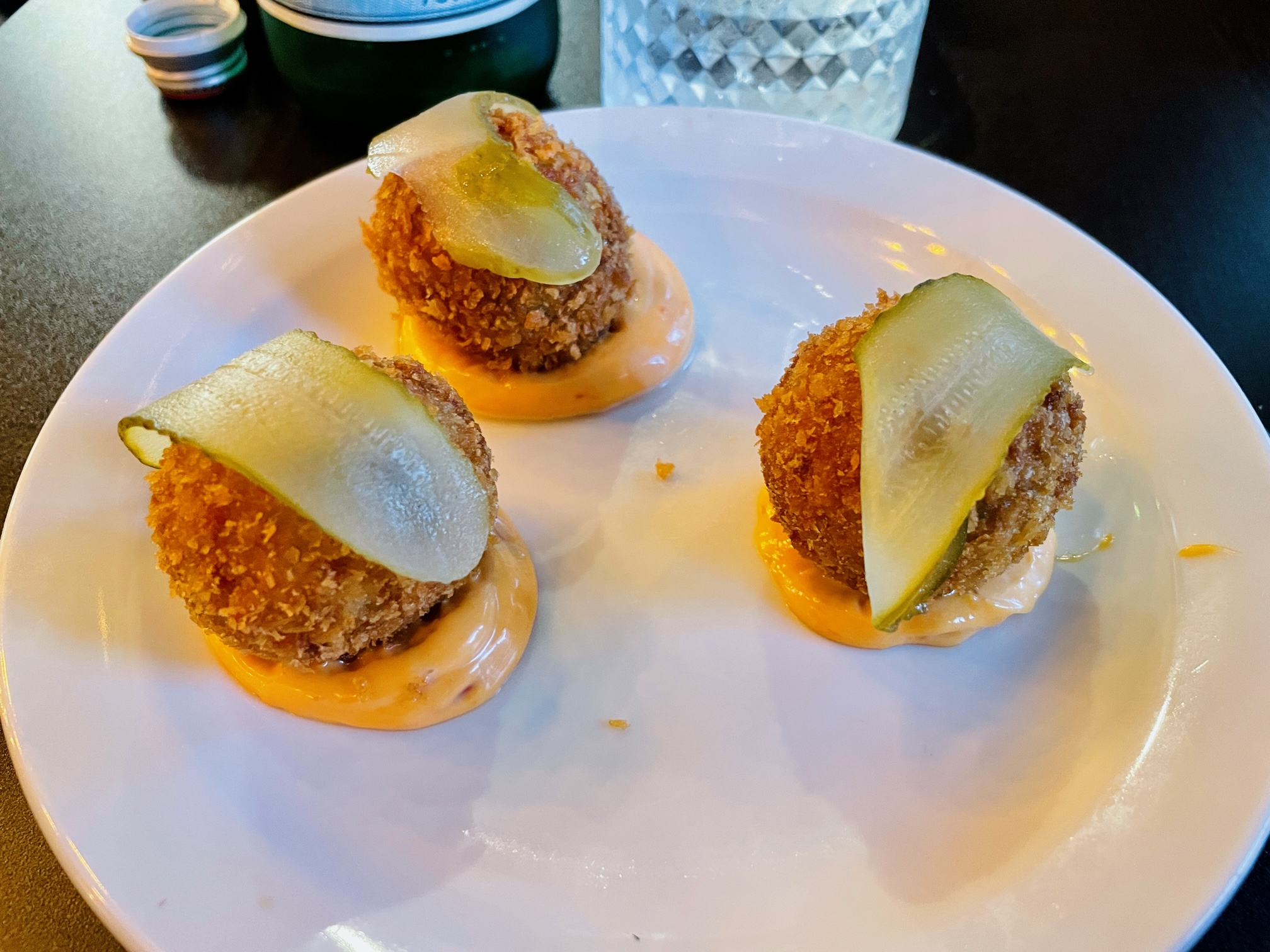
Would the food redeem matters? Some of it came close. We started with some thoroughly decent dishes from the starters menu and for a while I thought my tetchiness would be held in check. The pick of the bunch – of the whole meal, in fact – were the short rib beef croquettes: three beautiful specimens crisp of shell and packed with soft, yielding, slow-cooked beef. They were perched in a little moat of spiced mayonnaise which might have had a kiss of ‘nduja, and each had a slice of pickle draped on top which was more sweet than tart and tied things together nicely.
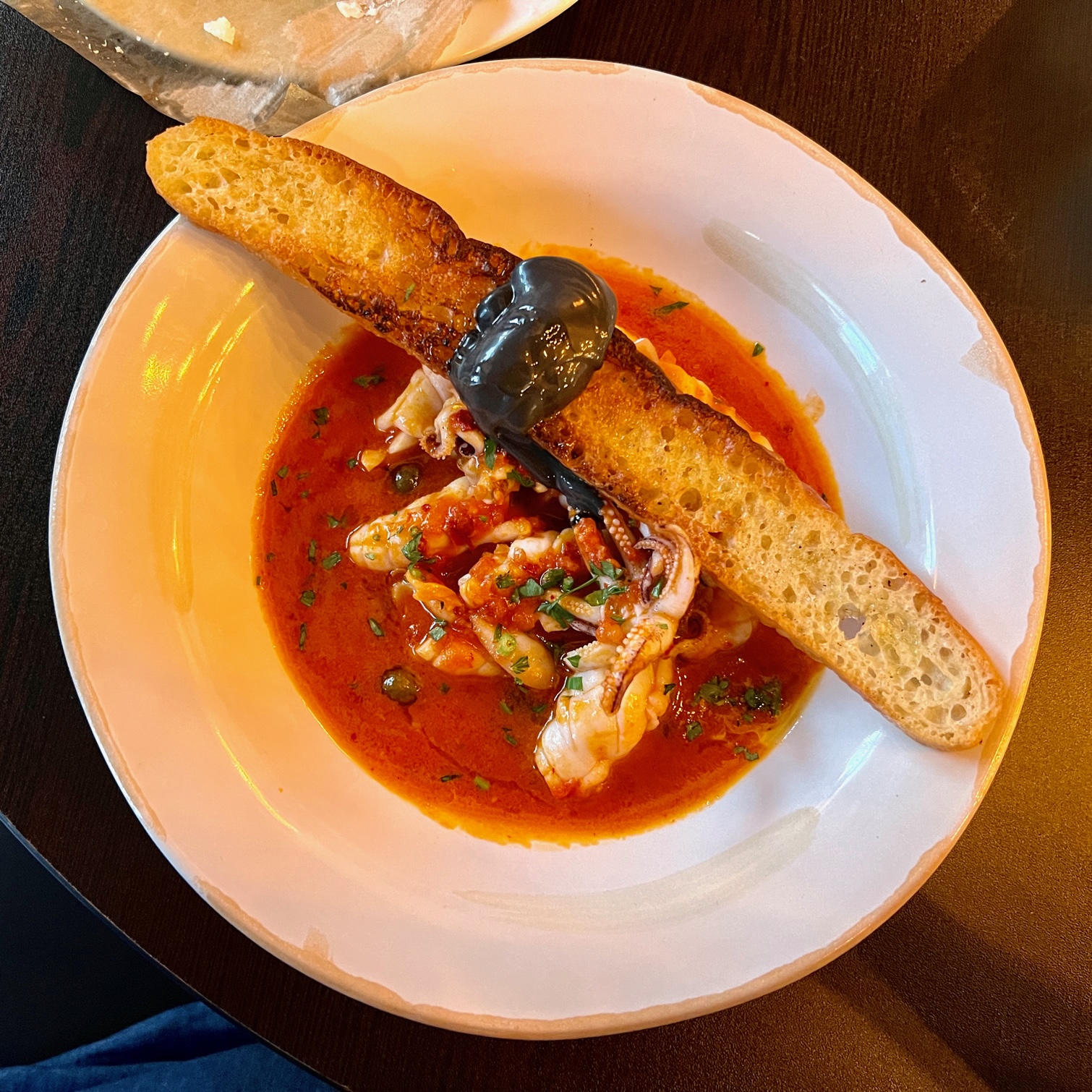
There were three of these and I let Zoë have the spare because she was so underwhelmed by the next starter, although I didn’t like it much better. Squid – “body and tentacles” according to the menu, which I think is TMI – was meant to come fried with ‘nduja but was actually in a thin, vinegary sauce with capers and no heat or seasoning. All the squid was bouncier than you’d like, and just made me think wistfully of better squid I’ve had in the not too distant past. It came with a long transverse slice of focaccia toast which was so rock hard that trying to cut it with a knife and fork left me worrying that half of it would ping off and hit the next table. A pointless blob of squid ink mayo perched on it, looking like a dirty protest.
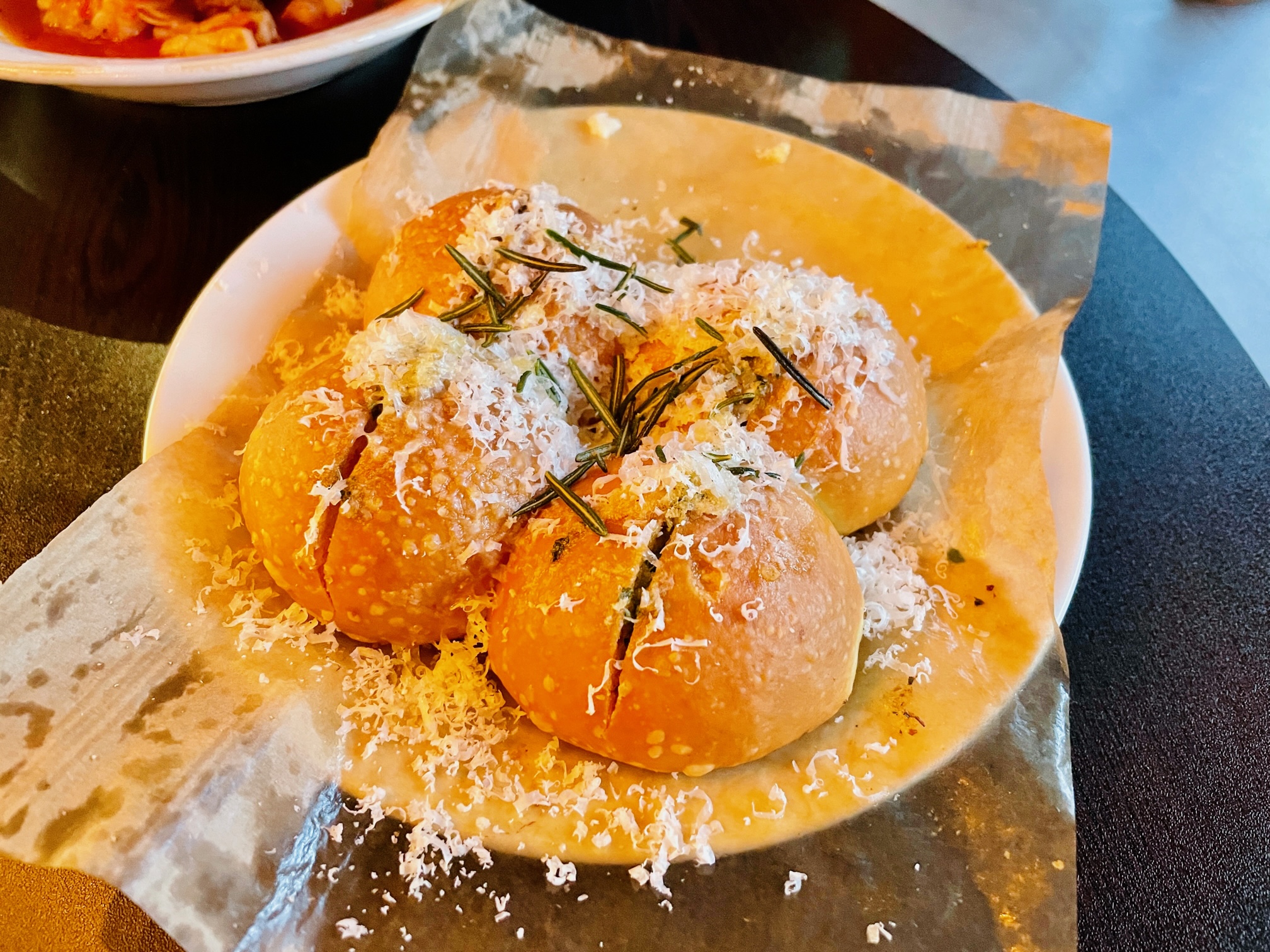
Finally, I wasn’t sure what “warm buttermilk garlic bun & parmesan” would turn out to be, and the answer is essentially this: four giant dough balls. They were about as nice as giant dough balls can be, strewn with Parmesan and rosemary, and I squidged a piece into the sauce that came with the squid to verify that yes, it really was that dull.
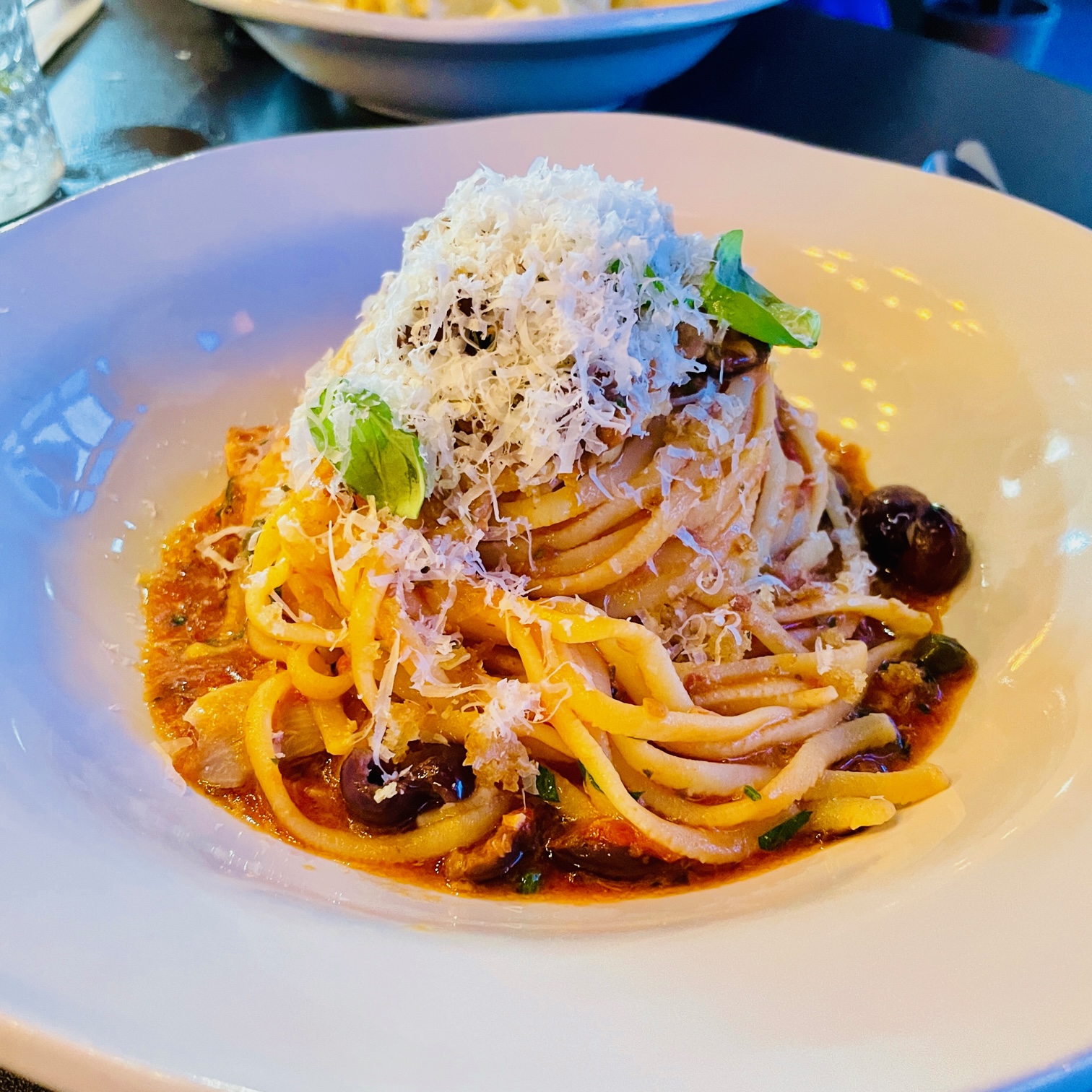
Mains were better but, and this is rather a theme, not exactly as billed. My linguine puttanesca was solid, I think. The ribbons had just enough pleasing bite and the sauce, a combination of all my favourite things, worked well. It had the note of acidity from the capers, a pleasant hum of chilli in the background and beautiful, plump olives. I felt like it needed more anchovy, but then I feel that way about the world in general so this dish was hardly an isolated incident. I’d paid extra to have some yellowfin tuna in the mix and I think I spotted a couple of forkfuls, but that was it. Not bad at all, and not bad value at fourteen pounds, but in the wider context of the whole meal it was doing a lot of heavy lifting.
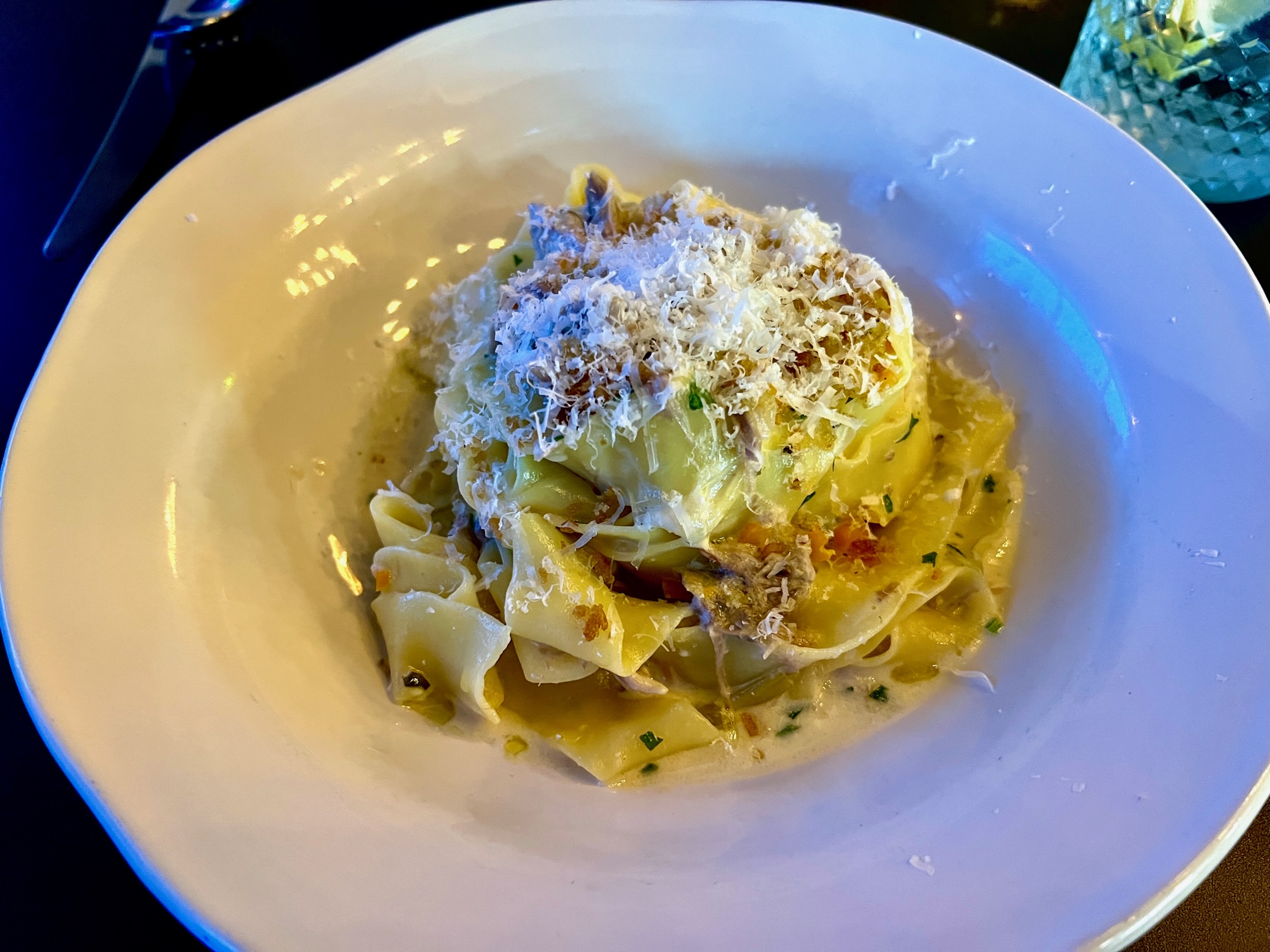
Zoë’s dish, slow-cooked duck ragu with tagliatelle, had sounded good on paper and she enjoyed it, but from what I tasted it didn’t quite work. Again, the menu was misleading: this didn’t feel like a ragu at all, and the pieces of duck leg I ate didn’t have that tenderness I associate with slow cooked sauces. This hadn’t been reduced for a long time in red wine and tomatoes, it was a white ragu if anything, but it felt like the duck had been added to the white wine and mascarpone right at the end.
And it tasted pleasant enough, but if I’d ordered it I’d have been disappointed: perhaps the kitchen’s other ragus – one made with beef shin, the other with pork and ‘nduja – showed off their skills better. Zoë couldn’t finish it – you can’t fault the portion size – but by the end the sauce had pretty much solidified which made it a challenge. I will say this for Sauce And Flour, though: both pasta dishes had the welcome crunch of judiciously added pangrattato, and it’s hard to completely take against a restaurant that does that.
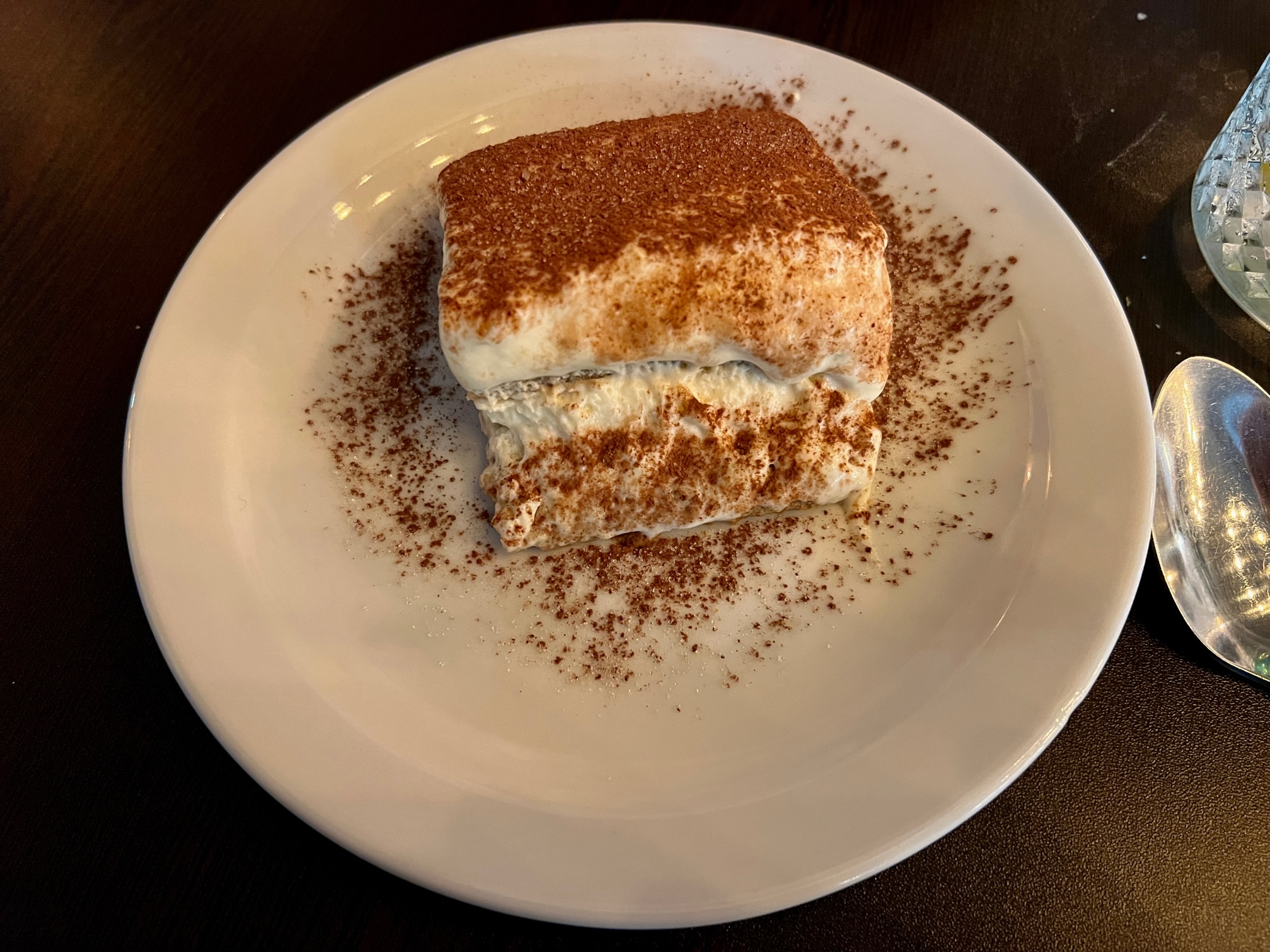
We decided to try dessert, to give the place a fair crack of the whip. They too were pretty representative of the whole Sauce And Flour experience. Zoë’s tiramisu was decent, and she loved the mascarpone and the leftfield inclusion of Kahlua, but it was a lot more cream than sponge. It didn’t dampen her ardour for Buon Appetito’s magical pistachio tiramisu, put it that way.
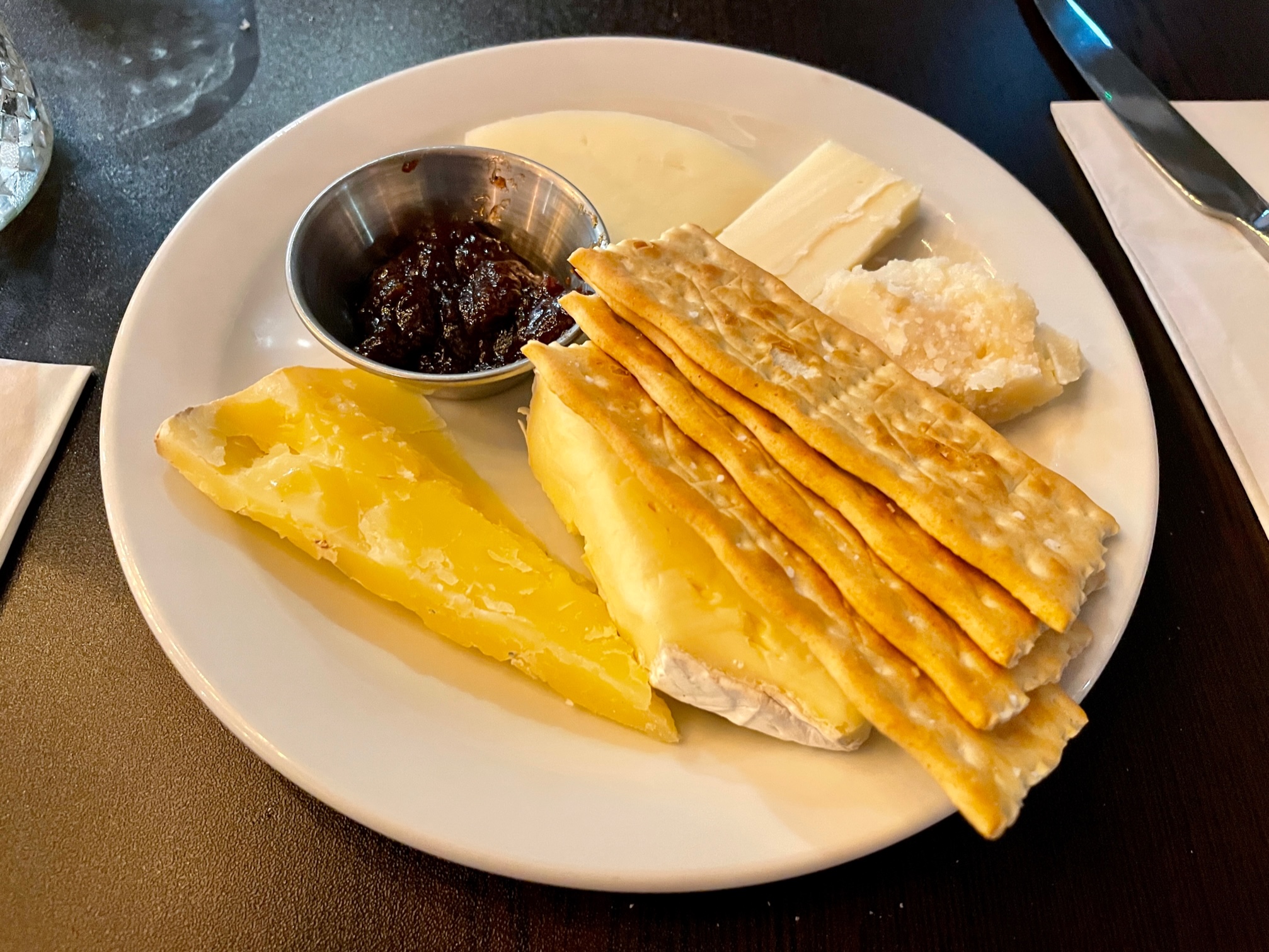
I went for the cheese selection and for one person, for seven pounds, I thought it was generous. They have a big deli counter just along from the open kitchen so you can see the staff cutting and preparing the cheese plate, and maybe if I’d had better eyesight I could have worked out what they were. But with the exception of a gorgeous, crumbly Parmesan with decent age which I left until last, I have no idea what they were because the wait staff just plonked them down and sodded off (the menu doesn’t say, either).
The others were a mix of a soft cheese that might have been Brie but possibly wasn’t, a hard cheese that could have been pecorino but probably wasn’t and a couple of other cheeses which honestly could have been anything. Maybe it was the adrenalin, or maybe I was just high on life and drunk on San Pellegrino but I have absolutely no idea. I do know that they came with crackers which tasted a lot like water biscuits and a little dish of something the menu just calls “jam” which tasted of surprisingly little.
Not telling us what the cheeses were was pretty consistent with service in general: it wasn’t unpleasant or rude, just distinctly brisk and disinterested. Maybe it’s because they were busy, but it lacked warmth – and I’m not just saying that because I was sitting by the open door. For me, that was arguably the biggest drawback about Sauce And Flour because it’s the thing – over and above the quirks of the menu or that sore thumb Welsh dresser – that badly needs to be fixed. Our meal came to just over sixty-seven pounds, and included a ten per cent service charge I’m not entirely sure was warranted.
On the train home, Zoë and I mused about exactly what had been missing from our evening.
“The room wasn’t that bad, and some of the food was very good, but great service would absolutely transform that place” she said. And she’s right. Sauce And Flour is a curious beast. It looks, on paper, like an attempt to recreate those specialist pasta restaurants in the capital, but scratch the surface and I have a horrible feeling that it’s actually just a reasonable Italian restaurant with a more limited menu. Like the faux marble wallpaper, it might look the part from a distance but underneath, it’s already peeling. So we can relax: Reading isn’t missing out, not this time anyway. If you want to leave town to eat superb Italian food, take a train to Mio Fiore.
What it really made me think about was the glory days of Dolce Vita, at the height of its powers. I loved Dolce Vita, but let’s be honest: the room wasn’t the best in Reading, and a fair amount of the food didn’t quite live up to its reputation (mainly, ironically, the pasta and pizza dishes). But because of the service, you never cared about that. You’d go back time and again, and it always felt like having friends cooking for you. And if I’d gone to Dolce Vita and there had only been one wine by the glass, I wouldn’t have given a shit; I don’t think I ever went there without ordering a bottle anyway. Trends or no trends, Reading doesn’t need a Sauce And Flour. But there will always be room for another Dolce Vita.
Sauce And Flour – 7.0 4A High Street, Maidenhead, SL6 1QJ 07516 948421
At the start of every year, the broadsheets wheel out an article about the food trends of the coming twelve months. And every year, nobody checks the article from the previous January to verify that almost none of the trends became a thing. Peruvian food never took off, beyond a couple of places in London. Neither did corn ribs, hard seltzers, carob, eringi mushrooms.
But it fills a gap for column inches in January, among all the clean eating/“new year new you” articles they dust off and spruce up at the start of every year. And besides, it’s not like anybody’s keeping score: from this year’s predictions, keep an eye out for potato milk, whatever that is. It has another four months to become famous (they sell it at Waitrose, where reviews run the full gamut from “another unsatisfactory milk alternative” to “very neutral tasting”).
Anyway, Reading food trends aren’t like London food trends, because every year since I started this blog the trend has been pretty much the same: you’ll get more cafés, and some dickheads will complain that we have too many cafés. You’ll get more burger places, and some dickheads will moan that there are too many burger places. And, in recent years, you’ll get more American chains and some dickhead will whinge about the Americanisation of Reading. And yes, that last dickhead is me.
The real trends are the ones that blindside you. Late last year and early this year it was biryani places, with a mini explosion of options – Biryani Mama in town, Biryani Boyzz on the Oxford Road and, just opposite it, the interestingly named Biryanish (“it’s sort of like a biryani…”). And then in the last few months, the trend literally nobody saw coming: three Japanese restaurants opening in the space of two months. Did anybody predict that on New Year’s Day?
I’ve always loved Japanese food, but Reading’s never been incredibly well served for it. In the centre, you had Yo! Sushi and Sushimania, and both have their place: Yo! Sushi in particular democratised sushi and acted as an introduction for many people, me included. And I’ve always enjoyed heading to Sushimania after a day at work with Zoe, grabbing seats on the banquette and looking out on the dining room with a cold bottle of Asahi.
More recently Oishi opened down the Oxford Road: I loved it when I went, but for a while it had an alarming hygiene rating which put me off a return visit. And of course there’s Osaka which I liked but didn’t love, although I visited it during one of the weirdest months the world has ever seen. But for a more special meal I’ve always headed to Windsor, to eat at Misugo (recent discovery Miyazaki is an excellent alternative). Did any of Reading’s newcomers have what it takes to displace Misugo in my affections?
Subscribe to continue reading
Become a paid subscriber to get access to the rest of this post and other exclusive content.
I don’t know how many restaurant reviewers you read – apart from yours truly, naturally – but the shocking truth is that I don’t really bother with any of them. I’ve no interest, for instance, in reading Giles Coren wanking on in his Corenesque way about another country pub near his house in the Cotswolds, peppering it with his usual contrarian casual racism. If I want to be bored shitless by an edgelord, I’ll just fire up Twitter.
That’s rich coming from me, I know. The irony isn’t lost on me, and if everybody thought the way I do I’d probably have the grand total of about three readers. But there you go: with some of the big names I have a peek to see where they’ve reviewed, and I might scan through to see if they liked it – if it’s somewhere I might one day go – but beyond that I don’t really pay much attention.
So for instance I know that Grace Dent from the Guardian had a meal in Maidenhead not too long ago that she really enjoyed. As a result I’ve added the venue to my to do list, but I won’t be poring over her deathless prose line by line before I go. Similarly the subject of this week’s review, Caper and Cure, received rave reviews in the Sunday Times and the Financial Times recently. I didn’t read them (because paywall, Rupert Murdoch etc.), but when I happened to be in Bristol for the weekend I made a beeline there to see what the fuss was about.
And yes, that means another Bristol review, which in turn means that some of you will look away now – or, more likely, didn’t click on the link in the first place. But I make no apologies, because for many years now Bristol has had, for my money, the most interesting food scene in the U.K. Cities and towns like Brighton (back in the day) and Margate always strike me as trying to be London-on-Sea, but what I love about Bristol is that it ploughs its own furrow, with no interest in being anything other than itself.
Places that want to develop a food culture, like Reading, could learn a lot from that: if we got even a fraction of the kind of restaurants in our town centre that Bristol seems to say hello to every month, we’d be a much richer place for it. Besides, it’s just over an hour away by train.
So Zoë and I turned up on a Saturday lunchtime to check it out. Caper and Cure is in Stokes Croft, a short stroll from Cabot Circus, the city’s main mall, at the point where Bristol starts to get properly lively and interesting. Beyond Caper and Cure, Stokes Croft becomes the Cheltenham Road and then the Gloucester Road, a fascinating indie-land of bars and restaurants, shops selling every kind of beer or wine and charcuterie (and a special prize surely has to go to the splendidly named Bristanbul, a Turkish bakery).
On the walk to the restaurant I saw the parts of this area that have defeated gentrification: the patch of land called Turbo Island still sports a couple of shabby sofas whose best days were decades ago, and the people sitting on them were already a few cans of lager to the good by early afternoon. The last time I was here I had a fantastic brunch at nearby Jamaica Street Stores: it closed last month after five years, partly because of growing issues with Turbo Island.
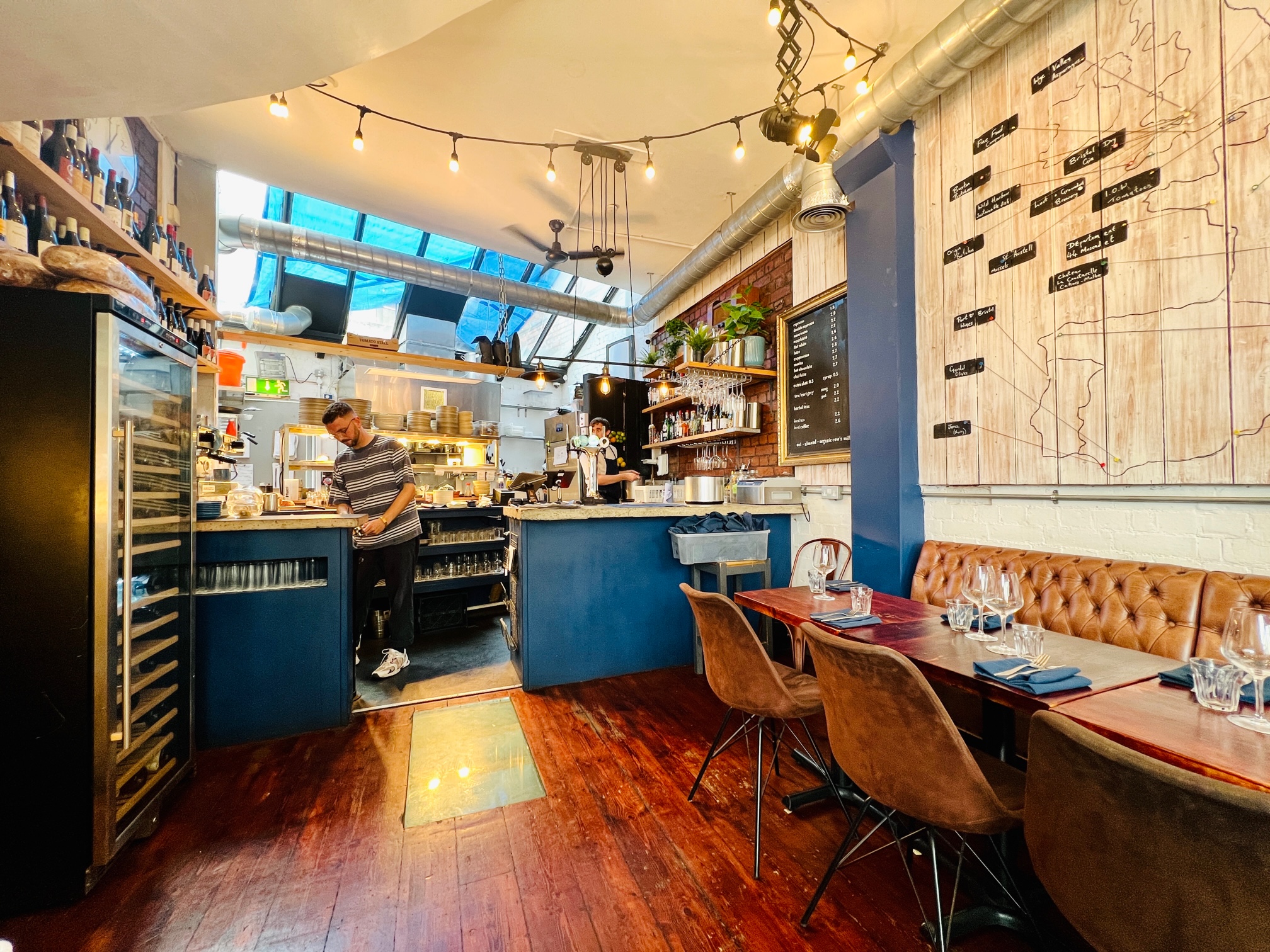
But Caper and Cure, a handsome blue and gold fronted restaurant on the corner, still felt relatively genteel; Stokes Croft institution Café Kino is next door, and the gorgeous Elemental Collective sells coffee and pastries the other side of the road. The building Caper and Cure is in used to be a chemist, back in the Twenties, and the room retains exceptional bones – generously proportioned floor to ceiling windows letting in tons of light, and a compact, almost-triangular dining room with about twenty covers.
A fetching button-backed banquette ran along one side – we were seated at the slightly less attractive tables on the other side of the room, but it didn’t feel like there were any truly duff seating choices. There was a small counter at the back, the open kitchen beyond, and along one wall was a map of Europe showing the provenance of some of the ingredients used in the kitchen: a nice touch. Why was Bristol so good at making excellent dining rooms and kitchens out of such modest spaces, and why had none of that genius ever made it down the M4 to us?
For that matter, why were Bristol restaurants so good at putting a menu together which was simultaneously compact but where you wanted to order everything? Four starters, five mains, three desserts, a cheeseboard and a couple of specials. Starters around a tenner, mains fifteen to twenty quid, desserts maxing out at eight pounds. Absurdly streamlined, really, compared to the overkill of so many restaurants, and yet I could have ordered any combination of dishes (I should mention, too, that this being Stokes Croft vegetarians and vegans also had decent, imaginative choices). There’s a real talent to assembling a menu like this, to hitting all the bases and keeping it lean and appealing, and I for one wish more restaurants had it.
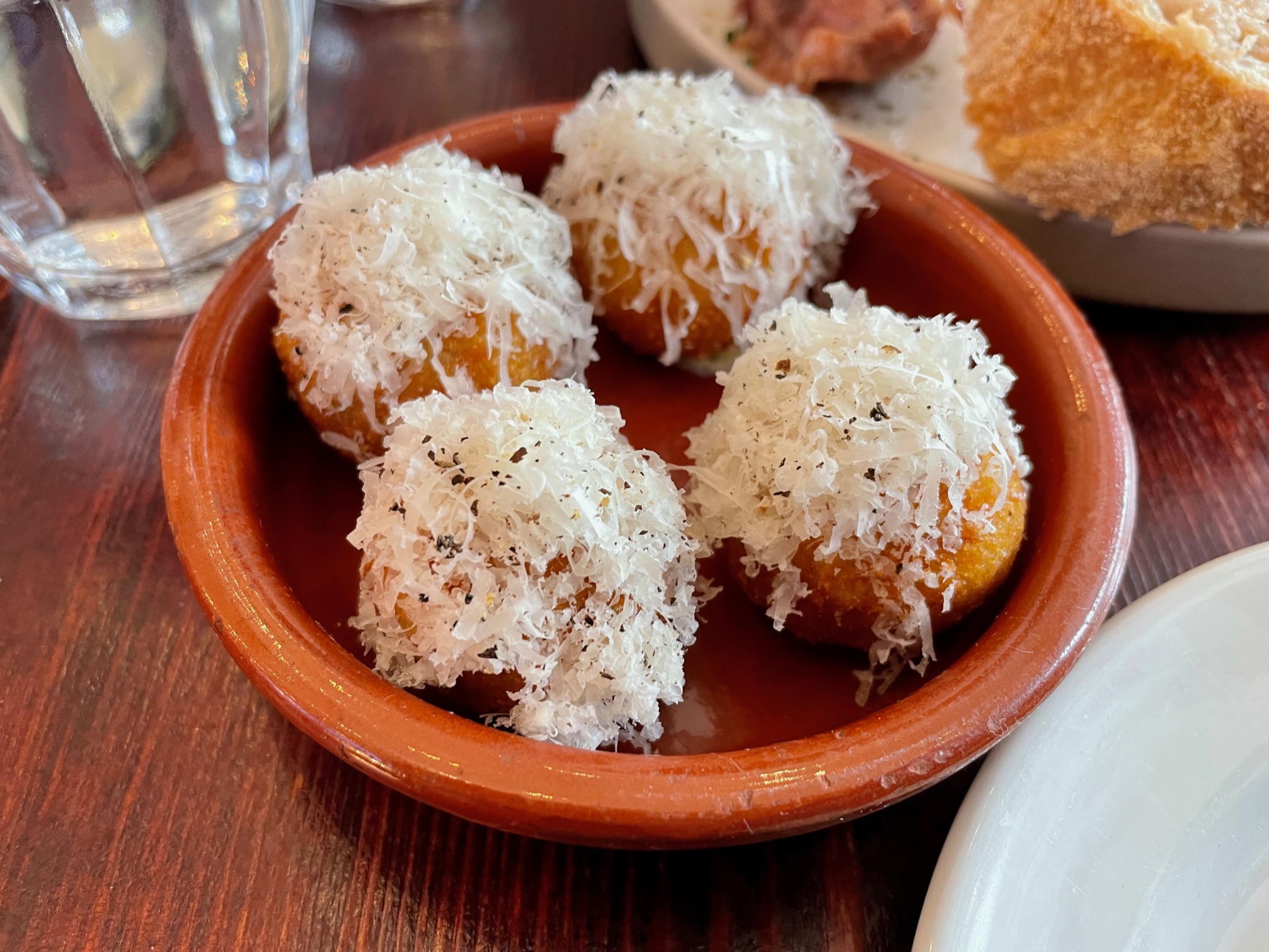
But before we made those agonising yet enjoyable decisions, we tried a couple of things from the snacks section of the menu. Cauliflower cheese croquetas were a real piece of wizardry, with spot on crunch and the smoothest, glossiest core, tangy with cheese and the sweetness of cauli. Each of them sat under a little Johnsonian toupée of Parmesan, each was stupendous. A ridiculous five pounds for these, and it took all my strength not to order more.
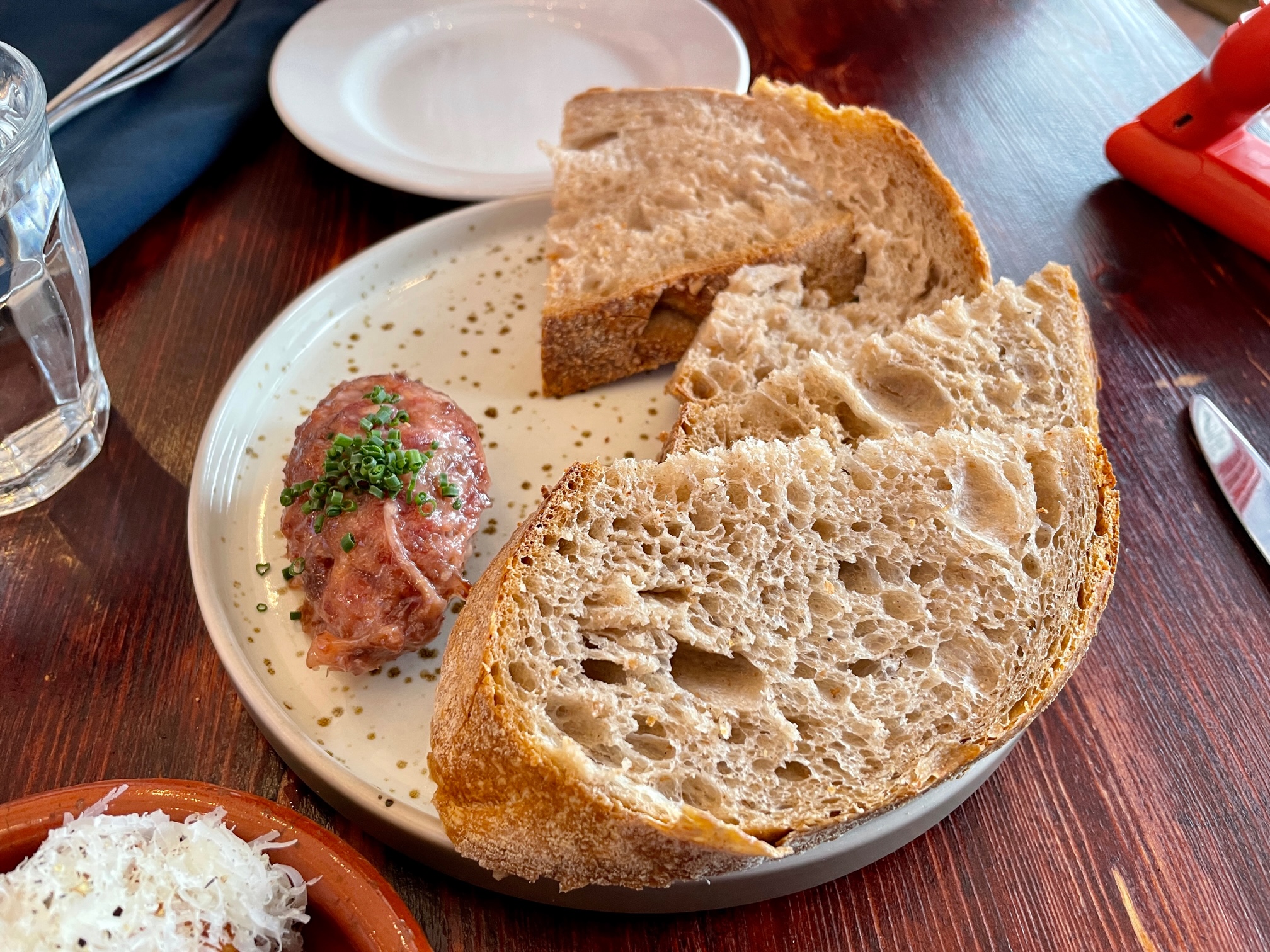
But even better was the sourdough with jamon butter. The words “jamon butter” rather sell short what you got, a quenelle of salty, savoury spreadable jamon with a texture somewhere between whipped butter and rillette. It was one of the most moreish things I’ve eaten in years, and if they’d sold it over the counter I’d have walked out of the restaurant at the end of my meal with a tub of the stuff the size of my head, knowing full well that it wouldn’t survive the rest of the weekend.
The bread that came with it was decent enough, but its one role was to provide a vehicle for eating the jamon butter that was more civilised than just devouring the stuff with your bare hands. If I’m being ultra-critical, one of the slices of bread was as much air as bread and if I’d been in the kitchen I wouldn’t have served it. But it upped the jamon butter to bread ratio, so it wasn’t all bad.
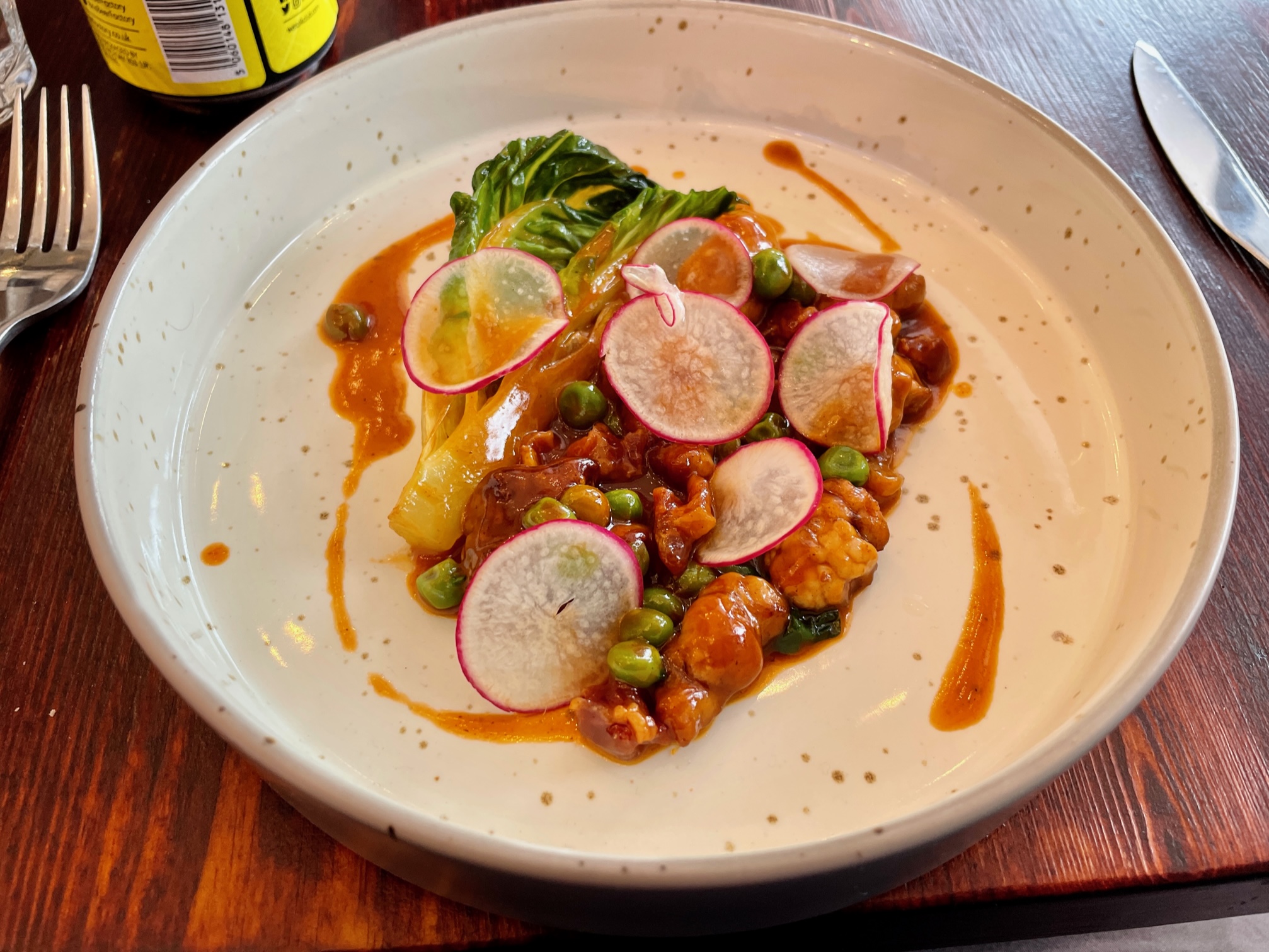
A high standard had been set, and the starters just vaulted over that as if it was nothing. I’d chosen the sweetbreads, because I love them and they don’t turn up on menus in this country anywhere near often enough. Caper and Cure’s might well be the best I’ve ever had: pert and tender, in a dish where they played the starring role but with excellent support. That meant fresh, nutty peas, translucent slices of radish and some braised baby gem, but more importantly it meant a chicken butter sauce bringing the whole thing together triumphantly. It supplied another intense umami hit, fortified with little nuggets of pancetta just in case you weren’t having enough fun already.
As we discovered over this and our other dishes, Caper and Cure specialises in those high-gloss, super-reduced sauces that speak of patience and expertise. Having finished my starter I was frustrated to see far too much sauce still in the high-sided bowl, but without prompting one of the wait staff asked if I needed some more bread. I didn’t think twice, and Caper and Cure’s bread with the remnants of my chicken butter sauce was, on its own, tastier than ninety per cent of the starters I’ve eaten in nine years of writing this blog.
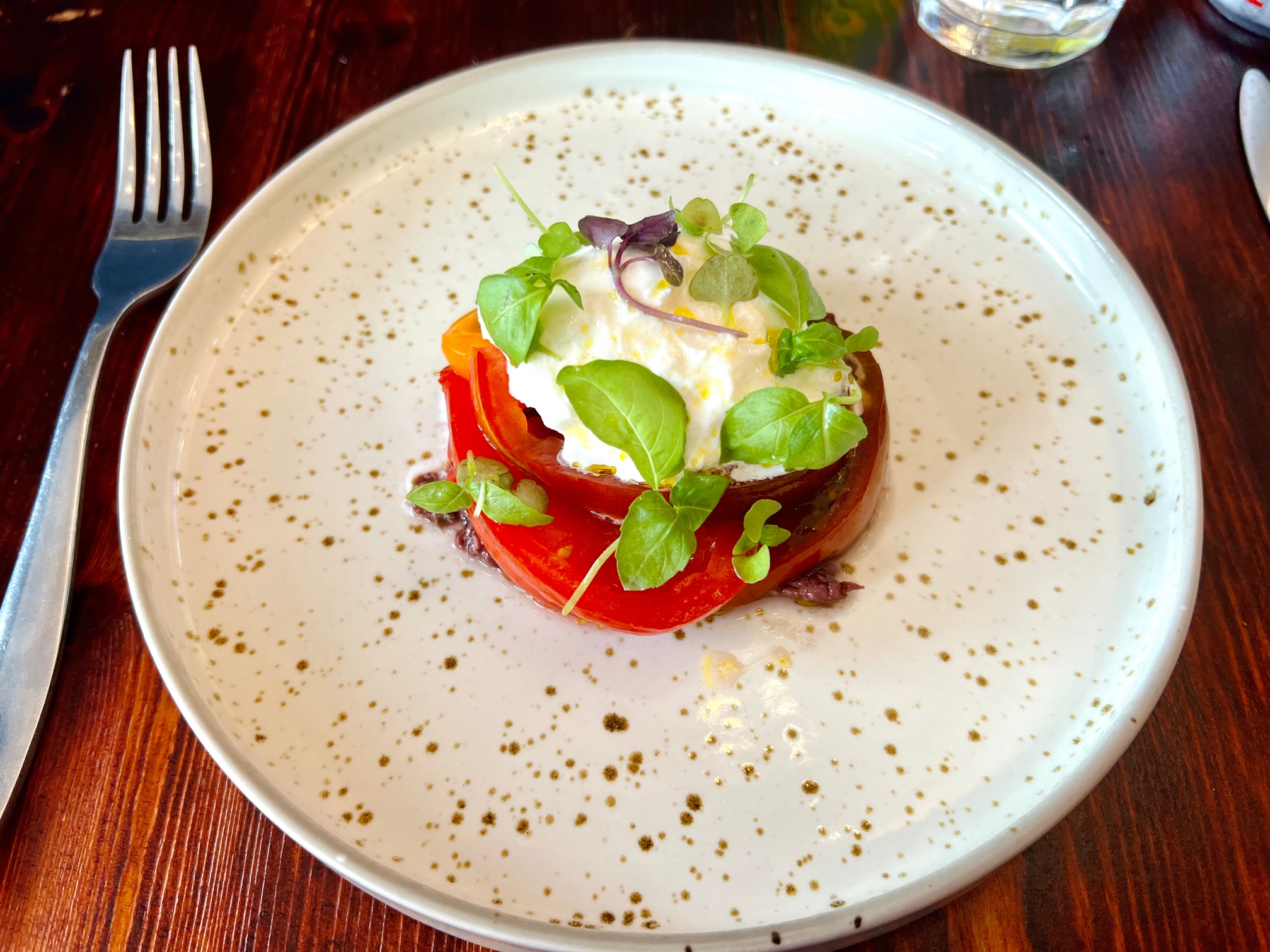
Zoë was equally happy with her decision to order the burrata. It’s an ever-present on menus now, but I doubt many restaurants pair it with tomatoes quite as good as these (from the Isle Of Wight, of course). And more importantly I doubt many restaurants plonk the whole thing on their own exemplary tapenade, with the perfume of deep purple olives. I had a forkful of this, and although I couldn’t have not ordered the sweetbreads it also had much to admire.
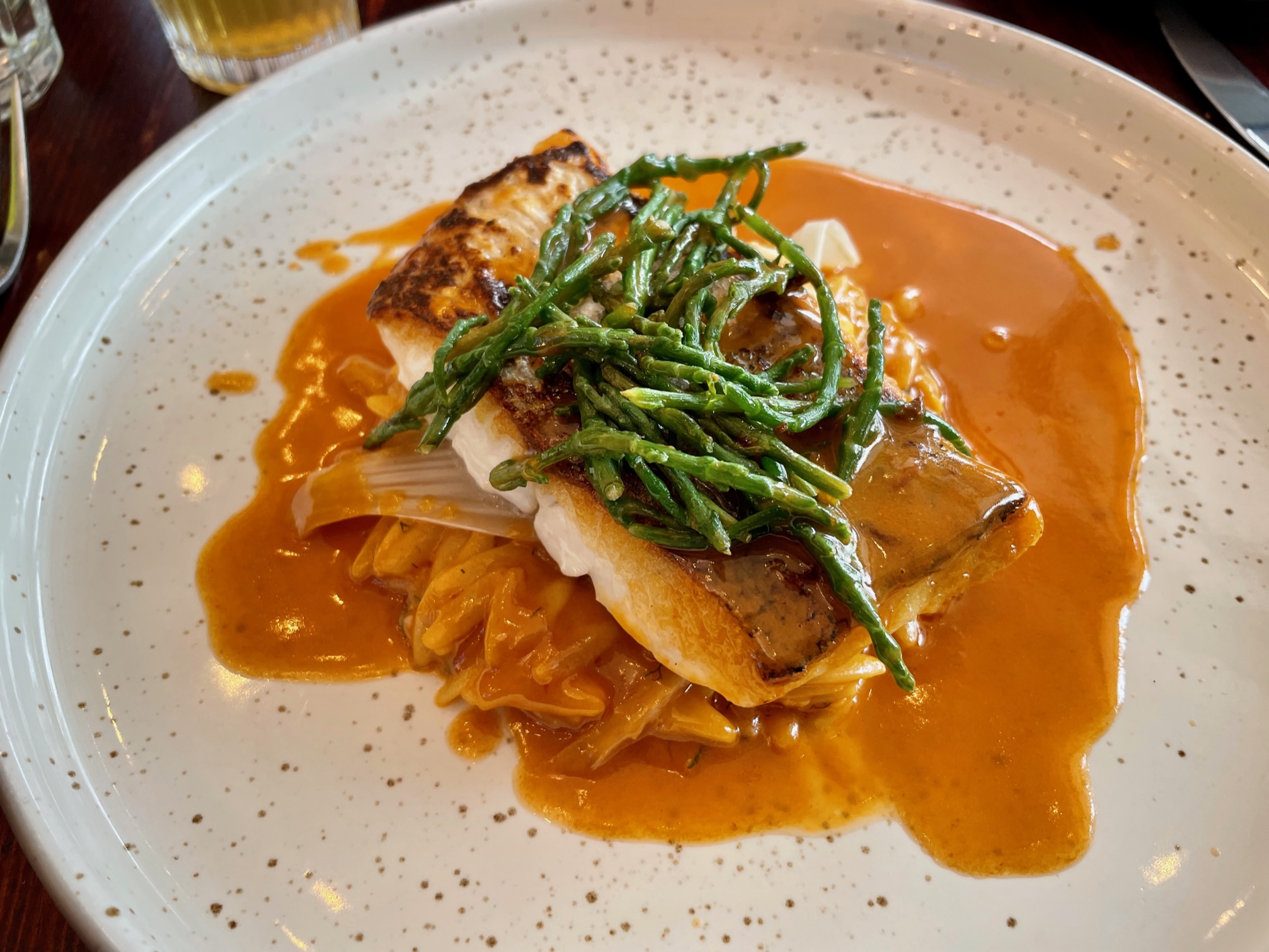
By this point I knew beyond doubt that we were in very good hands, and the only remaining question was just how special the rest of the meal might be. Our main courses answered that question emphatically. Hake, one of the two market fish on the blackboard, was cooked just right and perched on top of an absolutely glorious layer of pickled fennel, just sweet enough and just sharp enough: I’ve never had pickled fennel before, and now I’m just counting the days until the next time.
A tangle of samphire heaped on top added a little saltiness and if the skin wasn’t as crispy as I’d have chosen, that was probably because the whole thing was swimming in a superbly glacé lobster sauce. It wasn’t all perfect, mind you; I’d personally have liked the orzo, the base of the dish, a little closer to al dente and the lobster sauce was more muted than it could have been. But those would have been minor niggles at the best of times: on such a successful plate of food, coming in at a ludicrous twenty-one pounds, they were just the only things I could find that fell short of flawless. It was still one of the most marvellous dishes I’ve eaten all year.
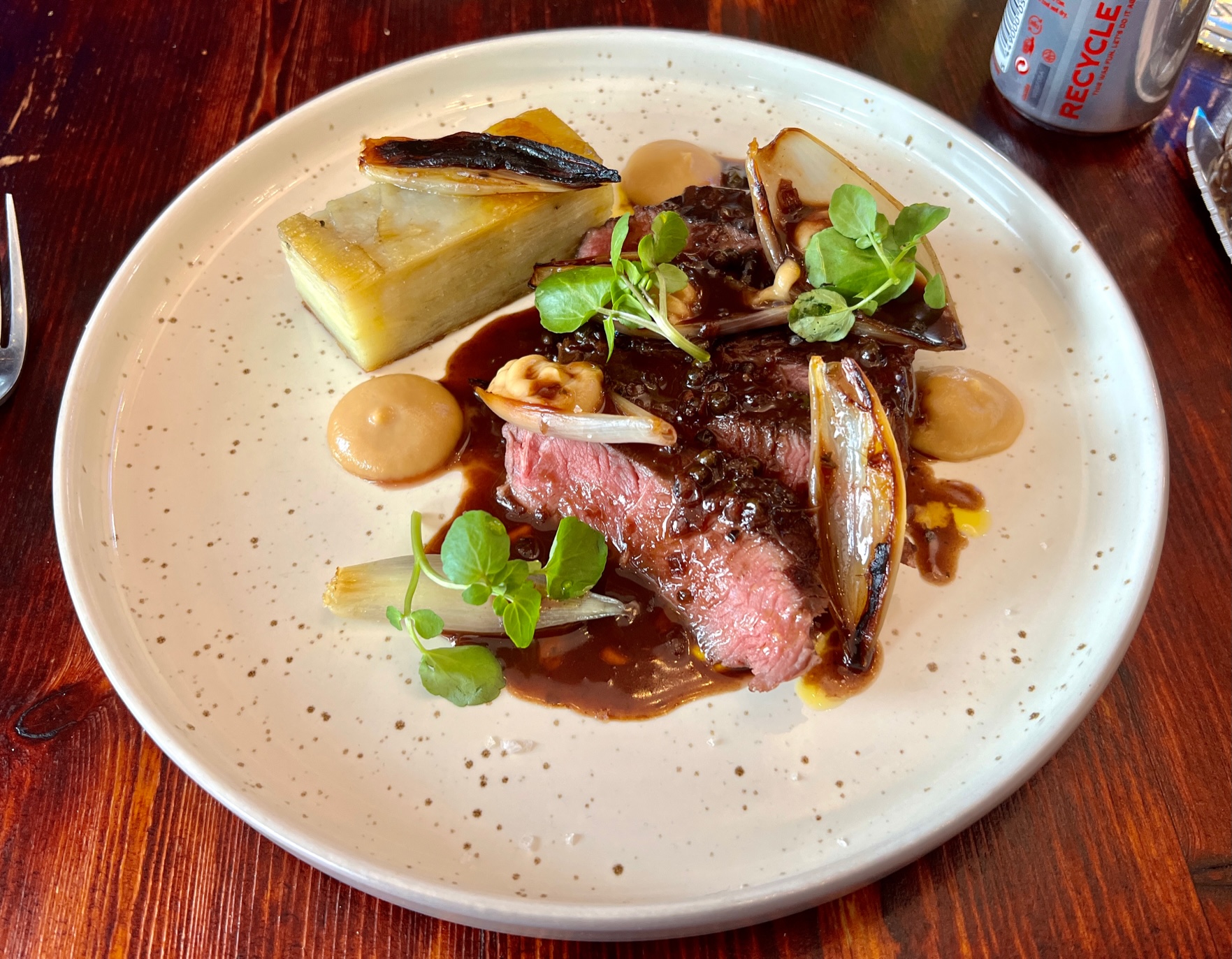
Zoë had absolutely no reservations about her rump of beef, and the couple of forkfuls I had were easily enough evidence to understand why. It was a beautiful piece of meat, cooked medium-pink but with a nice crust, but again it was all about how that ingredient played nicely with the delightful company it was keeping. In this case that meant another sticky, glossy sauce – peppercorn this time – little puddles of onion purée and banana shallots, also with a little char. And to add a little ballast, a perfect slab of Pommes Anna, as enticing and multi-layered as a great novel. This might have been one of the most marvellous dishes I didn’t eat all year, but at least it went to a truly deserving home
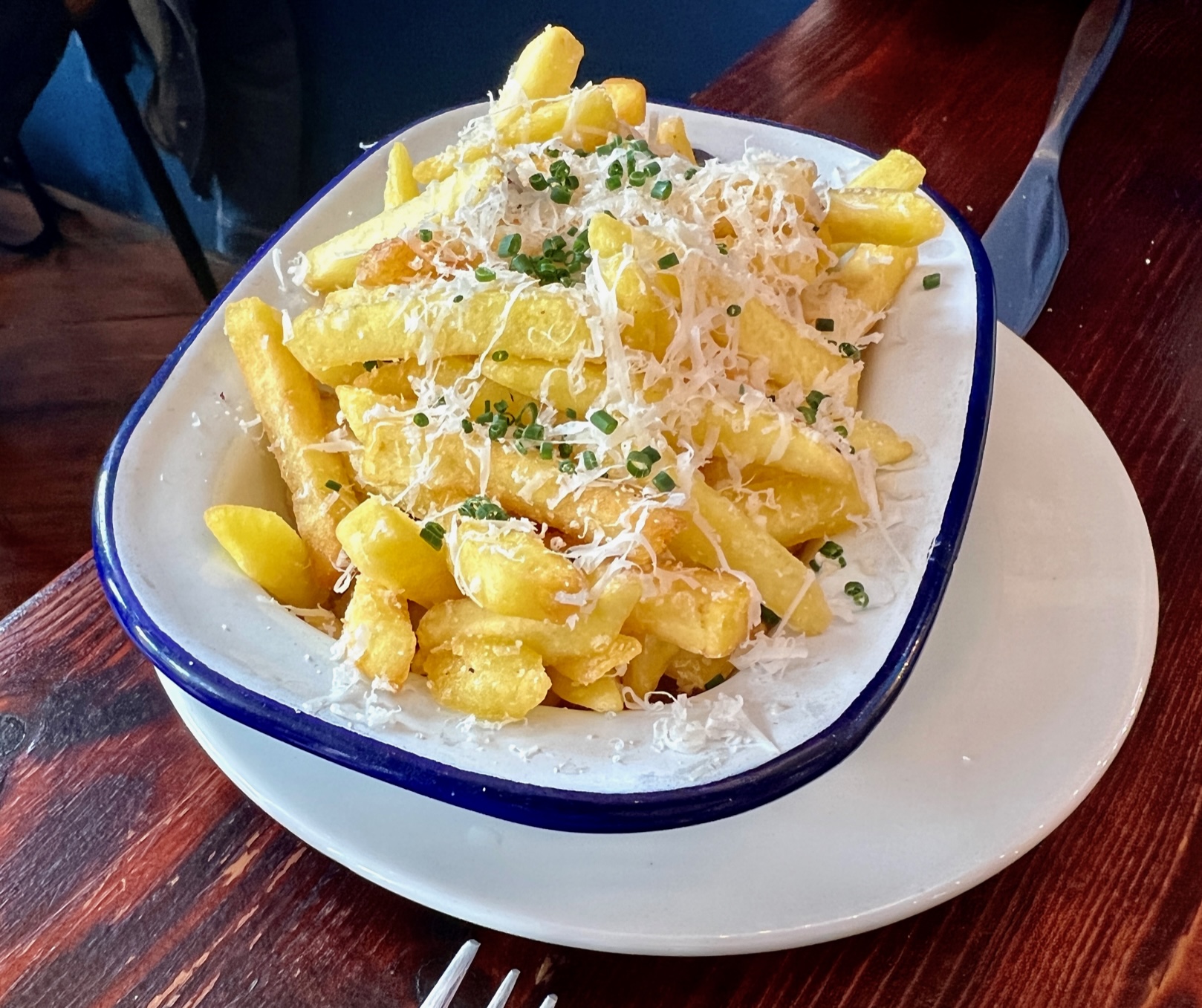
We had some Parmesan and truffle fries with our mains – completely unnecessary but also impossible to resist – and they were themselves a fascinating experience. It’s a dish that crops up on menus a lot lately, from Buon Appetito to the Last Crumb and beyond, but in most places it’s a way to tart up bought-in French fries and flog them for a fiver. Here they were the real deal, and when we’d finished our mains and used the fries to clean up the last of our respective sauces we picked at the rest with slightly oily fingers and glad hearts.
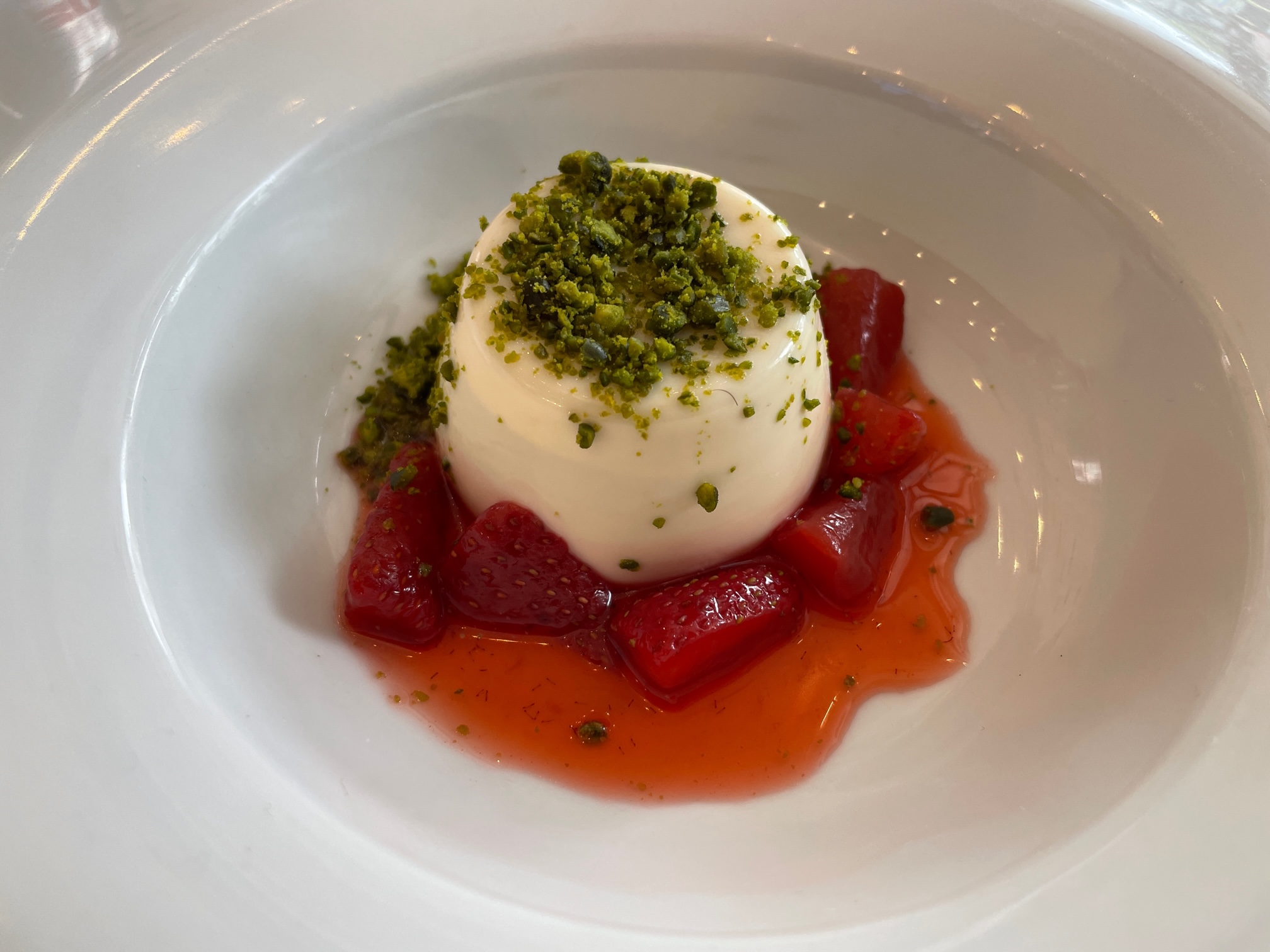
Dessert was the point at which things stopped being spectacular and settled for merely being rather good: technically there are only really two desserts on the menu along with a couple of cheeses and chocolate sorbet with coffee liqueur which felt like a distant cousin of the affogato. I rather liked my panna cotta, which had a pleasing wobble, tons of crumbled pistachio on top and a moat of strawberries and sweet syrup. But the advertised wild honey was the quietest of whispers, and without it the whole thing felt a little run of the mill.
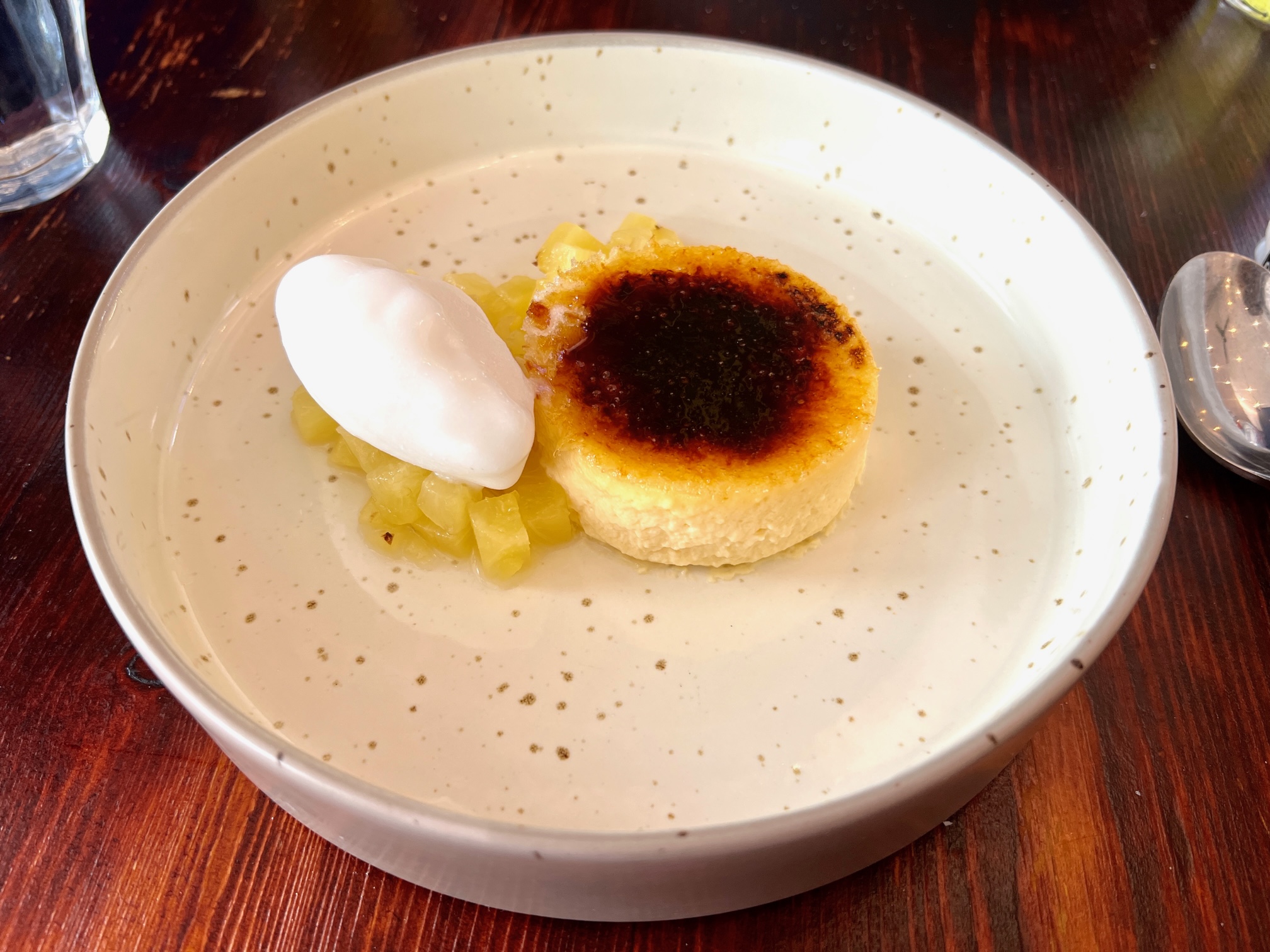
I thought Zoë chose better than me, but she wasn’t wild about her choice either. A rum brûlée was served denuded of a ramekin – how often does that happen? – with plenty of pineapple and coconut sorbet. I liked it, although again the rum was a little muted, and I thought it all worked well together. Zoë was less convinced, and I think on another day would have had the chocolate sorbet. But we were both being restrained, with a boozy evening ahead and (in my case) a gin sodden one behind me, so we steered clear of booze.
That means I can’t tell you anything about the wine list, which is a matter of some regret for me as it had plenty to appeal – and three special wines available by the glass, including a Georgian orange wine by Tbilvino which sounded well worth trying. But instead I’m afraid we were well behaved – I had a very good alcohol free pale ale by local Bristol Beer Factory and Zoë had soft drinks. Next time I go, which I anticipate will be the next time I visit Bristol, I’ll try it properly.
I haven’t really talked about service, but it was very much of a piece with everything else: smooth, efficient, friendly and good at making everything look easy. Offering me some bread with my starter was a great example, but really the whole thing seemed effortless. Caper and Cure wasn’t as busy as I expected but it had a real mixture of tables and types of diners, with more people coming in for lunch as we were leaving, and the whole thing had a nice flow and rhythm to it. I imagine it would be a truly enchanting place to have a boozy evening meal with friends, and next time I go there that’s exactly what I plan to do.
Our bill came to a hundred and twelve pounds, including a twelve and a half per cent service charge, and when the owner came to take our payment I pointed out that they’d slightly undercharged us. Before we left he asked where we came from, and if he was fazed that people had come all the way from Reading he concealed it well; I looked him up afterwards, and it turns out he’s also a professional actor (“you can just tell” said Zoë as we ambled up the Cheltenham Road in search of caffeination).
This is the second critically acclaimed Bristol restaurant I’ve visited this year, and the contrast with Sonny Stores couldn’t have been more marked. Restaurant critics like to talk about Bristol growing these restaurants – small, unpretentious places with short, magnificent menus and interesting wine lists – as if in a laboratory. And it’s true that the place is a Petri dish for culinary creativity, more than anywhere I know.
But I think it doesn’t do Caper and Cure justice to make it sound like just the latest place to fall off some gastronomic assembly line. There’s something uniquely special about it, and re-reading this review I’m not sure I’ve truly captured it in what I’ve written. It’s worth going to these places, even if they’re an hour and a quarter away by train, to remember what we have to aim for in Reading and that for all the Kungfu Kitchens, the Bakery Houses, the Lyndhursts and the Clay’s we still have some distance to travel.
If a restaurant like Caper & Cure opened in Reading it would be packed to the rafters every night and lauded as far as the eye can see. And yet in all the time I’ve been writing this blog, the best part of a decade, nowhere even slightly like Caper and Cure has opened here. At some point, we might all have to stop and think about why that is. Reading has the money, it has the prosperity and it has a discerning demographic. Why don’t we have the restaurants?
Caper and Cure – 9.2 The Old Chemist, 108a Stokes Croft, Bristol, BS1 3RU 0117 9232858

 Edible Reading