As of September 2026 Tanatan appears to be closed – possibly for maintenance, possibly for good.
Some restaurants wind up so indelibly linked with the buildings that become their homes that years later, long after they are gone, you still can’t imagine another menu outside, someone else trading behind those doors. Sometimes, no other restaurant even tries: ever since Dolce Vita left its spot on the top floor of Kings Walk nobody has taken its place, but even if they did, I don’t know how I’d feel eating somewhere that, to me, will always be Dolce Vita.
Sometimes the place stays the same but changes hands, with or without changing its name. At some point I should return to Namaste Kitchen, and people tell me it’s good, but without Kamal running the front of house and that magical menu of Nepalese small plates I’m not sure how I’d overcome the strangeness of dining there. I’ll do it, one day, and when I do the review will have to have a different preamble to this one, because this one’s taken.
Ditto Spitiko, where Kyrenia used to be. The site’s the same, the menu is similar, the furniture might be too, and Spitiko may well be a perfectly decent restaurant. But in my mind it will always be Kyrenia, the place where I celebrated my thirtieth birthday, where I’d always go for mezze and kleftiko, for a bottle of Naoussa Grand Reserva and Ihor’s twinkliest welcome. Its golden age was over fifteen years ago, yet I remember it like it was yesterday.
That’s before we get to the Lyndhurst, now under its third set of new management since they hosted guests for the very last time – my wedding guests, no less. This may sound silly, but I don’t feel ready to eat there again. Perhaps this sentimental streak should disqualify me as a restaurant reviewer. But on balance I don’t think so: these places get into our hearts, occupy a place in our affections, become part of our story. Not to feel that kind of thing is not to be alive.
But of course, nearly every restaurant was once somewhere else. Buon Appetito, that I still miss, may have become Traditional Romanesc, but before that it was Chi Oriental Brasserie. And again, when Chi closed I was devastated. You know where else Chi Oriental Brasserie used to live? The site that’s now Masakali. And I was sad when Chi left that spot on the TGI Friday roundabout, too, but I was equally forlorn when San Sicario, a wonderful restaurant, gave up the fight at that very location.
All these places come and go. They make your day one month and break your heart the next: that’s what getting attached to a restaurant can do to you. Worse still, throughout it all TGI Friday has been plugging away on the other side of that roundabout for as long as I can remember. I wonder if restaurants have their own version of that well-worn maxim that only the good die young.
All this might go some way towards explaining that although new-ish Indian restaurant Tanatan opened on London Street last December, it’s only on a week night in July, months later, that I went there with my oldest friend Mike for dinner. Because even though the site was an empty shell for over two years, before that it was Clay’s Hyderabadi Kitchen, and it’s still hard for me to think of it as anywhere else.
Clay’s, where I ate for the first time before it opened, where I celebrated birthdays – mine and theirs, as it happens – where I went on random evenings because it was just round the corner from my little house, where I ate with friends, family and visitors, where I held lunches for my readers. Few rooms contain as much of my personal history as that one, so I knew it would be odd to eat there again, to eat Indian food there at that, and to know that it was somewhere new.
Tanatan’s story is a curious one, by the way. In the run up to it opening, the Reading Chronicle trumpeted that it was a high end Indian restaurant which very much seemed like the natural successor to Clay’s. Not only that, but they claimed that it was the first U.K. branch of an upmarket Indian group of restaurants with its other branches in India and Dubai.
That all sounds magnificent, and Tanatan’s website contains a menu full of temptations. There’s only one hitch, which is that there’s no evidence at all that Reading’s Tanatan has any connection to that chain at all. It’s not mentioned on their website, and in fact Reading’s Tanatan, for a long time, didn’t have a website of its own. Now it does, but the menu bears about as much resemblance to the other Tanatan’s menu as I do to Jude Law.
It looks suspiciously as if the Chronicle had flagged the name, put two and two together and come up with five, which is a mistake not even the AI that writes most of its articles would make. So, what was this Tanatan, our RG-based restaurant, like? Was it a worthy successor to its precursor, or an attempt to hop on a bandwagon two years after the bandwagon rolled north, over the river? It was time to brave that all too familiar room and find out.
It’s traditional to say “I love what you’ve done with the place” in circumstances like this, but arriving I was struck by how, really, Tanatan had done next to nothing with the room they had inherited. The walls were still that shade of tangerine that had ruined almost every photograph I’d ever taken, the metalwork at the top of the stairs still canary yellow. Terra cotta pots still hung from the mesh ceiling, the banquette I’d sat at countless times still ran along the right hand wall.
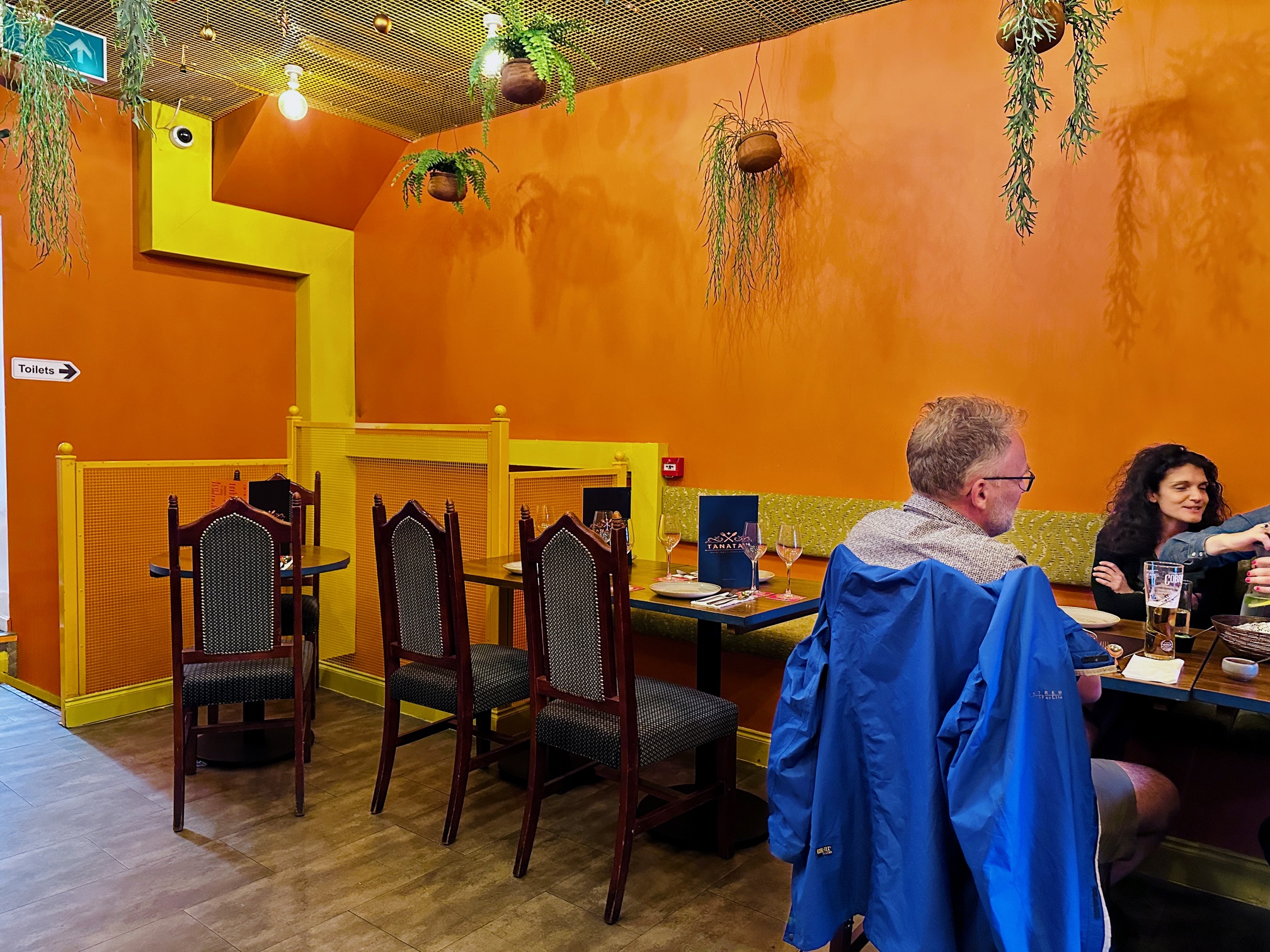
All that was new was the furniture – ugly, high-backed chairs on one side of the dining room, slightly unlovely booths on the other. The lack of a makeover surprised me somewhat, because the building had been vacant for so long between occupants. Did Tanatan open in a hurry, or were they trying to ride on the coat tails of their predecessor by hoping to be mistaken for them?
The room also had an unmistakeable, faintly frowsty smell of damp. Now, I didn’t know this but I bumped into a friend last week that told me that Clay’s, when it was open, had that slight odour too (“I always asked for a table upstairs”, he said). I never noticed it back then, but I guess two things that would have masked it were plenty of nice-smelling people and plates of fragrant food. And after all, even heating up a Clay’s At Home baghara rice could make your kitchen smell gorgeous for days. But on the night I visited Tanatan only one other table was occupied, although a couple of other diners came in after me.
Mike was already installed at a booth (“I got one with good lighting” he said, ever helpful) and – a nice touch, this – a bowl of complimentary poppadoms was on the table in front of us, with a greenish raita and a chutney that tasted of mango despite its colour being closer to ketchup. Both were lovely, and we ordered a pint of Kingfisher each as we chatted about how best to tackle the menu. In a nod to the more conventional curry house Tanatan offers Cobra and Kingfisher; I still haven’t worked out which I prefer, or what the difference even is.
Conventional also described Tanatan’s menu. The restaurant’s slogan is “where India’s spices dance”, and that might be true, but they’re not busting out any lesser-known moves. The menu was a step above the really entry level pick-your-sauce, pick-your-protein curry house, but only just. Korma, jalfrezi, dhansak and saag were all there, without much in the way of regional dishes; if you’re looking for something off the beaten track Tanatan might not be the place for you.
As so often nowadays, there was also a decent selection of Indo-Chinese dishes, although it didn’t have its own section on the menu. Starters ran in the main from six to ten pounds, mains stayed south of fourteen. The slightly disappointing range of the menu, though, wasn’t the main thing I noticed about it, because reading it truly made me feel like I was taking a day trip to the uncanny valley. Some of the menu items seemed to have been written by some kind of nightmarish fusion of Google Translate and ChatGPT.
For instance, I can’t think of any other reason why you would call onion bhajis Onions Crispy Fritters or chicken samosas Chicken Golden Crisp Pastry. In each case the dish’s actual name was written underneath in small print, after a prefix saying ‘Popular name’. If the name was that popular, why weren’t they just using it? It was like referring to Michael Caine as Maurice Micklewhite, only even weirder because at least that was Caine’s actual real name. But would anyone ever say, in real life, that they were gasping for a chicken golden crisp pastry?
It was so cack-handed that it was almost endearing, especially when the names of dishes took a turn for the chaotically poetic. I’ve heard chilli chicken called many things, especially Kamal’s Kitchen’s version the morning after, but The Fiery Phoenix? Actually, come to think of it that was a nicely euphemistic description of its consequences. And then there was my personal favourite: fish pakora was billed on the menu as Oceanic Crisp Delights, which sounds like the name of a Guided By Voices album track.
Anyway we began with some familiar but less mainstream dishes, for me to try and benchmark Tanatan – not just against Clay’s, but against plenty of Reading’s other Indian restaurants, the likes of Chilis, House Of Flavours and Deccan House. Chicken 65 is a go-to for me, and Tanatan’s rendition of it was a good statement of intent.
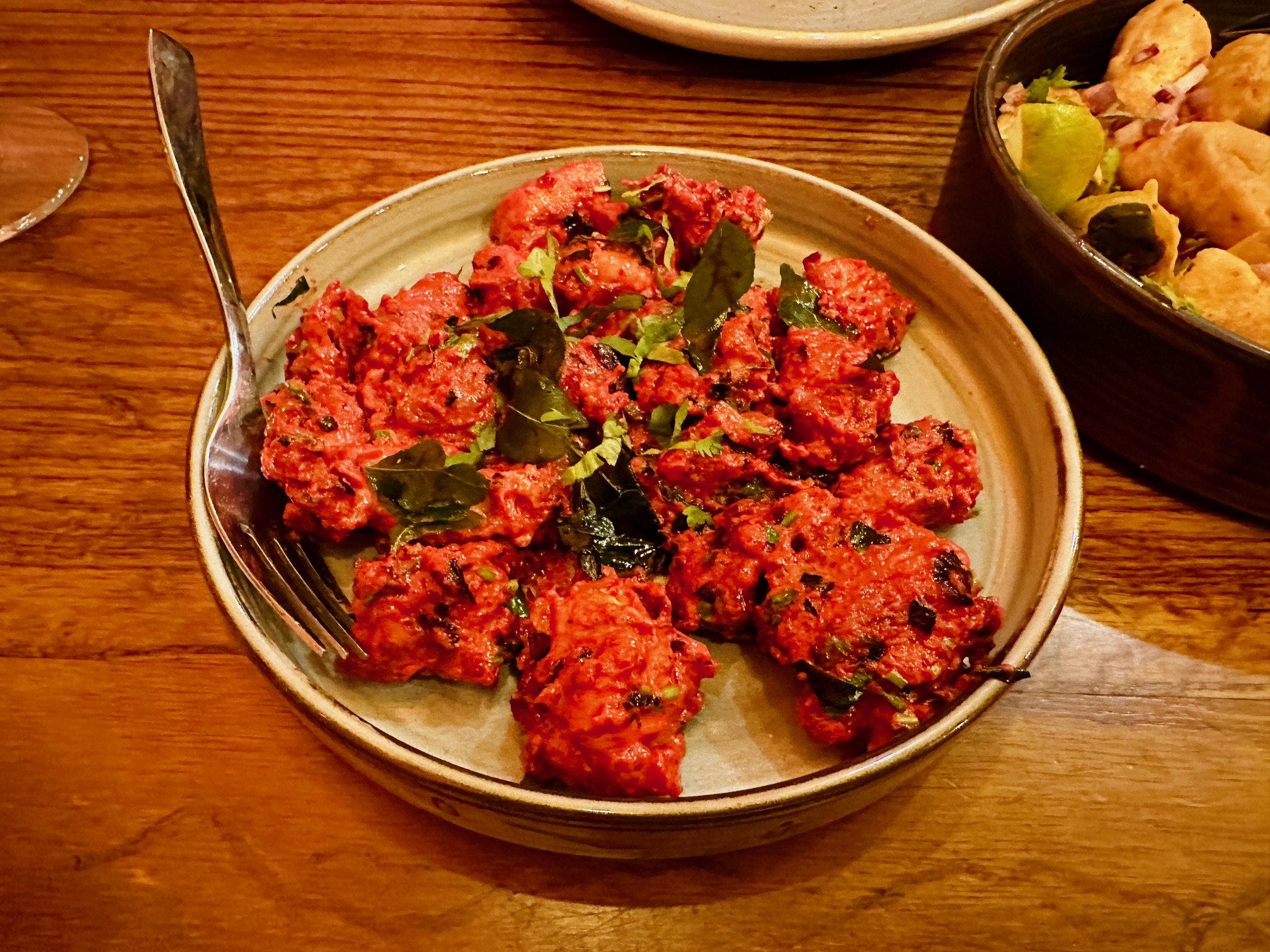
It got that sticky, savoury spicing bang on, and was less disconcertingly scarlet than my photo makes it look: Apple hasn’t yet discovered a filter for This photo was taken in a bright orange room, can you make it look normal please? The chicken felt like it had been marinated in yoghurt to within an inch of its life, and if I had one criticism it was that the texture sometimes was so soft that you weren’t entirely confident it could be completely cooked. I would have liked it a little drier, with a tad more char, but the flavour was unarguable.
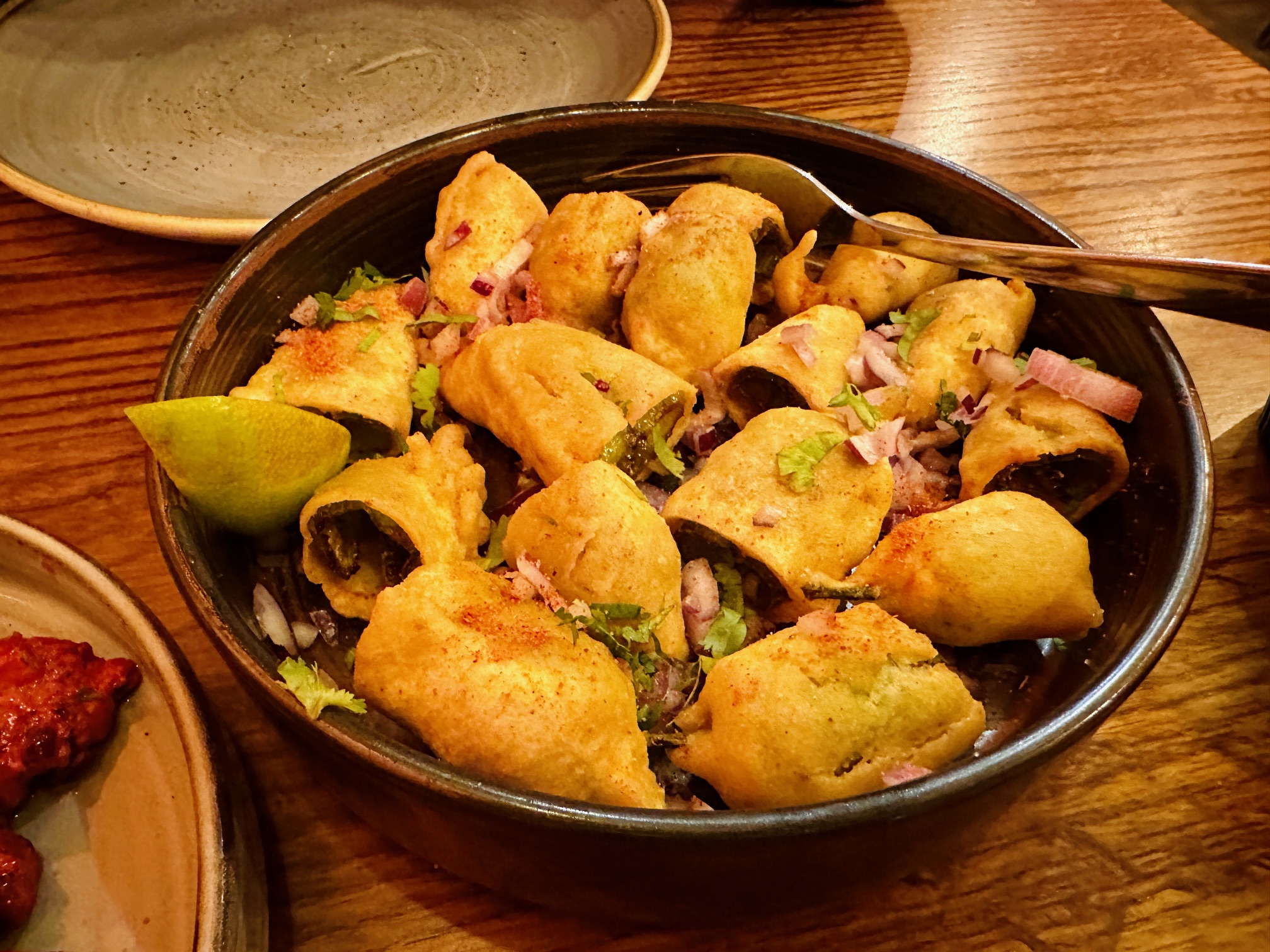
Our other starter, mirchi bhaji (unpopular name: crispy chilli fritters) was similar on paper to the cut mirchi I’ve had at Clay’s and Deccan House. In practice, though, it was different: the chillies, which were potent, had rather shrunk away in their jacket of spiced gram flour batter. But even with that said they were golden, crunchy, pretty fiery and immensely snackable and I enjoyed them a great deal with some more of that raita.
Despite it being a quiet night in the restaurant, pacing was leisurely and so it wasn’t until about forty minutes and another pint of Kingfisher later that our mains came out. But I was fine with that: Mike was back from his adoptive hometown of Madrid for a family visit, something he only does a few times a year, and even though I’d already seen him on this trip there was no shortage of stuff to chat about. There never is.
After all, we grew up, or rather didn’t, on the same street in suburban Woodley, over forty years ago. We played tennis in the road between our houses, the cracks in the tarmac serving as nets and baselines. We cycled to school together, bags slung unsafely over our shoulders. We went to university, dropped out (in his case), went back (also in his case) and have known each other for an exceptionally long time across all sorts of adventures and misadventures.
So, both still alive, both still relatively sane, it was a delight to sit there between courses and shoot the breeze – about his parents and mine, his brother and mine, about what the year had held so far and what lay ahead.
I thought the starters had held promise but not entirely delivered on it, and although I was hoping the mains would buck that trend they stayed firmly on it. Mangalorean prawn curry, one of the less generic dishes on the menu, went heavy on the coconut and had an interesting combination of heat and sweetness. But I found it disconcerting: a huge pool of extremely thick gravy, the consistency of Greek yoghurt, with surprisingly small prawns lurking in it.
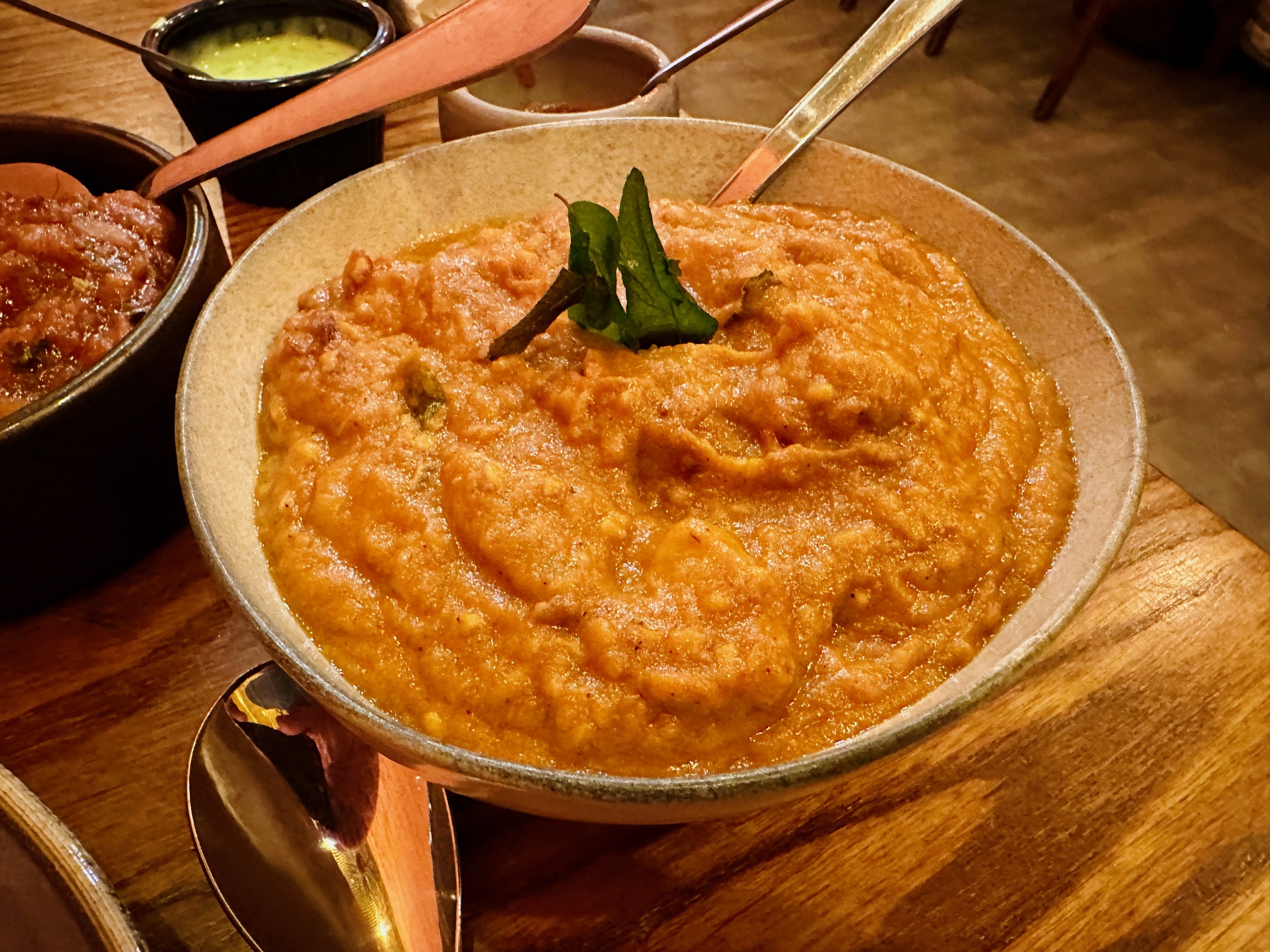
The ratios felt all wrong, as did the lack of anything else like veg to break up what was texturally quite mulchy: if it wasn’t prawn, it was sauce, and usually it wasn’t prawn. This dish wasn’t what I expected in the slightest, but I’m not sure my expectations were the problem.
Our second choice was more successful. Again, trying to steer clear of anything even remotely interchangeable, we’d opted for the Andhra lamb keema, partly also because I have a real soft spot for keema curries and think they’re often the most underrated thing on an Indian menu. I think I was right about that at Tanatan, at least, because this was miles more enjoyable than the prawn number in every respect. The lamb was very coarsely minced, so much so that it could have been finely chopped rather than put through a mincer, and that texture worked in terms of distributing flavour and, just as crucially, fat.
The whole dish felt like a coherent whole in a way that the prawn curry hadn’t, and was so much more fun to load onto bread or to fold rice into. The rice, jeera rice by the way, was perfectly pleasant but very light on the cumin (you’ll have to take my word for that, because putting a photo of rice up feels pointless).
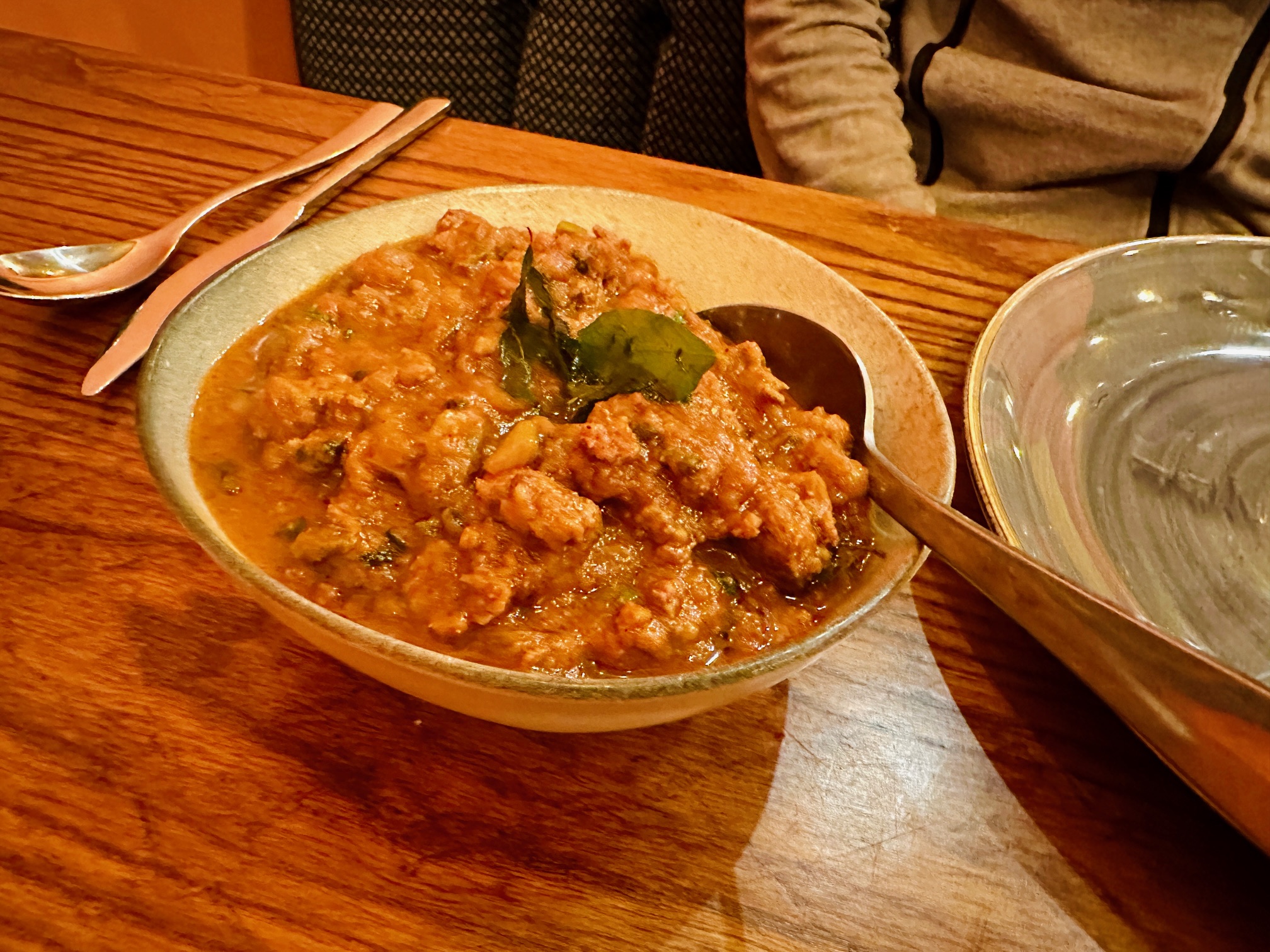
What I will say, though, is that a portion of rice at Tanatan is easily enough for two people to share with some bread, which is to their credit. Also, although this looks a very similar hue to the prawn curry in this photo they were reassuringly different: it’s the fault of those bloody orange walls again.
I’d read somewhere online that Tanatan’s Bombay aloo was worth ordering, and Tanatan offers smaller portions of some of its vegetable dishes as sides, so we gave it a go. This got everything right that the prawn dish had not, a thick, comforting and spicy panacea of a dish with hunks of potato with just enough floury give to them. Great news for vegetarians, yes, but to be honest great news for anybody eating at Tanatan: next time I’d order this as a main.
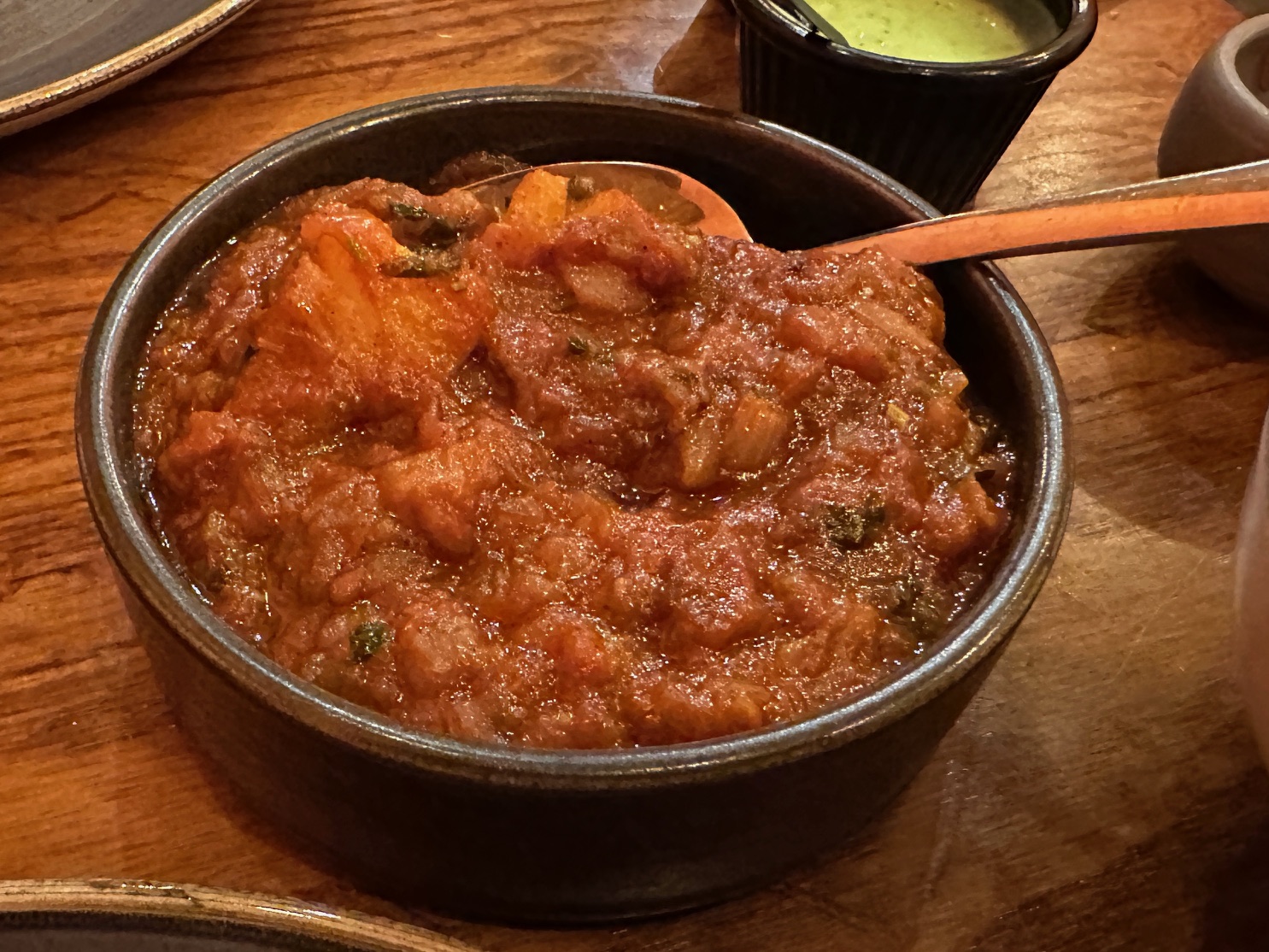
You would think that with a big portion of cumin flecked rice and a curry made predominantly of potatoes we had quite enough carbs to be going on with. And you would be right, but because we were greedy idiots we also decided to attack what was quite a substantial bread section on the menu. Nearly a dozen different types of naan, a few roti and half a dozen or so parathas is a lot, although I found it a bit strange that they had a keema paratha but no keema naan.
I’m also not entirely convinced that the naan in particular aren’t just the same naan turning up in a variety of slightly different outfits. We chose the signature garlic and chilli naan and although I quite liked it, especially the scattering of punchy sliced green chilli, the texture was round and uniform, the whole thing lacking in bubbles, blisters or fluffiness.
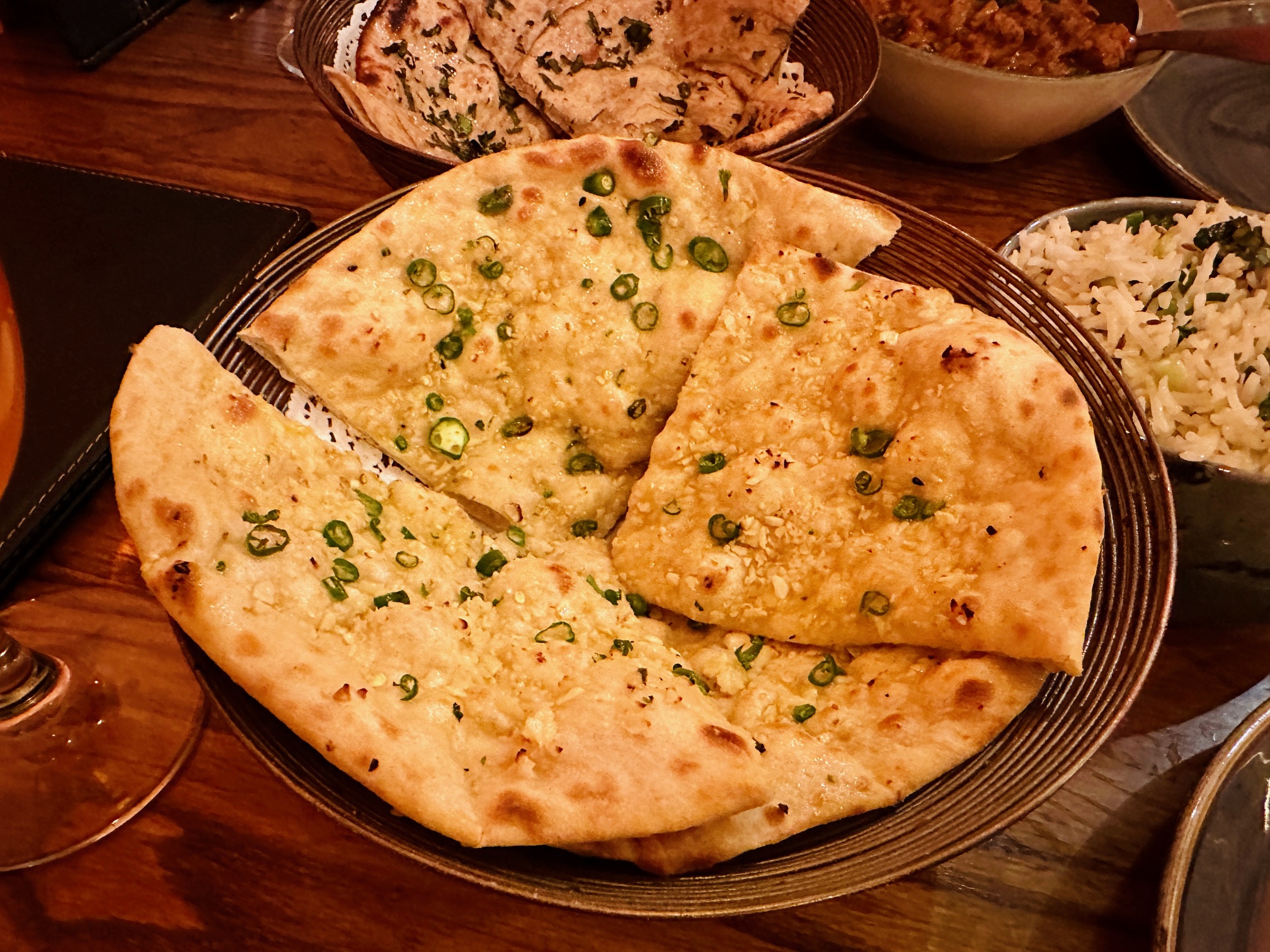
We also tried paratha with mint. Initially when I ordered this our server wasn’t entirely sure they had it, and wandered off to the kitchen before returning and saying that it would be no problem. I assume that what he meant was that the kitchen hadn’t run out of mint, because what we got was a paratha scattered with mint. If there is more to Tanatan’s breads than this you wouldn’t know it, and although this was serviceable it again lacked the flaky butteriness of the very best examples. It wasn’t hugely up to the job of dipping – you couldn’t fault the naan for that – and I didn’t feel an impetus to finish mine.
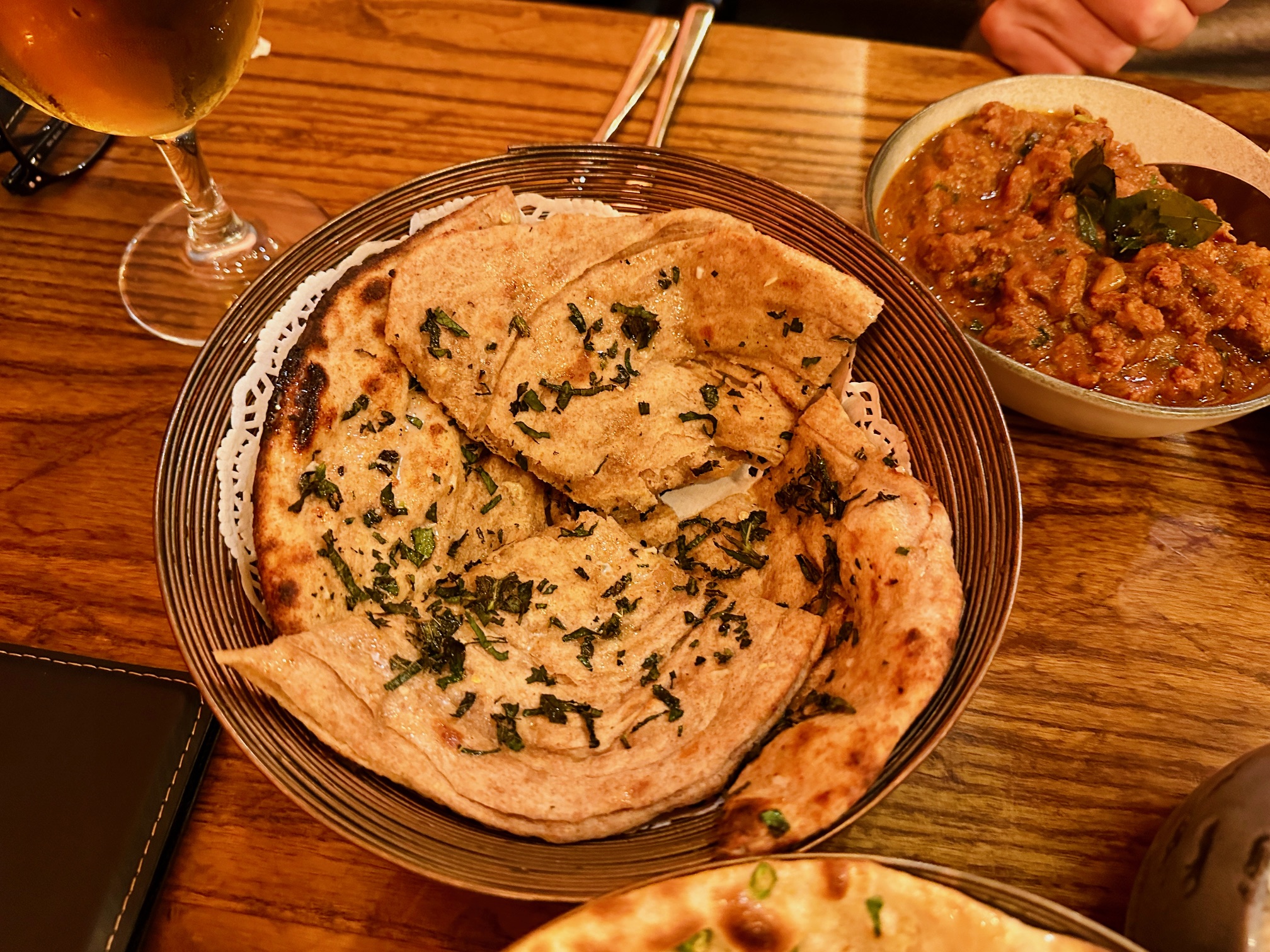
We kept eating until we could tackle no more, at which point, despite the very kind offer of our server, there wasn’t enough left of anything to be worth boxing up. Over two hours had passed by this point and somehow, in that time, I had stopped eating in the place that used to be Clay’s and had finished up eating in Tanatan.
Despite any quibbles about the décor or the odour, that was very much a good thing: I had expected to feel a little sad dining here (still not going back to the Lyndhurst any time soon) but in reality it made me feel far happier about the circle of life that is restaurants outgrowing buildings, if they’re lucky, and being replaced by something new. Some of that was down to our server Tarak, who was tremendous throughout. He was enthusiastic, attentive, explained bits of the menu to us – the concept of chaat was a new one on Mike – and apologetic about the food taking a while, even though we were in no hurry.
As we were settling up I asked him about Tanatan, and impressively he told me that although it opened late last year he had only been there a month. This was the owners’ second restaurant, their first being a place called India Rasoi in Chorleywood. When I asked him why they’d chosen Reading for a sequel the answer was prosaic: one of the three partners lives here. People pick places to open their restaurants for all kinds of reasons, and that’s as good a reason as any. Our bill for two starters, two mains, two pints apiece, rice and breads came to just shy of eighty-two pounds not including tip, which Tarak absolutely deserved.
I’ve had some grief about recent reviews – it’s a story for another time – for comparing places to one another, for visiting Venue A and partly framing it in terms of how it measures up to Venue B. But I think that’s a perfectly reasonable thing to do, because restaurants don’t exist in a vacuum and reviews of them have to sit in a wider context. You cannot talk about Tanatan, really, without talking about its peers, because if you don’t the review just drifts in mid-air, not answering the obvious question. Is it better than X, or Y?
If you don’t answer that question, you dodge the question altogether. It would only make sense not to talk about other Indian restaurants if Reading didn’t have any, and that will never happen. And even if it did, you’d still want to know whether to go here or to take the train to Newbury, or Wokingham, or Maidenhead. So comparisons are inescapable, and good restaurants have nothing to fear from them.
But I’m not going to compare Tanatan to Clay’s, even though I started this review talking about the previous tenants of 45 London Street. That would be pointless: you can’t compare anywhere in Reading to Clay’s, not in terms of Indian food, not in terms of profile or polish, barely in terms of quality at all. I wish more places came closer. And if Tanatan takes custom from other restaurants, despite its orange walls and the very limited makeover it’s given its dining room, it will be from its competitors in the town centre, not from the other side of the Thames.
So actually you need to decide whether you’ll eat at Tanatan – besides satisfying your curiosity or laying your own post-Clay’s ghosts to rest – instead of its neighbour Calico, or Royal Tandoori at the bottom of the road, House Of Flavours round the corner or Chilis in Kings Walk. For me right now, the last of those is the standout in a crowded field, with the others battling it out for the silver medal.
Time will tell where Tanatan finds itself in that chasing pack, and I would love to see it take more risks, widen that menu and, ideally, lose those chairs. But it has a fighting chance, because it gets a few things very right and service is one of them. If they ever do well enough to take a break, my advice to them is to get someone in to redecorate. If it lives up to its potential, you could get all the glow you need from the food, rather than the walls.
Tanatan – 7.4
45 London Street, Reading, RG1 4PS
0118 3049165
This review is exclusively for supporters of the blog – so if you’re reading this, thank you so much for subscribing.


