Restaurant review: M’s Smokehouse

As of October 2026, M’s Smokehouse appears to have closed. I’ve left the review up for posterity.

I’ve talked about this before, but it helps when you’re writing a restaurant review to have some kind of hook, some reason why you decided, this week of all weeks, to check that particular venue out. Canny restaurants make that easy by having something about them, whether it’s in their branding, their social media or their USP – or, in London, by having a well-connected chef or owner.

Big chain opens a branch in a prime location on the ground floor of one of Reading’s most iconic buildings, for instance: that’s a hook. So is Nationally acclaimed restaurant reviewer rather likes this place in Winnersh, or Is Reading’s most expensive restaurant worth the money? On the other hand, Yet another smash burger place opens in town isn’t: not unless there’s potentially something special about it.

In the case of M’s Smokehouse, which opened on the Basingstoke Road at the end of January, you’re spoiled for choice. Its Instagram describes it as the “First and Only Smokehouse in Reading”, which isn’t strictly true – remember Bluegrass BBQ? But Bluegrass closed last January, so the second half of that description is correct, for now at least. I don’t know about you, but I miss Bluegrass: a decent independent alternative in south Reading would be a find.

And there’s more. The smokehouse’s Instagram blurb also describes it as a “halal smokehouse”, and in that respect it is definitely a first: so no pulled pork or sausages, just brisket, burgers and fried chicken. Now, that kind of thing might enrage the swivel-eyed types who used to comment on my blog’s Facebook page, pretending to give a toss about animal welfare, but I thought it was worth checking it out.

The final clincher was a report from one of my readers – via Bluesky of all places – that M’s Smokehouse might be a different beast to the likes of Mr T, Smoke & Pepper, Grilla Kitchen and all those other attempts at viral status. “It was awesome,” my reader said. “I also had a lovely chat with the people running it about how smoking meat well is hard.” That settled it, so on a Monday evening I went for a stroll to investigate.

M’s Smokehouse is at the bottom of a hill, on the same run of shops as attempted viral restaurant Kyaneez, most famous for the videos featuring its eccentric owner, tracksuited and wearing shades, leading a choir of kids in reciting his restaurant’s catchphrase like some latter-day Pied Piper of Hamelin. On a Monday night the difference between Instagram and reality was stark, and Kyaneez was like the Marie Celeste, with no takers for its £10.99 “Munchy Box” or its pizza that claims to be 100% fresh, where the base looks like it’s 100% fresh out of some packaging.

Not that M’s Smokehouse was any busier when I got there. Two tables were occupied, one by what appeared to be a mother and son, laptop out while she had a long argument, on the phone, with her doctor’s surgery about a prescription. The other had a Deliveroo driver at it. It wasn’t clear that either table had anything to do with the restaurant’s food: I’m pretty sure the Deliveroo driver was waiting to pick something up from the big Morrisons down the road.
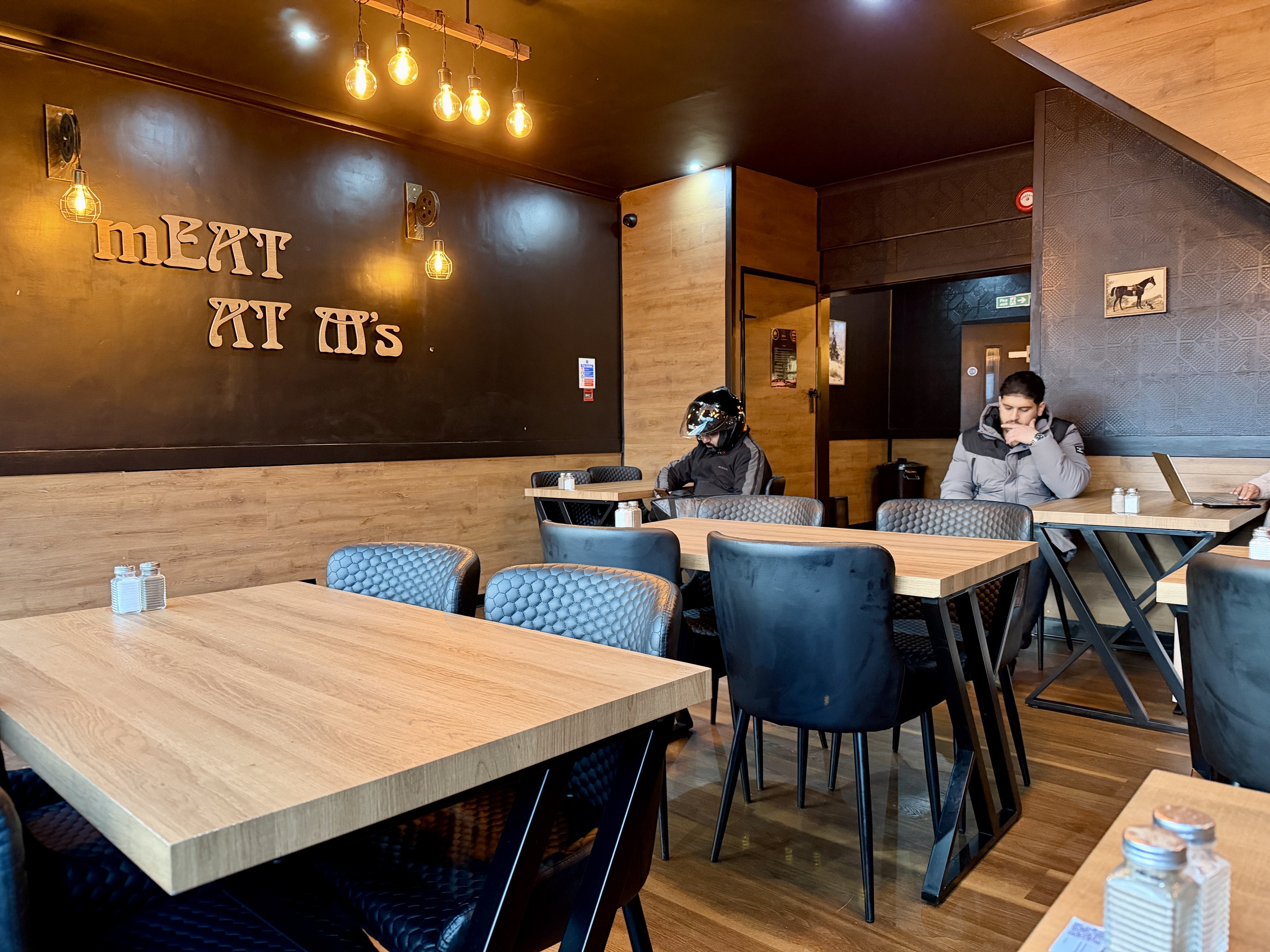
And the room looked – well, it looked like they’d opened in a hurry. Forbidding dark grey walls, pale wood panelling and tables, industrial lighting. It didn’t look like a place to linger and enjoy, although the seats were comfy. It felt like a place where you might wait to collect a Deliveroo order.

A pale wood clock, not adjusted yet for British Summer Time, was the only adornment on one wall. On the other, large letters spelled out mEAT AT M’s, a strange mix of upper and lower case, in the kind of Tolkienesque font last seen on a prog LP cover 50 years ago. Often with the design of a dining room, even if it’s not my thing, I can say “I see what they’re trying to do here” but in this case, really, I didn’t have a clue.

There were no menus on the tables and another weird feature of the layout was that you had to go up to the counter, through a little corridor, to place your order. Again, that created a feeling of disconnection: normally you can see the counter from where you’re sitting and the staff can see you. Without that, the space at the front felt even less like a dining room and more like a waiting room.

Anyway, the menu was compact in the way that always inspires confidence. Just the six burgers, featuring fried chicken, grilled chicken, smashed burgers and the smokehouse’s signature 12 hour smoked brisket, with prices ranging from £8 for a single smashed burger to £16 for the works, with both burger and brisket.

Fries cost extra, and you could either have them as they came or loaded with brisket, fried chicken and so on. Pricing again was a little variable – so, say, you would pay £2.99 for a large fries but to have one loaded with brisket would cost you £13.99.

The only way I could find to benchmark, really, was to compare the cost of a double smash burger with fries to Honest, and on that basis M’s Smokehouse is ever so slightly cheaper. But it doesn’t serve booze and you can’t stick bacon in it, so horses for courses.

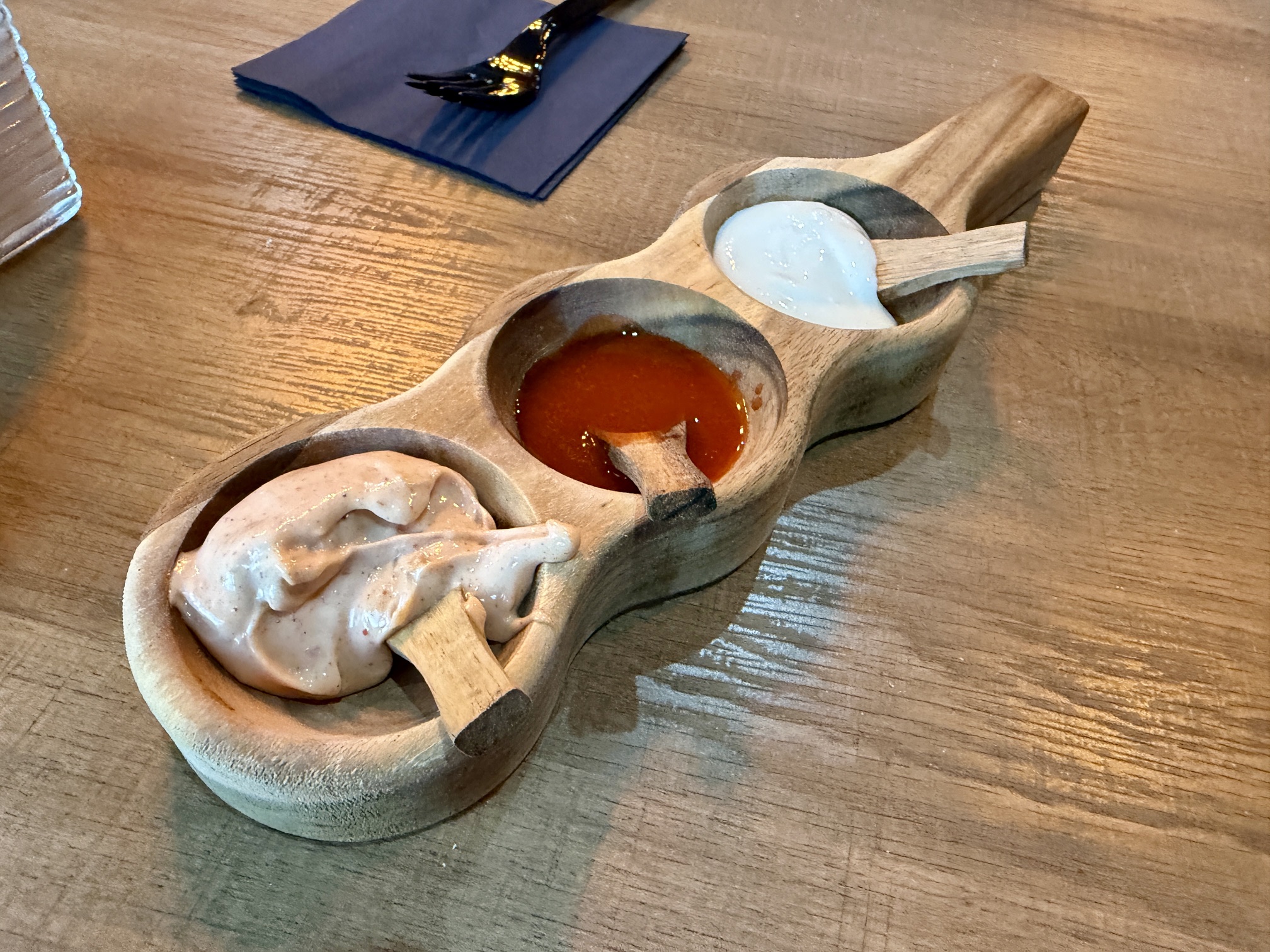
I was having trouble deciding, and the very nice lady behind the counter confirmed that all the burgers and sauces are made onsite, along with the brisket. I was torn between trying the burgers and the brisket so she pointed me to “M’s Signature”, which combines the two. That, some loaded fries and an orange Fanta set me back just under £30, including a 12.5% service charge. And about ten minutes later a chap who I suspect was the chef came out with a little wooden dish containing three sauces.

“That’s our signature sauce” he said, pointing to the one on the left. “And that’s our home-made garlic sauce. And that” – he gestured at the cherry-red one in the middle – “is kind of our take on a Louisiana hot sauce. You don’t have to use much of that one, it’s pretty strong. Although I’m saying that, and I’m a bit of a wuss at Nando’s.”
I got that feeling I get in restaurants when I talk to someone who knows what they’re talking about and cares what they do, the intangible inkling that it would all be okay. So I sat back and waited for my food to arrive. The Deliveroo driver skidaddled to go and get somebody else’s shopping, the argument with the doctor’s surgery continued interminably. Two chaps, clearly regulars, came in and took a table in the opposite corner. That was all the custom M’s Smokehouse was getting that evening, it seemed.

I thought to myself that Mondays, in hospitality, must be the slowest of all possible days: no wonder so many places took it off. Then I remembered that M’s Smokehouse is open, on paper at least, eleven hours a day, seven days a week. And that brought me up short, thinking of the punishing schedule small businesses take on and how, ultimately, I was judging décor and mentally correcting an incorrect clock while sitting in somebody’s dream. I said a little silent prayer, one I’ve uttered many times in the last twelve years: please let the food transcend the room.

Fifteen minutes later, it was answered.

I’d chosen the fries loaded with Nashville chicken, and to say it was enjoyable would have been an understatement. The fries themselves were skin-on and pleasingly irregular. I had a suspicion that they were home made, or at least I was ready to give them the benefit of the doubt: I subsequently discovered, through the restaurant’s TikTok of all places, that they do indeed make them themselves.

They were perhaps ever so slightly wan and limp, partly because they could have stood to be a tiny bit hotter, and partly because they were irregularly slathered in the house sauce, along with cheese that needed more of a chance to melt. Jalapeños added some crunch and piquancy and a very decent coleslaw was served, Sally Albright-style, on the side; so different from my experience at Smoke & Pepper where they dumped the coleslaw on top of the fries, to pad them out.
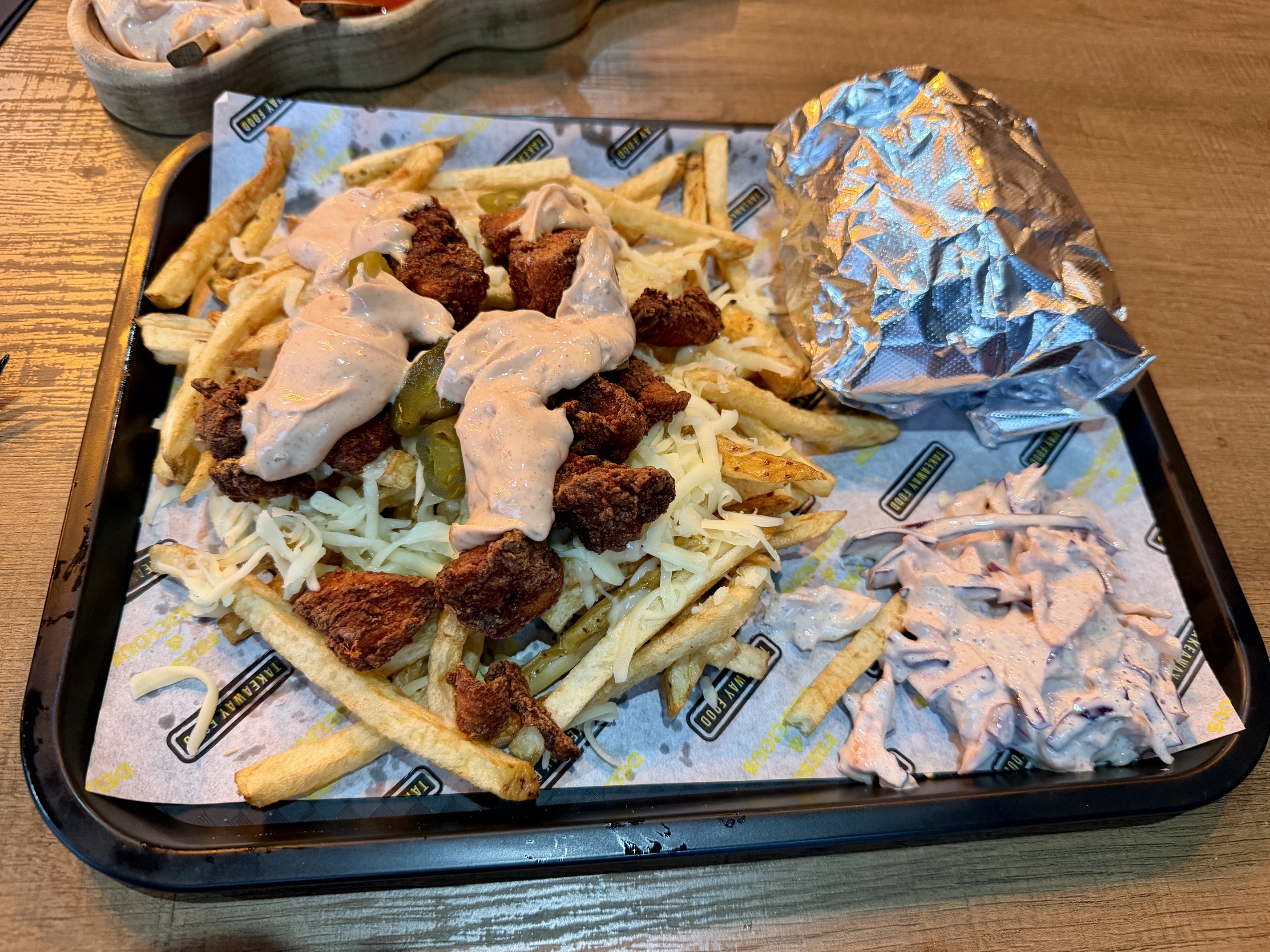
But the real hit was the Nashville fried chicken. I expected this to be a single fillet fried and cut into strips, but instead it was nugget after nugget after nugget, a riot of crispy, fiery fun. The whole thing might have seemed a tiny bit slapdash on camera, but it was a positive party on the tray. I checked my bill again, because I couldn’t quite believe my eyes. £7.99 and not a penny more. I think you’d struggle to spend that money with as impressive returns a few doors down at Kyaneez, in town at Smoke & Pepper or anywhere else that’s guilty of the twenty-first century crime of attempted virality.

This also gave me a chance to dip a few unscathed chips in the other sauces. For my money, the house sauce was maybe the weakest of them: I liked the garlic one fine, but that Louisiana hot sauce was the winner. If it was up to me, which clearly it isn’t, you’d be able to pick which one adorned your loaded fries, rather than having the default of a couple of whopping splodges of the house. But these are all quibbles: the bottom line is that I’m not, generally speaking, the target market for fries loaded with anything but salt and vinegar, and I really liked these.

And then there was my burger, tightly wrapped in foil and waiting for me to declare myself ready to eat it. This, again, was a corker. I don’t think eating a smash burger that’s topped with brisket gives you the best chance to assess the patty – I must try them as nature intended at some point – but I liked the patty even so. The brisket, though, was cracking stuff, crammed in, in tender strands with a good whiff of smoke.

I thought, by comparison, about the smoked lamb sandwich I’d eaten at Smoke & Pepper – they keep cropping up, I’m afraid, because they were so underwhelming – and in terms of quality and integrity this knocked the town centre venue’s efforts into a cocked hat. Best place for them, probably. Judicious use of gherkins and a beaut of a sticky barbecue sauce completed what was, by any standards, a relatively epic sandwich.
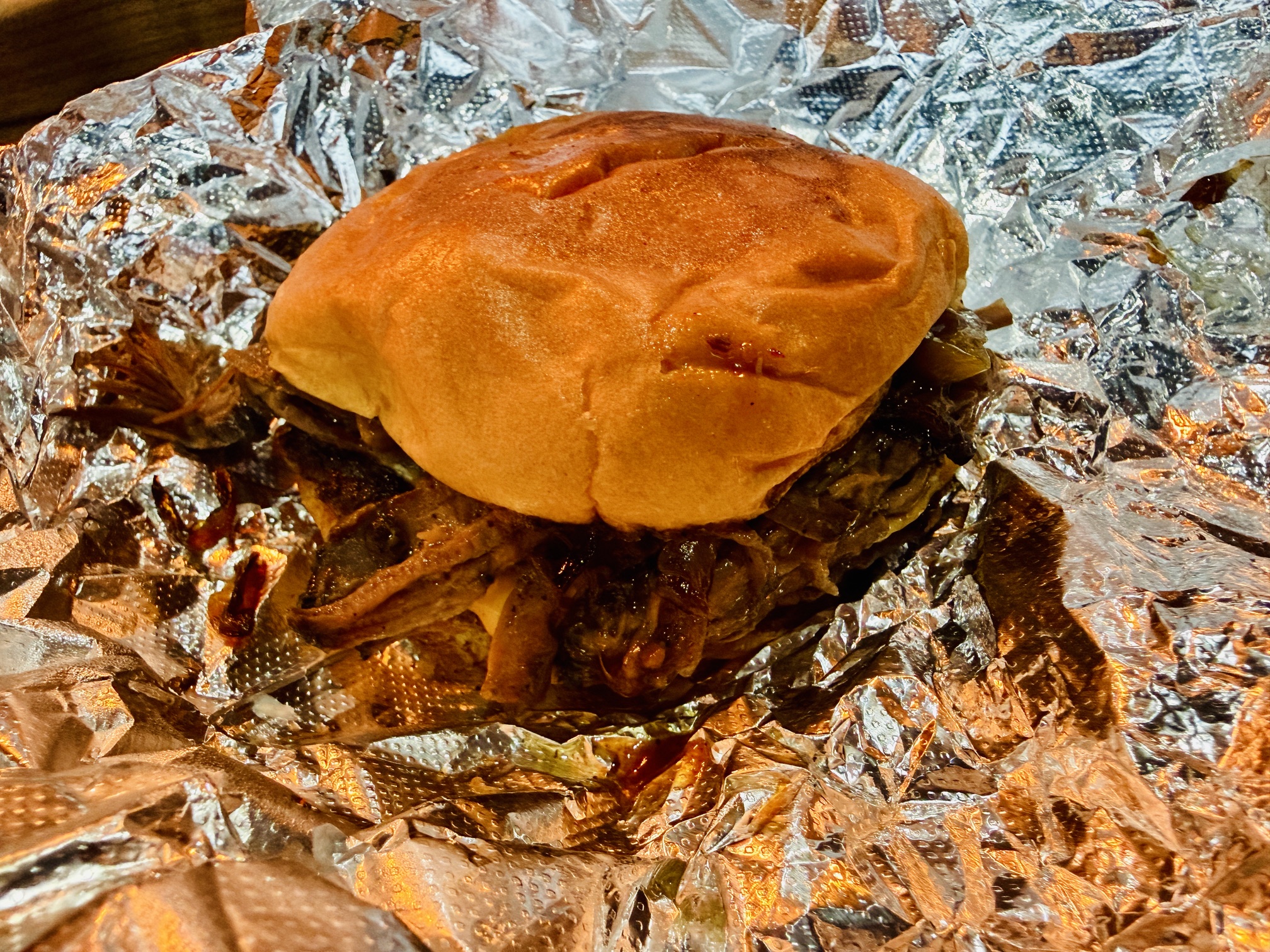
Well, almost, anyway. I would say that this burger – the Signature, according to the menu – was right at the outer limits of value at £16, before you even get round to ordering fries. But that’s where M’s Smokehouse’s menu needs a little ironing out, I think. This dish is a single burger with brisket if you eat it in the restaurant, whereas if you order from M’s Smokehouse on delivery apps, they offer something called The General Burger which is also £16 but throws in two smashed patties instead of one.

In that sense, the pricing still needs a bit of levelling and consistency: I wound up thinking my fries were an absolute steal, my burger perhaps less so. Did I mind the size of my bill across the two, on balance? Not one bit.

When my tray was taken away I told my server how much I’d enjoyed it and they told me the restaurant had been trading a couple of months. I asked how business was going, as I always do, and got a comme ci, comme ça kind of response. “We need the word to get out” they said, and I promised to leave a review on Google, as I also always do, even though it was something of a half-truth. After that I realised there was a number 6 bus coming past in a few minutes and, to my shame, I decided to grab it rather than schlep back up that hill. In my defence, I’d got my steps in already.

The good news is that everything that’s wrong with M’s Smokehouse is fixable. The room can get more ambiance over time, the influx of customers it deserves will do a lot to remove that feeling of being in a waiting room. The wrinkles can be taken out of the slightly erratic pricing and elusive nature of the menu. They can adjust that clock: I’m sure they have by now.

Most importantly, the owners need to find a way to bridge that gap between the space where you eat and the space where you order, because that disconnect is one of the biggest drawbacks as it stands. Both the owners (or servers, or what have you) I spoke to were brilliant, friendly and great ambassadors for what the restaurant is trying to do. But if they’re in a totally different room to you for the majority of your experience, they are missing a trick in a big way.

Because food is about telling stories, and M’s Smokehouse, I sense, has a good story to tell. It just needs to do more to tell it. In that sense it reminds me of places like Dough Bros and Stop & Taste, places that have justly earned local fame by doing things really well and giving a shit, rather than by larking around on TikTok or dishing out free scran. I would love to see M’s Smokehouse take off, and as they’re gladly not that far from my house I will do my best to help out.

And that’s the other thing: everything a restaurant really does have to get right – the things that are harder to fix as you go along – M’s Smokehouse pretty much nails. The brisket was great, the burger was profoundly decent, the sauces showed skill and care. The loaded fries made me very happy indeed. I didn’t miss pulled pork or bacon one little bit, and I think only a diehard Islamophobe – sorry, I mean animal rights activist – would.

I’ve already tried to talk Zoë into those loaded fries twice since I started writing this review, to no avail: she’s in one of those carb-free moods right now. But I have an evening to myself this week, and I already know where I’ll go.

M’s Smokehouse – 7.6
93-95 Basingstoke Road, Reading, RG2 0HA
0118 3044101

This post is exclusively for supporters of the blog – so if you’re reading this, thank you so much for subscribing.
Restaurant review: Tanatan

As of September 2026 Tanatan appears to be closed – possibly for maintenance, possibly for good.

Some restaurants wind up so indelibly linked with the buildings that become their homes that years later, long after they are gone, you still can’t imagine another menu outside, someone else trading behind those doors. Sometimes, no other restaurant even tries: ever since Dolce Vita left its spot on the top floor of Kings Walk nobody has taken its place, but even if they did, I don’t know how I’d feel eating somewhere that, to me, will always be Dolce Vita.

Sometimes the place stays the same but changes hands, with or without changing its name. At some point I should return to Namaste Kitchen, and people tell me it’s good, but without Kamal running the front of house and that magical menu of Nepalese small plates I’m not sure how I’d overcome the strangeness of dining there. I’ll do it, one day, and when I do the review will have to have a different preamble to this one, because this one’s taken.

Ditto Spitiko, where Kyrenia used to be. The site’s the same, the menu is similar, the furniture might be too, and Spitiko may well be a perfectly decent restaurant. But in my mind it will always be Kyrenia, the place where I celebrated my thirtieth birthday, where I’d always go for mezze and kleftiko, for a bottle of Naoussa Grand Reserva and Ihor’s twinkliest welcome. Its golden age was over fifteen years ago, yet I remember it like it was yesterday.

That’s before we get to the Lyndhurst, now under its third set of new management since they hosted guests for the very last time – my wedding guests, no less. This may sound silly, but I don’t feel ready to eat there again. Perhaps this sentimental streak should disqualify me as a restaurant reviewer. But on balance I don’t think so: these places get into our hearts, occupy a place in our affections, become part of our story. Not to feel that kind of thing is not to be alive.

But of course, nearly every restaurant was once somewhere else. Buon Appetito, that I still miss, may have become Traditional Romanesc, but before that it was Chi Oriental Brasserie. And again, when Chi closed I was devastated. You know where else Chi Oriental Brasserie used to live? The site that’s now Masakali. And I was sad when Chi left that spot on the TGI Friday roundabout, too, but I was equally forlorn when San Sicario, a wonderful restaurant, gave up the fight at that very location.

All these places come and go. They make your day one month and break your heart the next: that’s what getting attached to a restaurant can do to you. Worse still, throughout it all TGI Friday has been plugging away on the other side of that roundabout for as long as I can remember. I wonder if restaurants have their own version of that well-worn maxim that only the good die young.

All this might go some way towards explaining that although new-ish Indian restaurant Tanatan opened on London Street last December, it’s only on a week night in July, months later, that I went there with my oldest friend Mike for dinner. Because even though the site was an empty shell for over two years, before that it was Clay’s Hyderabadi Kitchen, and it’s still hard for me to think of it as anywhere else.

Clay’s, where I ate for the first time before it opened, where I celebrated birthdays – mine and theirs, as it happens – where I went on random evenings because it was just round the corner from my little house, where I ate with friends, family and visitors, where I held lunches for my readers. Few rooms contain as much of my personal history as that one, so I knew it would be odd to eat there again, to eat Indian food there at that, and to know that it was somewhere new.

Tanatan’s story is a curious one, by the way. In the run up to it opening, the Reading Chronicle trumpeted that it was a high end Indian restaurant which very much seemed like the natural successor to Clay’s. Not only that, but they claimed that it was the first U.K. branch of an upmarket Indian group of restaurants with its other branches in India and Dubai.

That all sounds magnificent, and Tanatan’s website contains a menu full of temptations. There’s only one hitch, which is that there’s no evidence at all that Reading’s Tanatan has any connection to that chain at all. It’s not mentioned on their website, and in fact Reading’s Tanatan, for a long time, didn’t have a website of its own. Now it does, but the menu bears about as much resemblance to the other Tanatan’s menu as I do to Jude Law.

It looks suspiciously as if the Chronicle had flagged the name, put two and two together and come up with five, which is a mistake not even the AI that writes most of its articles would make. So, what was this Tanatan, our RG-based restaurant, like? Was it a worthy successor to its precursor, or an attempt to hop on a bandwagon two years after the bandwagon rolled north, over the river? It was time to brave that all too familiar room and find out.

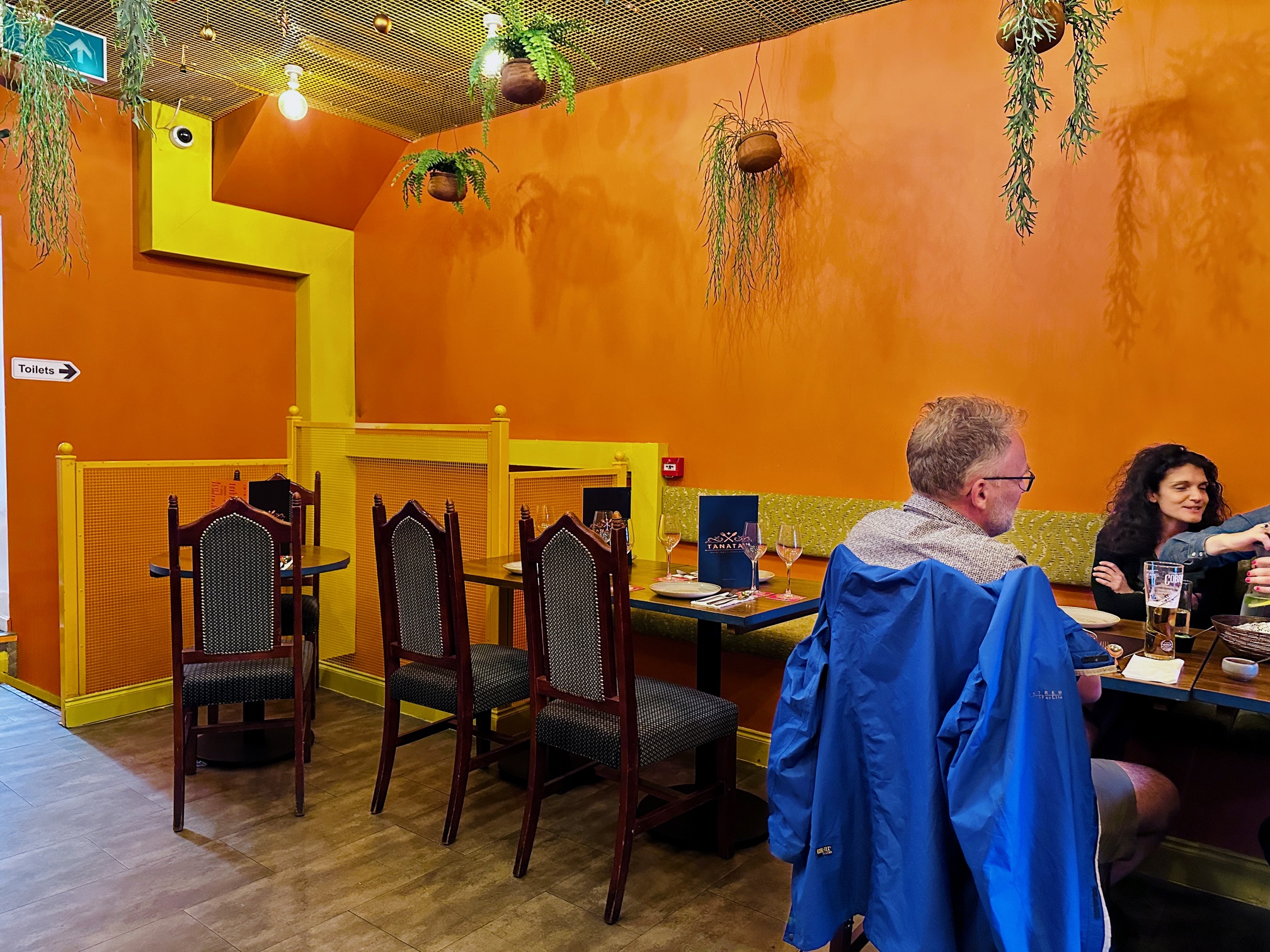
It’s traditional to say “I love what you’ve done with the place” in circumstances like this, but arriving I was struck by how, really, Tanatan had done next to nothing with the room they had inherited. The walls were still that shade of tangerine that had ruined almost every photograph I’d ever taken, the metalwork at the top of the stairs still canary yellow. Terra cotta pots still hung from the mesh ceiling, the banquette I’d sat at countless times still ran along the right hand wall.

All that was new was the furniture – ugly, high-backed chairs on one side of the dining room, slightly unlovely booths on the other. The lack of a makeover surprised me somewhat, because the building had been vacant for so long between occupants. Did Tanatan open in a hurry, or were they trying to ride on the coat tails of their predecessor by hoping to be mistaken for them?

The room also had an unmistakeable, faintly frowsty smell of damp. Now, I didn’t know this but I bumped into a friend last week that told me that Clay’s, when it was open, had that slight odour too (“I always asked for a table upstairs”, he said). I never noticed it back then, but I guess two things that would have masked it were plenty of nice-smelling people and plates of fragrant food. And after all, even heating up a Clay’s At Home baghara rice could make your kitchen smell gorgeous for days. But on the night I visited Tanatan only one other table was occupied, although a couple of other diners came in after me.

Mike was already installed at a booth (“I got one with good lighting” he said, ever helpful) and – a nice touch, this – a bowl of complimentary poppadoms was on the table in front of us, with a greenish raita and a chutney that tasted of mango despite its colour being closer to ketchup. Both were lovely, and we ordered a pint of Kingfisher each as we chatted about how best to tackle the menu. In a nod to the more conventional curry house Tanatan offers Cobra and Kingfisher; I still haven’t worked out which I prefer, or what the difference even is.

Conventional also described Tanatan’s menu. The restaurant’s slogan is “where India’s spices dance”, and that might be true, but they’re not busting out any lesser-known moves. The menu was a step above the really entry level pick-your-sauce, pick-your-protein curry house, but only just. Korma, jalfrezi, dhansak and saag were all there, without much in the way of regional dishes; if you’re looking for something off the beaten track Tanatan might not be the place for you.

As so often nowadays, there was also a decent selection of Indo-Chinese dishes, although it didn’t have its own section on the menu. Starters ran in the main from six to ten pounds, mains stayed south of fourteen. The slightly disappointing range of the menu, though, wasn’t the main thing I noticed about it, because reading it truly made me feel like I was taking a day trip to the uncanny valley. Some of the menu items seemed to have been written by some kind of nightmarish fusion of Google Translate and ChatGPT.

For instance, I can’t think of any other reason why you would call onion bhajis Onions Crispy Fritters or chicken samosas Chicken Golden Crisp Pastry. In each case the dish’s actual name was written underneath in small print, after a prefix saying ‘Popular name’. If the name was that popular, why weren’t they just using it? It was like referring to Michael Caine as Maurice Micklewhite, only even weirder because at least that was Caine’s actual real name. But would anyone ever say, in real life, that they were gasping for a chicken golden crisp pastry?

It was so cack-handed that it was almost endearing, especially when the names of dishes took a turn for the chaotically poetic. I’ve heard chilli chicken called many things, especially Kamal’s Kitchen’s version the morning after, but The Fiery Phoenix? Actually, come to think of it that was a nicely euphemistic description of its consequences. And then there was my personal favourite: fish pakora was billed on the menu as Oceanic Crisp Delights, which sounds like the name of a Guided By Voices album track.

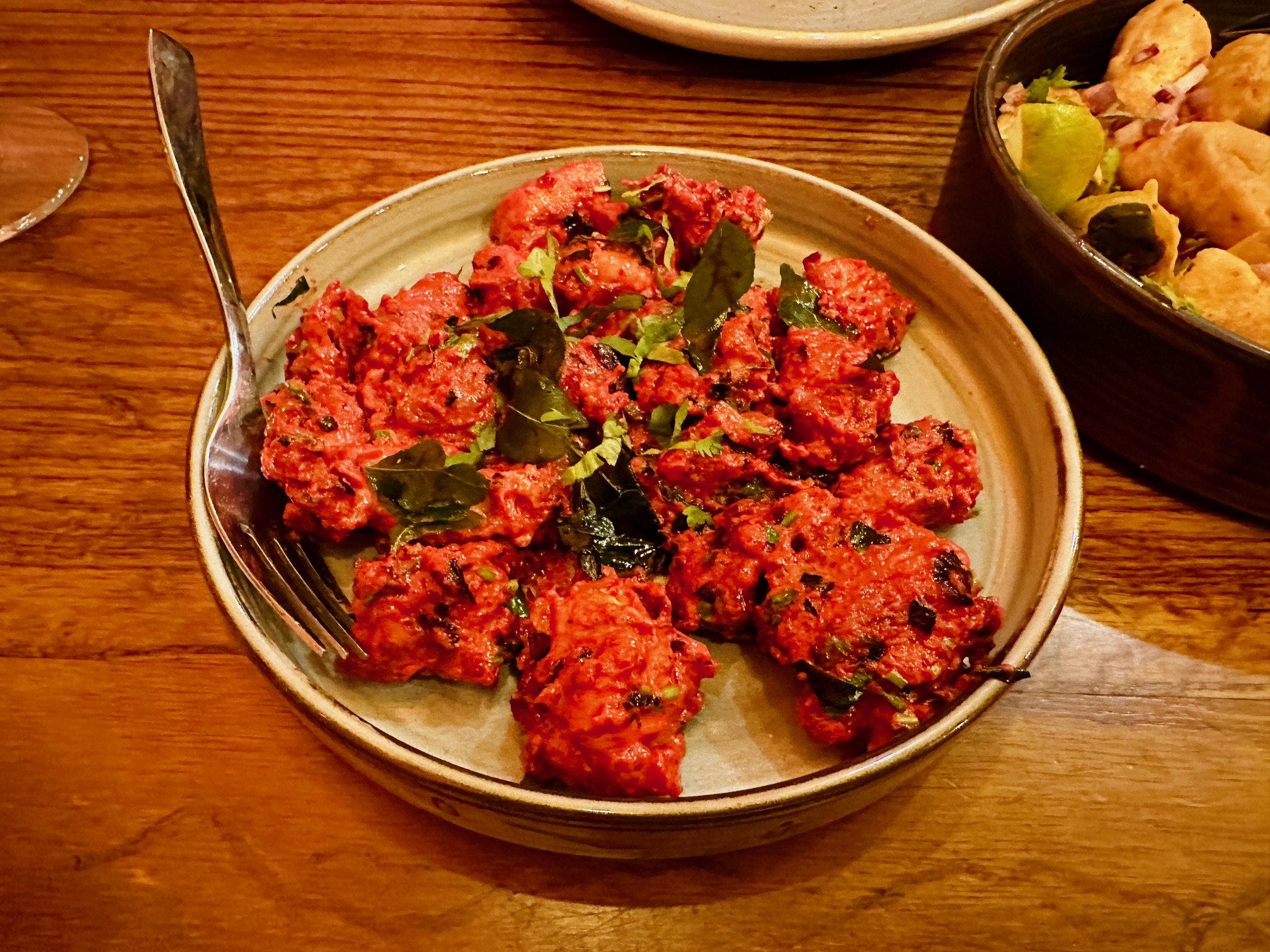
Anyway we began with some familiar but less mainstream dishes, for me to try and benchmark Tanatan – not just against Clay’s, but against plenty of Reading’s other Indian restaurants, the likes of Chilis, House Of Flavours and Deccan House. Chicken 65 is a go-to for me, and Tanatan’s rendition of it was a good statement of intent.

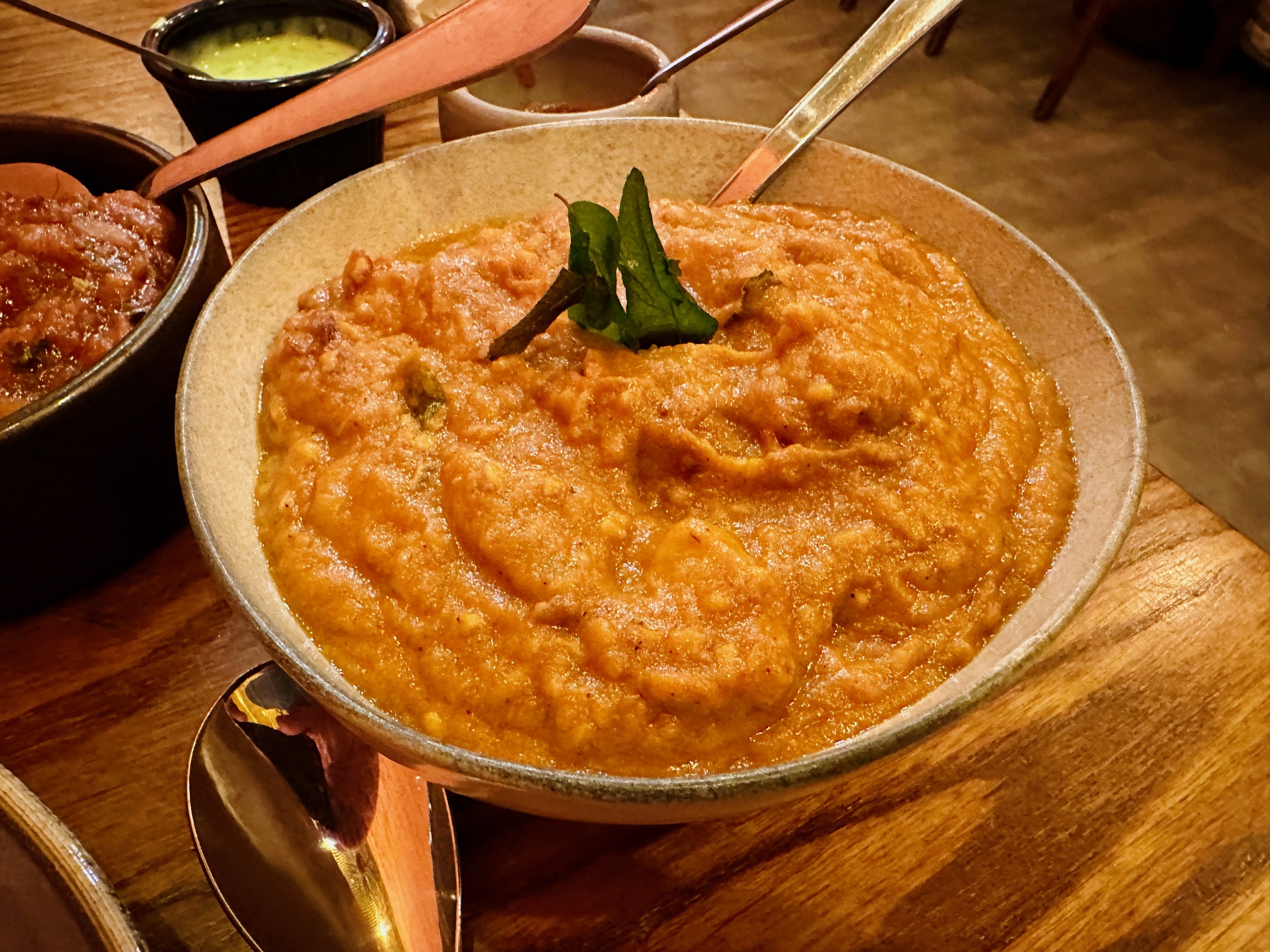
It got that sticky, savoury spicing bang on, and was less disconcertingly scarlet than my photo makes it look: Apple hasn’t yet discovered a filter for This photo was taken in a bright orange room, can you make it look normal please? The chicken felt like it had been marinated in yoghurt to within an inch of its life, and if I had one criticism it was that the texture sometimes was so soft that you weren’t entirely confident it could be completely cooked. I would have liked it a little drier, with a tad more char, but the flavour was unarguable.

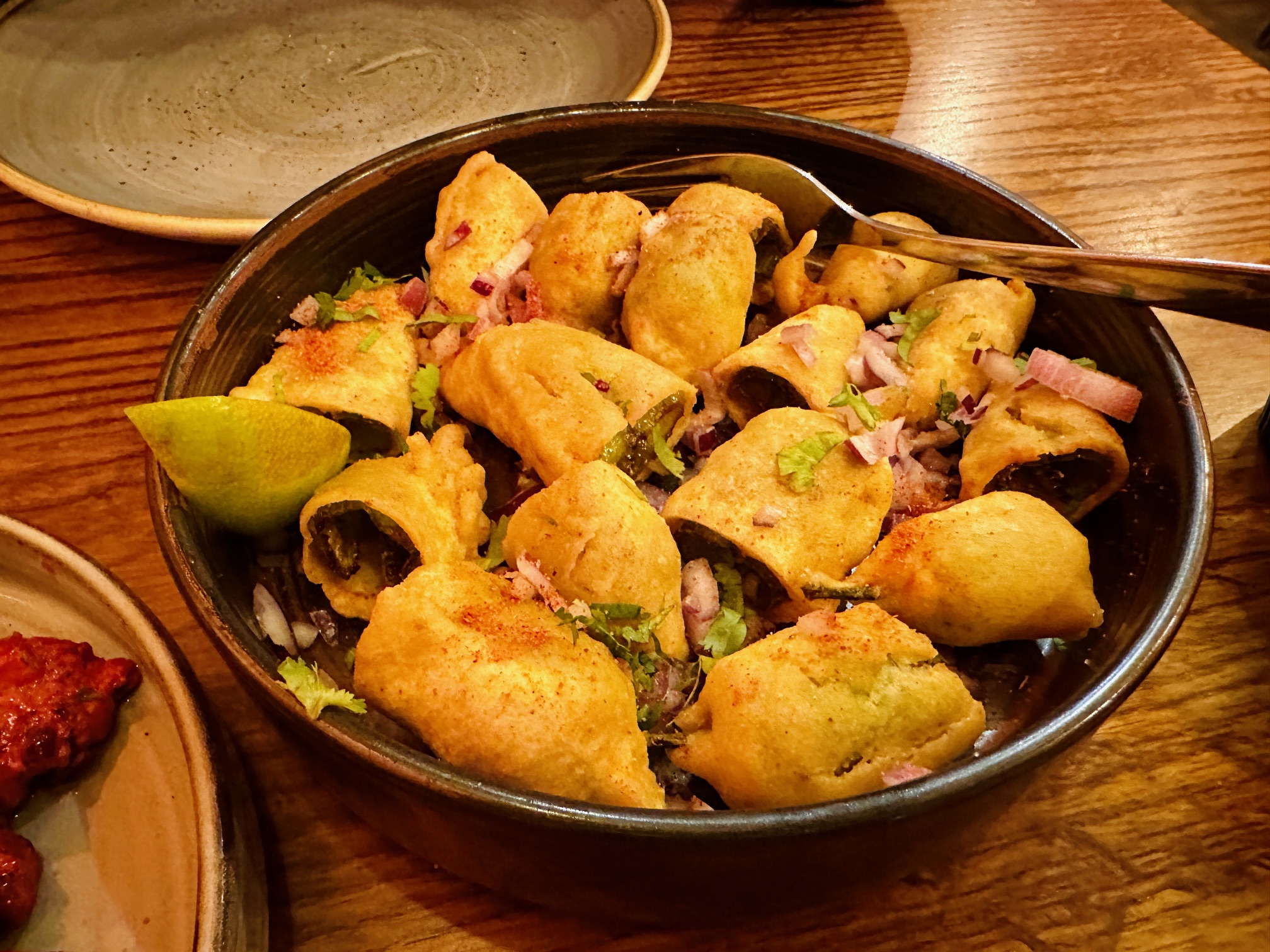
Our other starter, mirchi bhaji (unpopular name: crispy chilli fritters) was similar on paper to the cut mirchi I’ve had at Clay’s and Deccan House. In practice, though, it was different: the chillies, which were potent, had rather shrunk away in their jacket of spiced gram flour batter. But even with that said they were golden, crunchy, pretty fiery and immensely snackable and I enjoyed them a great deal with some more of that raita.

Despite it being a quiet night in the restaurant, pacing was leisurely and so it wasn’t until about forty minutes and another pint of Kingfisher later that our mains came out. But I was fine with that: Mike was back from his adoptive hometown of Madrid for a family visit, something he only does a few times a year, and even though I’d already seen him on this trip there was no shortage of stuff to chat about. There never is.

After all, we grew up, or rather didn’t, on the same street in suburban Woodley, over forty years ago. We played tennis in the road between our houses, the cracks in the tarmac serving as nets and baselines. We cycled to school together, bags slung unsafely over our shoulders. We went to university, dropped out (in his case), went back (also in his case) and have known each other for an exceptionally long time across all sorts of adventures and misadventures.

So, both still alive, both still relatively sane, it was a delight to sit there between courses and shoot the breeze – about his parents and mine, his brother and mine, about what the year had held so far and what lay ahead.

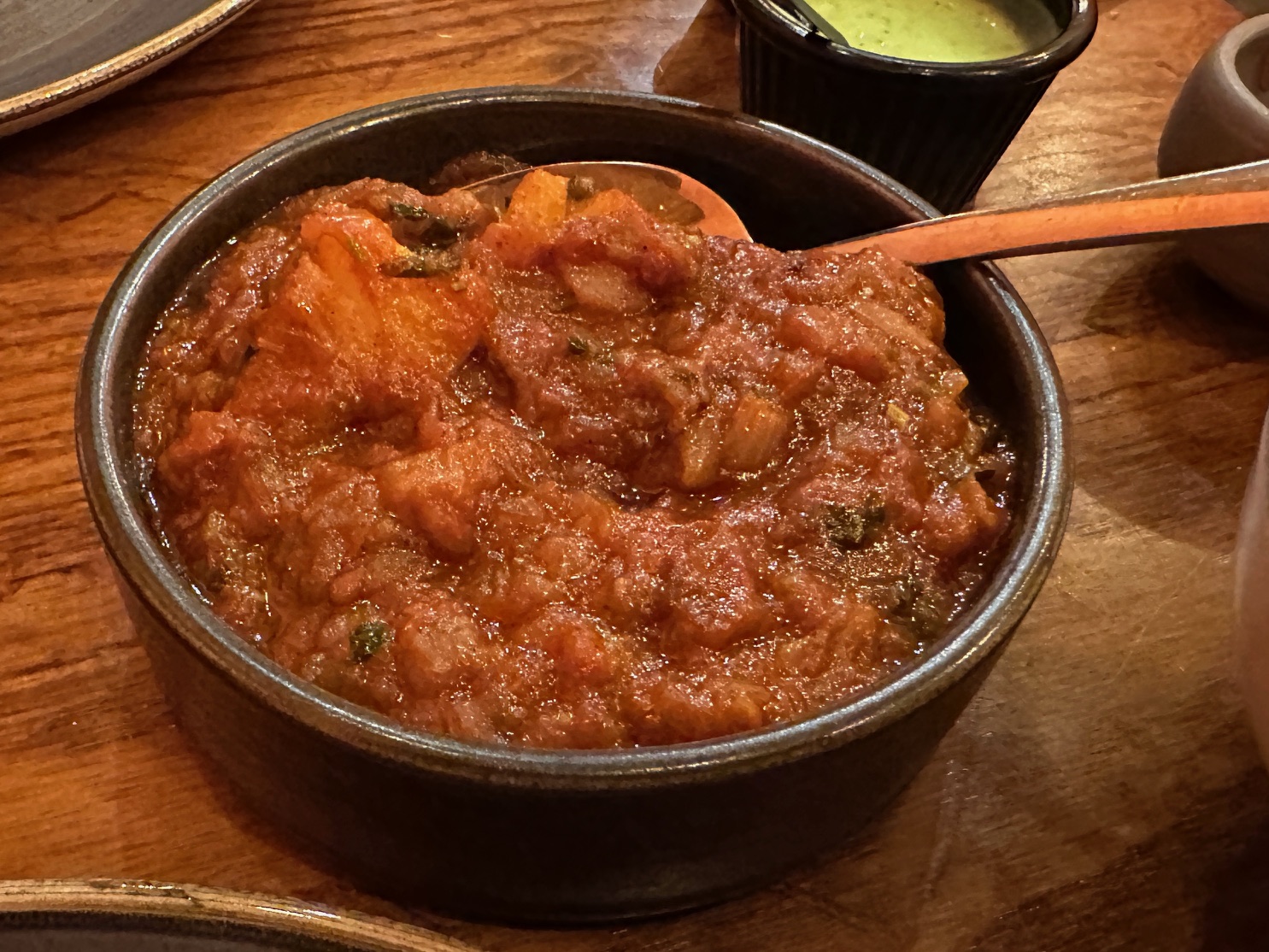
I thought the starters had held promise but not entirely delivered on it, and although I was hoping the mains would buck that trend they stayed firmly on it. Mangalorean prawn curry, one of the less generic dishes on the menu, went heavy on the coconut and had an interesting combination of heat and sweetness. But I found it disconcerting: a huge pool of extremely thick gravy, the consistency of Greek yoghurt, with surprisingly small prawns lurking in it.

The ratios felt all wrong, as did the lack of anything else like veg to break up what was texturally quite mulchy: if it wasn’t prawn, it was sauce, and usually it wasn’t prawn. This dish wasn’t what I expected in the slightest, but I’m not sure my expectations were the problem.

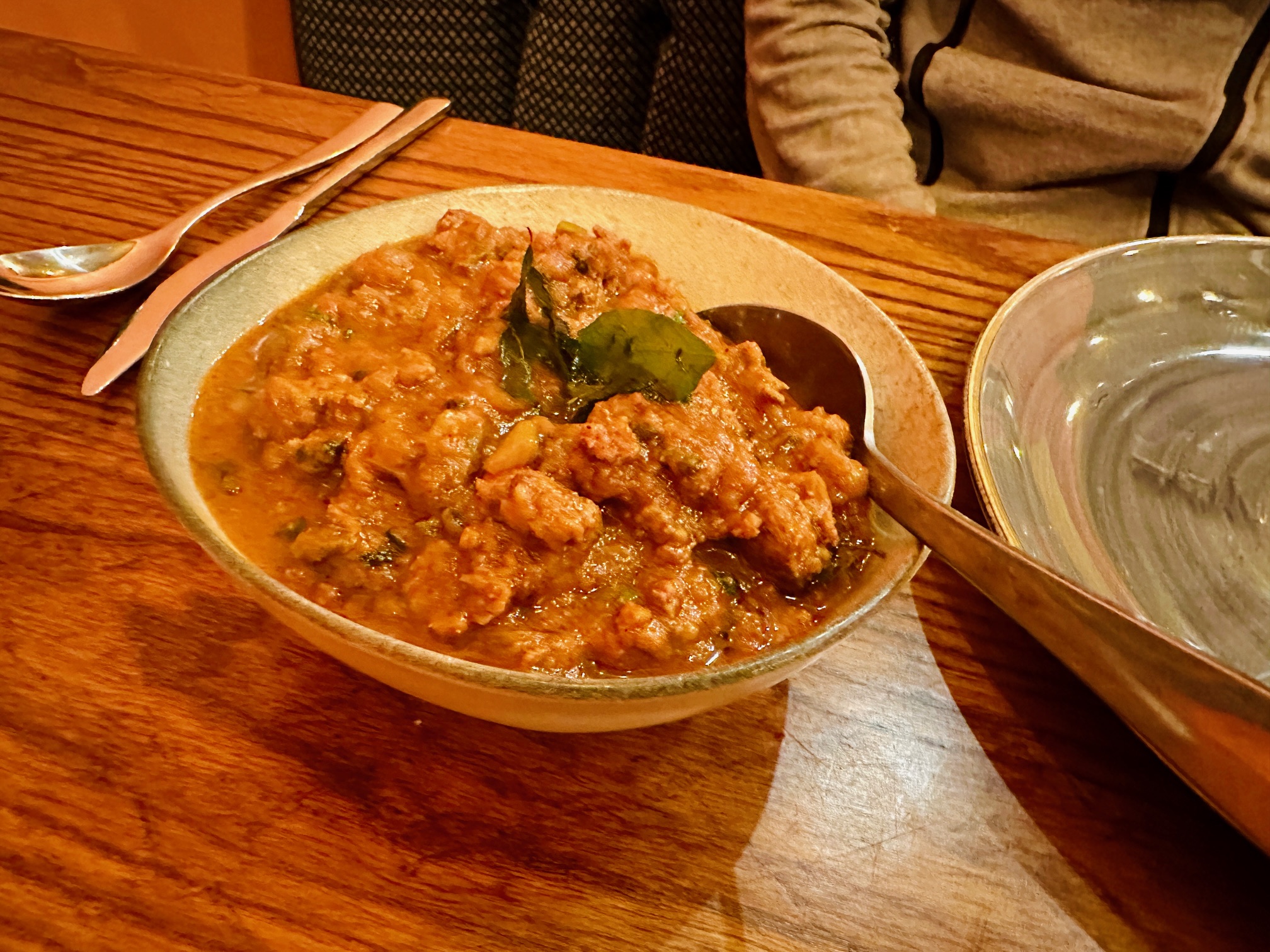
Our second choice was more successful. Again, trying to steer clear of anything even remotely interchangeable, we’d opted for the Andhra lamb keema, partly also because I have a real soft spot for keema curries and think they’re often the most underrated thing on an Indian menu. I think I was right about that at Tanatan, at least, because this was miles more enjoyable than the prawn number in every respect. The lamb was very coarsely minced, so much so that it could have been finely chopped rather than put through a mincer, and that texture worked in terms of distributing flavour and, just as crucially, fat.

The whole dish felt like a coherent whole in a way that the prawn curry hadn’t, and was so much more fun to load onto bread or to fold rice into. The rice, jeera rice by the way, was perfectly pleasant but very light on the cumin (you’ll have to take my word for that, because putting a photo of rice up feels pointless).

What I will say, though, is that a portion of rice at Tanatan is easily enough for two people to share with some bread, which is to their credit. Also, although this looks a very similar hue to the prawn curry in this photo they were reassuringly different: it’s the fault of those bloody orange walls again.

I’d read somewhere online that Tanatan’s Bombay aloo was worth ordering, and Tanatan offers smaller portions of some of its vegetable dishes as sides, so we gave it a go. This got everything right that the prawn dish had not, a thick, comforting and spicy panacea of a dish with hunks of potato with just enough floury give to them. Great news for vegetarians, yes, but to be honest great news for anybody eating at Tanatan: next time I’d order this as a main.

You would think that with a big portion of cumin flecked rice and a curry made predominantly of potatoes we had quite enough carbs to be going on with. And you would be right, but because we were greedy idiots we also decided to attack what was quite a substantial bread section on the menu. Nearly a dozen different types of naan, a few roti and half a dozen or so parathas is a lot, although I found it a bit strange that they had a keema paratha but no keema naan.

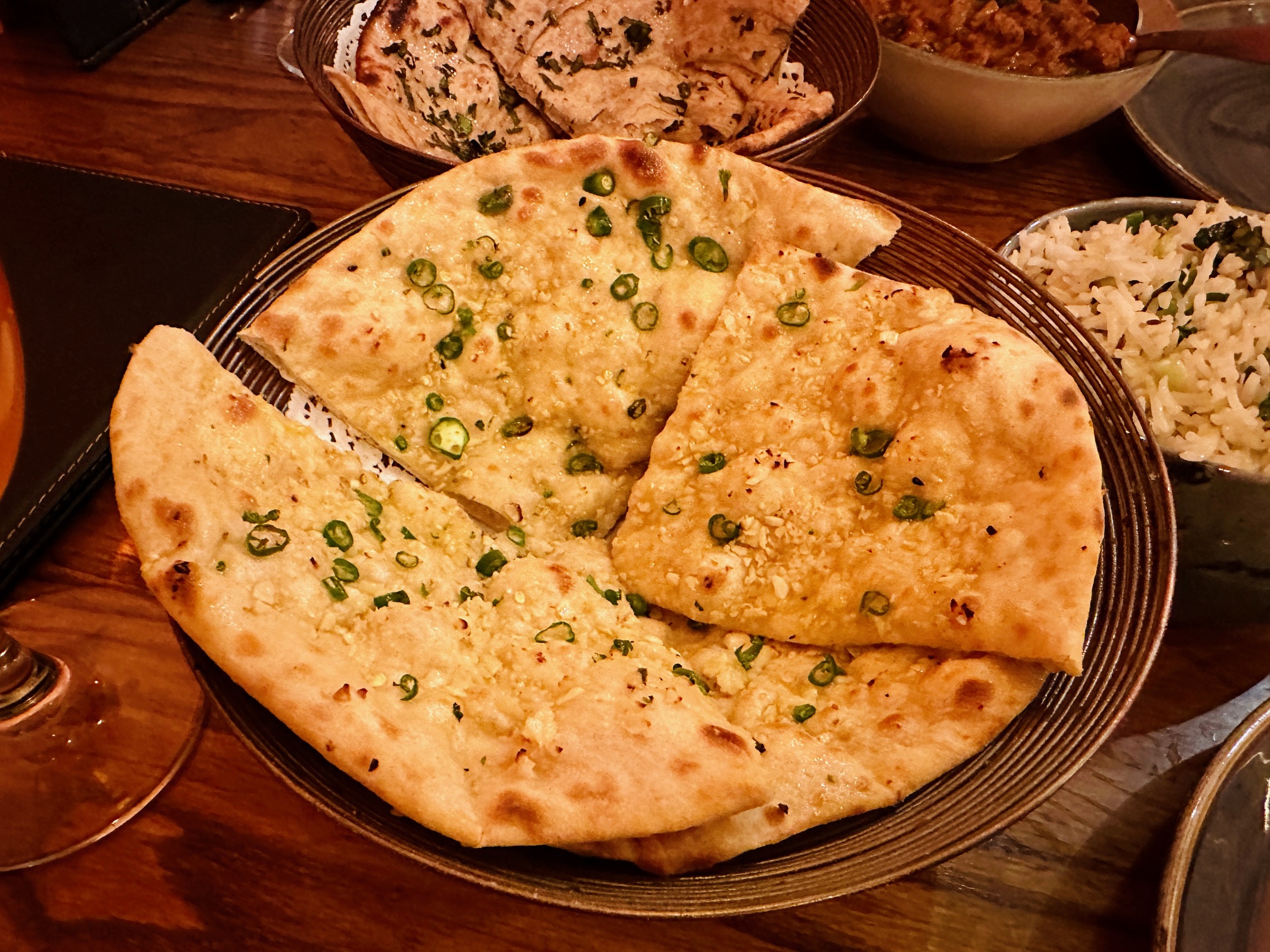
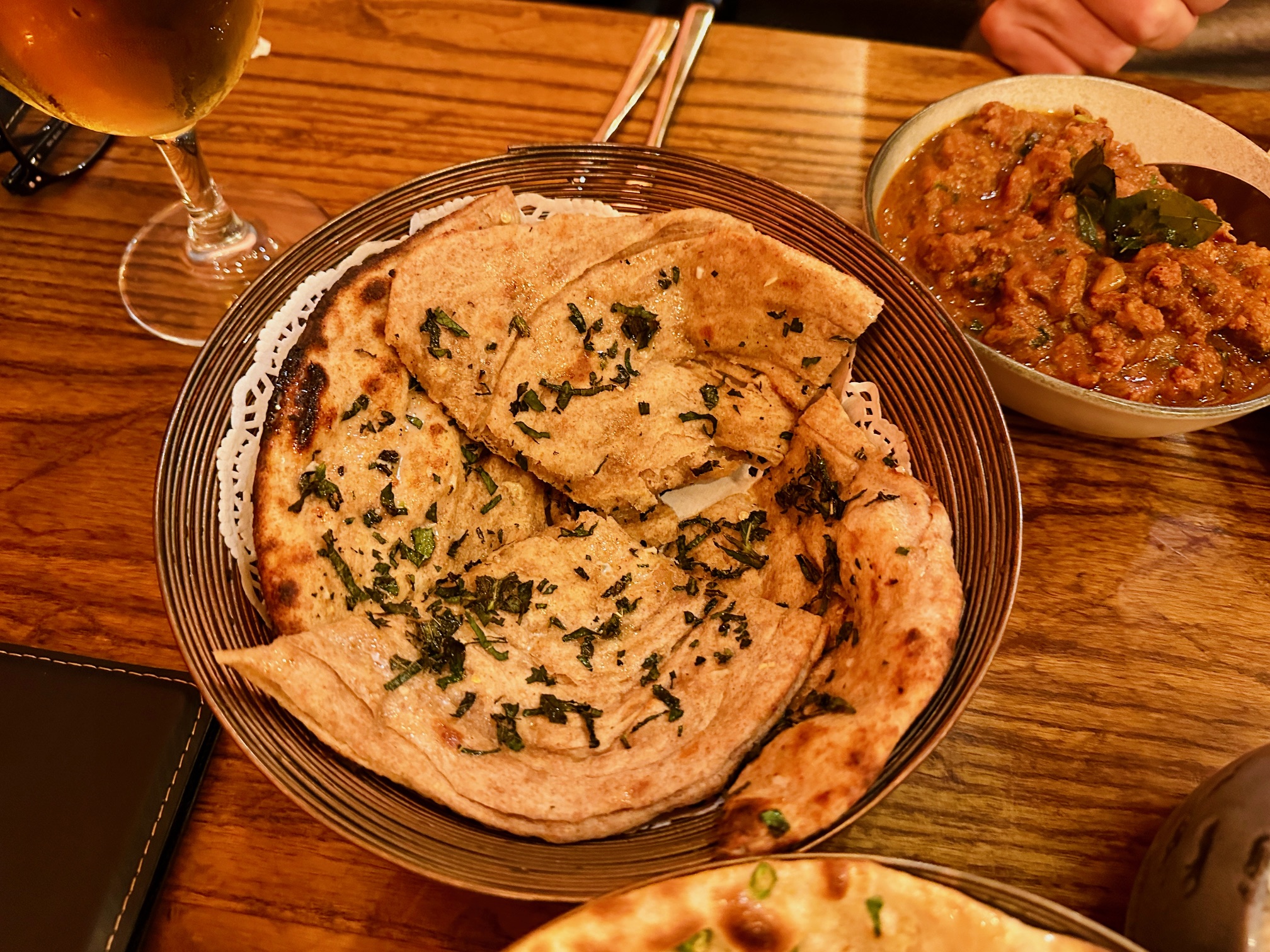
I’m also not entirely convinced that the naan in particular aren’t just the same naan turning up in a variety of slightly different outfits. We chose the signature garlic and chilli naan and although I quite liked it, especially the scattering of punchy sliced green chilli, the texture was round and uniform, the whole thing lacking in bubbles, blisters or fluffiness.

We also tried paratha with mint. Initially when I ordered this our server wasn’t entirely sure they had it, and wandered off to the kitchen before returning and saying that it would be no problem. I assume that what he meant was that the kitchen hadn’t run out of mint, because what we got was a paratha scattered with mint. If there is more to Tanatan’s breads than this you wouldn’t know it, and although this was serviceable it again lacked the flaky butteriness of the very best examples. It wasn’t hugely up to the job of dipping – you couldn’t fault the naan for that – and I didn’t feel an impetus to finish mine.

We kept eating until we could tackle no more, at which point, despite the very kind offer of our server, there wasn’t enough left of anything to be worth boxing up. Over two hours had passed by this point and somehow, in that time, I had stopped eating in the place that used to be Clay’s and had finished up eating in Tanatan.

Despite any quibbles about the décor or the odour, that was very much a good thing: I had expected to feel a little sad dining here (still not going back to the Lyndhurst any time soon) but in reality it made me feel far happier about the circle of life that is restaurants outgrowing buildings, if they’re lucky, and being replaced by something new. Some of that was down to our server Tarak, who was tremendous throughout. He was enthusiastic, attentive, explained bits of the menu to us – the concept of chaat was a new one on Mike – and apologetic about the food taking a while, even though we were in no hurry.

As we were settling up I asked him about Tanatan, and impressively he told me that although it opened late last year he had only been there a month. This was the owners’ second restaurant, their first being a place called India Rasoi in Chorleywood. When I asked him why they’d chosen Reading for a sequel the answer was prosaic: one of the three partners lives here. People pick places to open their restaurants for all kinds of reasons, and that’s as good a reason as any. Our bill for two starters, two mains, two pints apiece, rice and breads came to just shy of eighty-two pounds not including tip, which Tarak absolutely deserved.

I’ve had some grief about recent reviews – it’s a story for another time – for comparing places to one another, for visiting Venue A and partly framing it in terms of how it measures up to Venue B. But I think that’s a perfectly reasonable thing to do, because restaurants don’t exist in a vacuum and reviews of them have to sit in a wider context. You cannot talk about Tanatan, really, without talking about its peers, because if you don’t the review just drifts in mid-air, not answering the obvious question. Is it better than X, or Y?

If you don’t answer that question, you dodge the question altogether. It would only make sense not to talk about other Indian restaurants if Reading didn’t have any, and that will never happen. And even if it did, you’d still want to know whether to go here or to take the train to Newbury, or Wokingham, or Maidenhead. So comparisons are inescapable, and good restaurants have nothing to fear from them.

But I’m not going to compare Tanatan to Clay’s, even though I started this review talking about the previous tenants of 45 London Street. That would be pointless: you can’t compare anywhere in Reading to Clay’s, not in terms of Indian food, not in terms of profile or polish, barely in terms of quality at all. I wish more places came closer. And if Tanatan takes custom from other restaurants, despite its orange walls and the very limited makeover it’s given its dining room, it will be from its competitors in the town centre, not from the other side of the Thames.

So actually you need to decide whether you’ll eat at Tanatan – besides satisfying your curiosity or laying your own post-Clay’s ghosts to rest – instead of its neighbour Calico, or Royal Tandoori at the bottom of the road, House Of Flavours round the corner or Chilis in Kings Walk. For me right now, the last of those is the standout in a crowded field, with the others battling it out for the silver medal.

Time will tell where Tanatan finds itself in that chasing pack, and I would love to see it take more risks, widen that menu and, ideally, lose those chairs. But it has a fighting chance, because it gets a few things very right and service is one of them. If they ever do well enough to take a break, my advice to them is to get someone in to redecorate. If it lives up to its potential, you could get all the glow you need from the food, rather than the walls.

Tanatan – 7.4
45 London Street, Reading, RG1 4PS
0118 3049165

https://tanatanindian.com

This review is exclusively for supporters of the blog – so if you’re reading this, thank you so much for subscribing.
Restaurant review: Gees, Oxford

In 2026 Gees appointed Nick Galer, formerly of The Miller Of Mansfield, as its new head chef which means this review is no longer current. I have kept it up for posterity and will re-review Gees in due course.

For my money, there are a few finer things in life than a long, leisurely Saturday lunch with a very good friend. Especially when you’re in a fetching room, in a beautiful city, faced with a cocktail, an appealing menu and excellent people watching opportunities. In fact, one of the only things finer than that is to do exactly what I’ve described above, but on a Friday, with four whole days off stretching out in front of you. So I was very happy indeed to find myself sitting in Gees’ gorgeous conservatory on Good Friday with my dear friend Jerry, Easter weekend only just beginning.

By this point, the day had already got off to a magnificent start. The train to Oxford was quiet, deserted almost, and it was the first time in as long as I could remember that it only took a couple of minutes to exit the station, a station whose abysmal design doesn’t seem to have significantly changed in the thirty or more years that I’ve been making that journey. We had a bimble round the Covered Market, we bought bread and cheese for later on, we had a beautiful latte in the Missing Bean on Turl Street, chatting away non-stop. 

Jerry and I had never been to Oxford together before, so we compared our experiences of the city over coffee, looking at the connections between his mental map of the place and mine. I thought how nice it was to introduce him to some of my favourite spots, particularly as if it wasn’t for Jerry (it’s a long story) I might not know Oxford half as well as I do. The weather could’ve been nicer – the day was dry yet overcast, which never paints Oxford’s buildings in their best light – but the company was unimprovable.

I had chosen Gees for our lunch because it had been on my to-do list for quite some time. A glorious spot on the Banbury Road mainly famous for its conservatory slash greenhouse dining room, there’s been a restaurant on the site for nearly forty years, a mind-boggling record. It started out as Raymond Blanc’s restaurant, with John Burton Race in the kitchen, then five years later it became Gees and has stayed that way ever since. It’s now part of The Oxford Collection, a small and exclusive group including The Old Bank and Old Parsonage hotels, and their respective restaurants.

That length of tenure means that Gees was already trading when I turned up at Oxford in 1992, sporting terrible spectacles and even worse clothes, to study my degree alongside some of the brightest people I have ever met (and some of the thickest too, would you believe). Not, of course, that I would’ve eaten there then. As I’ve said before, my meals out were limited to regular trips to the fish and chip shop on Carfax, and the rest of the time I was either heating up an M&S chili con carne in the microwave of our communal kitchen, or enjoying – and I use that word as loosely as humanly possible – the food in my college halls.

Many Oxford colleges have an excellent reputation for food, as it happens. They also have shitloads of land and investments, and in one case their own deer park. My college had none of those things, which is probably why they accepted the likes of me: the food there was purgatorial. So Gees was for a long time a kind of mythical place, the sort of restaurant other people went to, people with wealthy parents and substantial allowances. It wasn’t until much later, probably twenty years or so later, that I went there, just once.

That too was in another life, with my then wife and a bunch of our friends who turned out, when push came to shove, to be her friends. I don’t remember much about that meal, except that it was deeply convivial, but I do remember following it up with a lot of drinks in one place or another and stopping on the way to the station for a shameful KFC. I always intended to return to Gees, but somehow I never did.

I was quickly reminded, as we stepped through the door, what an attractive place it is. Most of the seating is indeed in that big conservatory, with its banquettes, leather-backed chairs and handsome tiled floor, and it makes for a great place to eat. Even on a cloudy day the room fills with light, and something about that light, the room’s airiness, the bustle of its supremely efficient staff and the chatter from prosperous neighbouring diners created a truly brilliant atmosphere. If I gave out ratings for rooms alone, Gees would take some beating. 

Gees’ menu is sort of modern European, with something from everywhere. Oysters and in-season Wye Valley asparagus were on offer, as were Serrano ham croquetas and braised octopus with romesco. But Italian dishes and ingredients tend to dominate – pizzetta, pasta, burrata, aubergine parmigiana, the list goes on. It’s as tempting a menu as any I’ve seen on my travels for a while, and on another day I could have ordered almost anything on it.

I think I read somewhere that Gees was influenced by the River Cafe, and I could imagine that in both the menu and the surroundings. Not that I’ve ever been to the River Cafe: for all the rave reviews I’ve read, paying nearly forty pounds for an asparagus starter has always been beyond my means; that said, I’m sure some of my Oxford contemporaries have been more than once. Gees’ asparagus was perhaps more keenly priced at under twelve pounds. Starters more generally weighed in at between ten and twenty pounds, pasta dishes close to twenty and main courses between eighteen and thirty-five. Not River Cafe levels, but not cheap either.

Another thing to love about an unhurried lunch is the possibility of an aperitif. So Jerry had something which the bill described as a “Bergamont Spritz”. It’s not in the drinks menu online, so I’m assuming it contained gin, some kind of sparkling wine, bergamot and – surely – a typo. I had something called a Contessa Negroni which swapped out Campari for Aperol in the classic, simple, three ingredient cocktail. You might wonder why this has never been done before, and now I can tell you: because it doesn’t taste as nice as a proper negroni.

That was all forgivable, though, because the bar snack we ordered to go with them was a real cracker – little dabs of anchovy sandwiched between two sage leaves, battered and fried. These were outrageously good, salty little treats and a really excellent idea. A far better idea than putting Aperol in a negroni, anyway. I wasn’t to realise, at that point, that my bar snack would be far and away the best thing either of us ate all day, so instead I sipped my cocktail, enjoyed the surroundings and felt pleased with the course the day was taking. At all the tables around me, people were doing much the same.

The problem is that after that, despite the room being lovely and our bottle of txakoli being cold, fresh and zippy it felt to me like Gee’s menu delivered wobble after wobble. Take my starter, which was described as venison tonnato. Now, I thought that sounded like an interesting idea: a vitello tonnato swapping our the veal for venison could, after all, possibly work. And it might still be an interesting idea, but it wasn’t in a million years what this dish was.

Instead of thinly sliced venison, you got a piece of venison fillet, cooked through without pinkness, thickly sliced and drizzled with a pale sauce that contained absolutely no tuna. Not the slightest hint of it, not even a whisper of tuna. I don’t know what it tasted of – not a lot, really – but it meant that both the main ingredients of vitello tonnato were missing, replaced with things that were damage not homage. And then there was a big pile of salad, because this starter cost fifteen pounds and they had to find ways to distract a paying customer from realising that this wasn’t in any way what they had ordered.

Ordering a salad by mistake seemed to be quite an Oxford thing: I was reminded of a similar incident at Branca when I went there earlier in the year. I didn’t mind that then, because my stealth salad at Branca was still an excellent dish. This, not so much. If it had been called “venison salad with tonnato dressing”, while not 100% accurate, I’d have had fewer quibbles. Of course, if it had been called that I’d have ordered something else.

The problem is that not only is stealth salad seemingly an Oxford thing, it’s also – to paraphrase Dr Dre – a Gees thing. Jerry’s soft shell crab with saffron aioli was nice enough, but you get an idea even from the picture below of how diddy it was. Again, salad appeared mainly to be there to fill negative space, a kind of gastronomic find the lady deception. A different salad to that accompanying my starter, with shaved fennel and olive oil. Again, not mentioned on the menu but, in truth, a large part of proceedings. Jerry gave me a forkful of his crab. There was so little that I felt guilty taking it.

Jerry is on some kind of medication that reduces his appetite (although, gladly, not where booze is concerned). He quite enjoyed this, but I think you’d have to be on that medication to find it enough. And Jerry’s drug regime came in even handier with his main course: butterflied sardines, which apparently came with tomato, sumac pickled onions and chermoula.

I try not to talk about value much in restaurant reviews these days: things cost what they cost, and restaurants need to make money. So for me to mention it, pricing has to verge on the egregious and, at twenty-two pounds, that’s why I’m bringing it up here. Here they are in their glory, all five of them. This, to me, looks like a starter. Is that all there is? you might ask. Where’s the tomato?

Well have no fear, because this dish – the generosity never starts – came with tomatoes and radicchio. Rocket, too, to match the rocket dumped in the centre of the Maltese Cross of disappointment that was those sardines. Double rocket, the treat nobody ever asked for: still, it beats pea shoots, I suppose. Why did the menu not mention that this was yet another salad? Was Gees just a glorified salad bar, and nobody had told us? Was it north Oxford’s upmarket tribute to Harvester, Gregg Wallace’s favourite restaurant? It was a puzzle and no mistake.

Yet I couldn’t help feeling that really we had just ordered exceptionally badly, because the dishes arriving at other tables looked more like actual food. A tall, substantial burger was brought to one of our neighbours, with a decent-looking portion of chips. Lamb cutlets piled high on a plate were put in front of the chap next to him, although in fairness they were on top of some little gem lettuce and peas. See? Another salad.

My main gave Gees one last chance to dish up something more convincing. And I’ll say this for my chicken cacciatore: it was not a salad. But it wasn’t great either. The pool of stretchy polenta was pleasant enough: I would probably always choose mash over polenta, but the menu clearly advertised it, so I couldn’t complain. And I did really love the sauce my chicken came in: rich with tomato, sharp with capers, studded with judiciously-cooked carrots and celery, a vegetable I always think is underrated in this context.

The chicken was the problem. I’m really partial to chicken thighs on the bone, but you have to achieve one of two things and ideally both. A crispy skin, if you can get that right, is a truly wondrous thing. But I would pass on that if the chicken is so well cooked that it flees the bone at speed, and breaks into strands. That’s when chicken thighs become properly magical. If Gees had achieved that the chicken, with that sauce and some of the polenta (if you must) would have made for splendid mouthful after splendid mouthful.

But to get both of those wrong, to have flaccid skin and firm, almost rubbery meat that needed to be prized away from the bone? That’s really not great. And to charge twenty-eight pounds for two undercooked chicken thighs that weren’t fit to grace the sauce they came in? Cheeky doesn’t even come close.

No side dish could rescue this sorry affair, though in Gees’ defence their braised leeks in feta and dill, served warm, were delightful. I’m no fan of dill, generally, yet I loved this dish and at six pounds it was better, and better value, than nearly anything else we ate. About the same size as those sardines too, come to think of it. It was a beautiful lipstick – applied to a pig, yes, but a beautiful lipstick nonetheless.

Would you have stayed for dessert? We nearly didn’t but felt like we had to see it through, like a disappointing box set. To Gees’ credit I asked who they bought their ice cream from and was told they made it in house. That probably swung it, and Jerry was delighted with his affogato, served with Pedro Ximenez.

I mean, again, if I’m being a stickler (which I am), if you swap the espresso for PX then what you have might be lovely but it’s no longer an affogato, just as the negroni wasn’t a negroni, the tonnato not a tonnato. Gees seemed to have taken Lewis Carroll, another Oxford type, very seriously when he wrote in Through The Looking Glass that “When I choose a word, it means just what I choose it to mean”. Words, salad, word salad: it was all the same to Gees. Let’s call the whole thing off.

To close on a damp squib of faint praise, Gees’ ice cream is pleasant stuff. I tried vanilla and chocolate – don’t expect any leftfield flavours – and both were very good. Smooth, no ice crystals, plenty of specks in the vanilla and an excellent balanced depth in the chocolate. Two scoops for eight pounds didn’t feel like highway robbery, although it made the nine quid Gees charged for Jerry’s single scoop with a slug of Pedro Ximenez seem decidedly impudent.

What else is there to say? The whole meal, service included, came to two hundred pounds between the two of us, including an optional 13.5% service charge. The cognitive dissonance is strong in this one, because I had a lovely time and the best of company, the room is hard to fault and the service is excellent. You almost enter some kind of trance where despite the preponderance of foliage on the plate and the underwhelming nature of so much of what you eat, you still have a very nice time.

It was, food aside, as enjoyable a lunch as I’ve had this year. Just think how much of a riot we’d have had if the food was at the standard of somewhere like Upstairs At Landrace, a restaurant considerably more reasonably priced than Gees! And there’s the elephant in the conservatory, the question of cost and value. Because when the bill arrives the spell is broken, and you think about what a hundred pounds could buy you anywhere else.

I have to hand it to Gees because they are very popular and an awful lot of people have become very taken with the place. But unless we ordered very poorly, I do have to ask myself: how on earth did Gees manage that? I’m starting to feel bad for Jerry because whenever he comes out with me on duty, however nice a time we have, the food seems to be pricey and middling. Take Zia Lucia, or Storia in Maidenhead: the poor guy can’t catch a break. I will have to think much more carefully about our next meal out, because Jerry deserves some food as brilliant as he is.

To make amends, after we finished our lunch I took Jerry to the Rose & Crown on North Parade, my very favourite Oxford pub. We sat in the back room and polished off a couple of pints, and I told him how I used to drink there thirty years ago, and how it almost felt like it hadn’t changed a bit. A lovely international group – three French, one Slovenian – perched on the end of our table and we ended up in conversation about all sorts of things: the English; Brexit (always Brexit); where to eat in Montpellier; Oxford’s best restaurants, you name it. None of them mentioned Gees in that context, and I can’t say I blame them.

It was only later that I realised that the Rose & Crown, like Gees, has been under the same management since the Eighties, which means that those first drinks I had there, fresh out of university, were under the same landlords looking after me and my very good friend over thirty years later. That gave me a warm feeling in a way that nothing I ate that day managed, however lovely Gees seemed on paper. Forty years, whatever way you look at it, is one hell of an achievement, even in a city which has a track record of keeping establishments alive for many, many centuries. I am glad there are still institutions like Gees and the Rose & Crown in Oxford. But when I go back, only one of them is on my list for a return visit.

Gees – 6.5
61-63 Banbury Road, Oxford, OX2 6PE
01865 553540

https://www.geesrestaurant.co.uk

Since January 2025, Edible Reading is partly supported by subscribers – click here if you want to read more about that, or click below to subscribe. By doing so you enable me to carry on doing what I do, and you also get access to subscriber only content. Whether you’re a subscriber or not, thanks for reading.

Restaurant review: The Pot Kiln, Frilsham

In March 2026 the Pot Kiln has scrapped its Basque concept and reverted to offering pub food. Nick Galer left the pub in May 2026, so this review is no longer current. I’ve left it up for posterity.

One of the big gaps in my coverage of restaurants, given the name of this blog, is my failure to review the plethora of highly-rated gastropubs in the countryside around Reading. Berkshire is a funny-shaped county, long and thin, and that means you can strike out into Oxfordshire to the north or Hampshire to the south as easily as you can head east towards Maidenhead or west to Newbury staying within county lines. And one of the reasons, I suspect, why central Reading has never attracted many special occasion restaurants is the embarrassment of riches to be found a short drive away.

I’ve done some of them in my time of course, like the Bell or the Bottle & Glass, but the vast majority remain on my to do list, or at least they would if I were able to drive. And that means that when Britain’s Top 50 Gastropubs publishes its annual list, as it did early this year, I scan it for pubs nearby and realise, ruefully, that I’m unlikely to review them. This year The Loch & The Tyne in Old Windsor, Tom Kerridge’s two pubs in Marlow and The Crown in Burchett’s Green remain on my “maybe one day” list.

Another strange phenomenon in the gastropubs nearby is a tendency for musical chairs where highly rated chefs move from one pub to another. So for instance Dominic Chapman, who earned a Michelin star at the Royal Oak at Paley Street, which I reviewed, then moved on to the Beehive in White Waltham, which I have visited but not reviewed (it was, by the way, not bad at all).

And then, nine years later, he sold up: by that time he had taken on The Crown at Burchett’s Green, which he took over from Michelin starred Simon Bonwick. Again, I ate at The Crown once under Bonwick and thought it was quite good and extremely expensive. Bonwick then pitched up at The Dew Drop Inn in Hurley, managing eighteen months there before moving on again: he now cooks upstairs at a pub in Marlow three times a week.

This happens all over: The Loch & Tyne in Old Windsor is run by Michelin starred Adam Handling, but before that it was called the Oxford Blue and run by a chap called Steven Ellis. Ellis has moved on to another spot, The Bailiwick in Englefield Green which just so happens to be my stepmother’s favourite restaurant in the whole world. Again, I’ve been and it’s really rather nice, especially the venison bon bons; if you ever go, get a portion to yourself.

So maybe one good reason not to review pubs in this part of the world is the amount of toing and froing that goes on, with almost as much transfer activity as the Premiership: even The Plough, which I loved, is on to another head chef since I visited, its third in two years.

One of the benefits of this phenomenon, though, is that sometimes you see welcome, familiar faces pop up in new places. And that brings us to the Pot Kiln in Frilsham, out in West Berkshire, nestled in the Yattendon Estate. This bit of the world, too, has always been sprinkled with good food pubs: the Royal Oak in Yattendon and the Bladebone Inn in Bucklebury are just two more to add to the list of Places I Like But Have Never Reviewed.

The Yattendon Estate now owns the Pot Kiln, as it does nearby Renegade Brewery and Vicar’s Game in Ashampstead. Before that, for a long time under chef Mike Robinson – who held a Michelin star at Fulham’s Harwood Arms – the Pot Kiln was already synonymous with game, all caught on the estate. I ate there once, when Robinson was at the helm, and thought it was rather enjoyable, the surroundings idyllic. But then Robinson got divorced, and his wife got custody of the pub, running it with her musician partner, the magnificently named Rocky Rockliff.

For whatever reason the Estate subsequently snapped up the pub and installed new management. But rather than pick one of the merry-go-round of local chefs and get them to do what the pub had always done, the Pot Kiln took a more interesting course of action. It decided that instead of offering mainstream pub fare or more generic modern British food it was going to serve a Basque-infused menu. A three quarters of a million pound refurb was carried out, including a new open kitchen and a parilla grill, and it reopened last summer.

The other interesting thing they did was appoint chef Nick Galer. Now, I knew Galer’s food from his very successful spell at the Miller Of Mansfield, a lovely pub I did manage to review six years ago, out in Goring. He left the pub three years later, when our old friends Stonegate decided to nearly double the rent, and after that he had an incongruous spell cooking at a nearby golf club, but the move to the Pot Kiln made sense. It’s been on my list ever since, and as my future brother-in-law Matt drove us through the winding lines of West Berkshire in the gathering gloom I realised that I had a real sense of curiosity about the meal that lay ahead.

The thing is, I loved the Miller, and had some really successful meals there. But there were also a couple of times, especially one Christmas Day set meal, when I left somewhat peckish, and I’d heard similar reports from other people who had acted on my recommendation. A pub in the countryside offering tapas and the heartier food of Northern Spain, making good use of cooking over fire, could be an intriguing second act for Galer’s cooking.

In the summer, I imagine a review of the Pot Kiln would talk about just how beautiful its surroundings are, and what good outdoor space it has. But in grim, largely sunless March, before the clocks went forward, all I can say is how glad I was to be in the passenger seat next to an extremely competent driver and navigator. The pub itself looks classy and cosy – definitely one of those gastropubs that still operates as a pub – but the dining room of the restaurant, next to the open kitchen, was a little harder to love.

I couldn’t quite put my finger on why, because the tables were generous and the chairs comfy, but the lighting was a tad cold and the whole place had a certain feeling of sterility. It wasn’t for the lack of diners, because the room was reasonably well-occupied on a Monday night, including a large group which sang Happy Birthday later in the evening. But we grabbed a table for two with our back to all of that, both looking out on the open kitchen, and perhaps that was an error. Galer was not in the kitchen that night, although that didn’t seem to remotely affect the bustle of the staff beavering away.

The Pot Kiln’s menu read really well. There were ten tapas dishes, ranging in price from just over four to just over ten pounds, and eight mains, two of which were sharers. They started around twenty pounds and climbed from there. Half a dozen vegetable dishes, appearing out of sequence before the mains, completed the picture, although they appeared more to be sides than tapas. And actually, although I found plenty to potentially order on it, this menu wouldn’t suit vegetarians or vegans. Only one main for them, baked rice with cauliflower and capers, and four tapas options. In that sense, I suppose you could say it was quite authentically Spanish.

All that being the case, the drinks list surprised me. The local beers on offer highlight the owner’s connection to Renegade, the brewery formerly known as West Berks. But I thought there might be some Spanish sidra on offer, or at the very least some txakoli, the slightly sparkling wine which is one of the Basque country’s best exports. Not only wasn’t there any, but the wine list was dominated by other countries: less than half of the whites and about a third of the reds on offer came from Spain. It felt like some bet hedging was going on.

I decided to stick to the two Spanish whites available by the glass, starting with a Macabeo which was fresh, if slightly astringent. The Verdejo I moved on to later in the evening, not significantly more costly at eight pounds a glass, was much better: fuller, rounder, more interesting. Matt stuck to an alcohol free Asahi before then trying a mocktail with elderflower and ginger which he rated.

So, how many tapas dishes would you have ordered to share between two, not knowing how big they were or how large the mains after them would turn out to be? We opted for three, which I worried might be over-ordering: I suspect my appetite is bigger than Matt’s, or possibly it’s just that his manners are better than mine. But I needn’t have worried, because these were definitely tapa rather than media or racions.

First up, two mushroom croquetas, each topped with a thin slice of raw mushroom – this seems to be in vogue at the moment, although I’m not sure it added anything – resting on a puddle of thick mushroom ketchup.

I have to say, the taste of these was extraordinary. The concentration of savoury notes at the heart of those breadcrumbed spheres was something else, but better still was the depth of the ketchup. It had an awful lot going on – yet more umami, but also a very pleasant acetic spike in the mix. These were two really lovely croquetas. Two really lovely, rather small croquetas. Two really lovely, rather small croquetas that cost seven pounds fifty.

If you wanted any proof that the Pot Kiln, whatever else it might be good at, could do ketchup, the next tapa amply demonstrated this too. A pair of empañadas, with pleasingly dense pastry, had a filling of slow-cooked short rib and came with a blob of Kermit-coloured gherkin ketchup. The star of the show here was the ketchup – even Matt, who had been suspicious from the moment he spotted the word “gherkin”, tried some and declared himself a convert.

This dish was worth ordering for the ketchup alone, such a clever piece of work, something which captured the taste of gherkins in an almost photorealistic way despite being a puddle of green. It redeemed a multitude of sins, but did it redeem the fact that the two empañadas weren’t exactly bursting at the seams with strands of beef? Maybe.

Did it also redeem the fact that a pair of empañadas set you back eleven pounds? Maybe not. The philosophical struggle I had detected in the menu was between Spanish cuisine sending you away very full indeed and Galer’s cooking sometimes rarefying things to the point where they were a perfect, but tiny, distillation of themselves. On this evidence, the latter was winning out.

I minded all that less with the third tapa, but the fact remained that it too was small and perfectly formed. Two titchy triangular toasts, topped with tomato, finely chopped onion, oil, herbs and, from somewhere, a gorgeous supporting note of citrus. These too were this kind of thing – so often in Spain a huge piece of bread amply covered in their peerless tomatoes and salt – miniaturised to a lovely, exceptionally high end version of the same.

Getting tomatoes this good in March is itself, after all, quite an achievement. If elevation was the intention, mission accomplished. But although I could well believe you wouldn’t get a better rendition in San Sebastian, I could imagine you wouldn’t get a smaller one, either. Six pounds fifty for this.

At this point I was, in truth, a little concerned that it would be one of those meals, where everything tasted amazing but you had to seriously over-order or leave without feeling replete.

But Matt and I had ordered the 12-hour lamb shoulder, intended for two or three people, and we’d been warned in advance that it took a while, so we moved on to our second drink and caught up – his job, my job, his household adjusting to the arrival of my second niece, the ins and outs of the family we were both lucky enough to have found ourselves part of. Matt has the sort of senior job that means you have to be good at talking to anyone and everyone, which makes him an excellent conversationalist, although it did leave me hoping his evening with me didn’t feel like work.

From our vantage point I could see that the lamb shoulder had spent most of its 12 hours cooked sous vide, so it was rescued from a plastic cocoon and finished in the oven. And when it was eventually brought to our table, bronzed, with a thick layer of crispy, salted fat, I thought it looked about as wonderful as could be. It was accompanied with a little pot of anchovy and garlic sauce, which had also been artfully squiggled around the plate in an unnecessary fashion. Our server – all the people who looked after us that night were excellent, by the way – started the process of testing the lamb off the bone and shredding it, doing just enough for us to dish up and leaving the rest of us to explore for ourselves.

It was absolutely glorious. Lamb is one of my favourite meats, and this must be one of my favourite ways to have it. I’ve had slow cooked shoulder before where the fattiness is to the fore, where it’s slicked with the stuff, a little too much. But this was gorgeous, almost like the best kleftiko there is, and the texture was spot on, with enough of everything: crispy shards, plenty of supremely tasty fat, both crunchy and wobbly, and piece after piece of shredded lamb, some moist, some dry, all brilliant.

The salt studded along the edge of the fat made those pieces an especially savoury delight, and although it didn’t slump off the bone the way some slow-cooked lamb can, it didn’t take an awful lot of persuasion. For some reason we’d been brought quite dinky plates, which meant that we had to keep coming back for more, but that was very far from an ordeal.

Matt wasn’t sure about the sauce, but I suspect he’s less of an anchovy fan than I am. Even being a huge lover of anchovies, I thought this was salty overkill: I’ve read other reviews that say this used to be served with a mint sauce, and I can see that, or salsa verde, offering the counterpoint this needed. It also worked out fortuitously, I think, that the bits I were drawn to, especially the fatty ones, were naturally the ones Matt might have passed on. We were a regular Jack and Mrs Sprat, and between us we polished off the lot.

At seventy pounds, I think this served two nicely but might have been stretched between three. But I liked it so much that for even for two I thought it represented agreeable value.

Meat requires potatoes, whether you’re in Thatcham or Bilbao, and torn between the enigmatically described “Spanish potatoes” and the Pot Kiln’s chips we went for the latter. Very good chips came speckled with crispy flecks of jamon and under a light dusting of Idiazabal, a Basque cheese. There was also, apparently, “Bravas seasoning”, which I imagine was another piece of refinement and deconstruction. Too much refinement, I fear, because nothing was really detectable. Still, good chips with cheese and jamon on them are always going to go down well with me, and these did.

All that was an overload of saltiness, and much as I loved that I was glad we had some contrast in the form of some carrots. These were beautiful, fresh, just-cooked things dusted in something which apparently contained chives but, to both of us, tasted strikingly of aniseed. The fact that these, really, were the only vegetable of the evening was Matt’s and my fault for ordering the way we did, but also felt quite authentically Spanish: finding anything with vegetables in it can often be a challenge there, in my experience. Not that I’ve ever tried that hard.

By this point, things had quietened down in the restaurant and we were almost the last people there. I almost felt guilty about keeping them by ordering dessert, but I also felt like we ought to try that part of the menu out.

The dessert menu is compact – five dishes and a selection of cheeses, and one of them, turron at five pounds fifty a piece, felt more like something to accompany a coffee than a dessert in its own right. Matt was tempted by the apple tart with apple sorbet and calvados syrup, but unsure: he liked apple, but did he like it that much?

I told him you couldn’t have too much of a good thing, so he went for it and I think he was rewarded with the better dessert. My spoonful, again, pointed to the kitchen’s technical gifts and command of flavours: each element a slightly different iteration of apple, prioritising sweetness, sharpness or booziness. I would have been happy, had I ordered this. But had I ordered it – and even though I didn’t – I would say it was more a cake than a tart.

My choice, on the other hand, was one of those disappointing examples of how a menu can say one thing and mean another. Rhubarb sorbet, gingerbread, cava paints a picture of those three elements in harmony, maybe equivalent amounts of each, and I was expecting that to be the case. Instead, in the Pot Kiln’s standard issue terra cotta pots, I got a dollop of (admittedly very good) rhubarb sorbet with a scattering of gingerbread crumbs, like snow that would not settle.

Cava was then poured over it, but the terra cotta pot wasn’t the right vessel for a dish like this. It just meant that you got a thin lake of booze at the bottom that you couldn’t spoon up. So essentially this was a rhubarb sorbet with whistles and bells that didn’t blow or ring. At eight pounds fifty, this felt like a lot to spend on a dish that didn’t entirely cohere.

All told we’d been enjoying the Pot Kiln’s hospitality for over two hours, and I was increasingly conscious that we were probably preventing them from shutting up shop in the restaurant. At this point the open kitchen was less of a selling point: it’s one thing when you see activity, vitality, prep, flames, dishing up, but perhaps another entirely when they are mopping the floor with one eye on the service after this one, the following day.

So we settled up and Matt prepared to effortlessly work wonders with his satnav, ease us out of deepest darkest West Berkshire and take us back to the bright lights of Reading. Our meal – three tapas dishes, that lamb and side dishes, a couple of desserts and a couple of drinks apiece – cost about one hundred and sixty-five pounds, which included an optional ten per cent service charge. Overall I thought that was reasonable value – fair in parts, good in others, questionable in a few.

That was something I pondered and weighed up in the week I took to mentally digest, between eating this meal and writing it up here. Because after those tapas dishes I was all ready to write my oh-so-slighly disappointed not-quite-a-peroration, in which I gently pointed out that “perfect for sharing” should translate as “this dish is big enough for two people to enjoy” rather than “this dish is made up of two individual, rather small, morsels”.

But then the main course completely subverted all that – it wasn’t cheap, but it was outrageously good. It was the kind of food I had been expecting to find at the Pot Kiln, but I don’t think I was expecting it to be bookended by things so different – by tapas dishes that worked wonders with flavour but left you wanting more in all the wrong ways on one side, by desserts that were a tad pedestrian on the other.

In the run up to this visit I wondered which would prevail – the big portions and big flavours of the Spanish food I’ve enjoyed in the past (notwithstanding that I’m yet to go to the Basque country, sadly) or the precise, distilled, excellent cooking that Nick Galer is so good at. And the answer, based on this visit, is that the Pot Kiln, not quite open a year yet, is still resolving that identity crisis.

There is plenty to enjoy here, and I enjoyed plenty of it, but “let’s open a Basque inn in the middle of beautiful countryside just outside Newbury” is a concept I can get behind. “Let’s do the most beautiful portions of tapas that take a classic idea and produce it in its smallest, purest form” is perhaps not.

So if you want tapas, I think you might be better off heading just down the road to Goat On The Roof. If you want ludicrously good meat cooked beautifully on an amazing piece of kit, you should go here. Because that’s the part of this meal I’ll still be thinking about in the months ahead, the part I’d passionately recommend to others, the part I am remembering now, with a grateful smile on my face. For what it’s worth, I hope that side of this particular see-saw gains the upper hand.

The Pot Kiln – 7.5
Chapel Lane, Frilsham, RG18 0XX
01635 201366

https://thepotkiln.co.uk

As of January 2025, Edible Reading is partly supported by subscribers – click here if you want to read more about that, or click below to subscribe. Whether you’re a subscriber or not, thanks for reading.

Restaurant review: The Cellar

The Cellar closed in June 2025. I’ve left the review up for posterity.

Here’s a question for you: when does a restaurant become a new restaurant?

Is it when the name changes, or when the chef changes, or when the owner does? Celebrated Reading restaurant Mya Lacarte changed chefs many times during its lifetime, but it always remained Mya. But with some restaurants, it can feel like a completely different place. Take Pepe Sale – the name and the room stayed the same, but without Toni in the kitchen and Marco or Samantha running the front of house, it might have been a decent Italian restaurant, on a good day, but it wasn’t Pepe Sale.

One of my favourite restaurants, back in the mists of time, was a place in Cheltenham called Lumiere. It was run by a married couple, a lovely, homely spot that did brilliant food, and I loved it. And then the owners decided to get out of hospitality and sold to another couple, one with a track record and aspirations. Fourteen years later, they won their first Michelin star. I’ve been since it changed hands, and I liked it well enough, but it wasn’t the same place I loved long ago.

I feel like this is especially a problem with pubs. When restaurants change hands, unless the new owners are buying a going concern the name often changes. But pubs can go through good phases and bad phases, new chefs and new concepts, all under the same name. Look at my reviews of all the pubs out on the way to Henley – the Pack Horse, the Pack Saddle, the Crown. Are any of them recognisably the same as they were when I reviewed them all that time ago? Almost certainly not.

The reason I’m starting out talking about this is that the subject of this week’s review also begs this question. Between 1996 and 2008 there used to be a restaurant on Valpy Street called Chronicles, and back then it was very much a peer of London Street Brasserie. It closed, and became an Italian restaurant and then, briefly, a truly woeful place called The Lobster Room. And then in 2015 Chronicles owner Andrew Norman decided to have another bite of the cherry and opened Valpy Street in that spot. New name, new era, new restaurant.

But in August Valpy Street closed after nearly nine years trading. Sadly this hasn’t been an isolated occurrence this year – restaurants have been dropping like flies in 2004 – and the announcement from Valpy Street listed the usual suspects: Covid, the cost of living, wage increases. But there was an additional horseman of the apocalypse in Valpy Street’s case: “accountancy errors”. War, famine, death, shonky accountants. It figures.

And so that was it for Valpy Street, but the following month another restaurant, The Cellar, opened in the same spot. The Chronicle had already reported that this was going to happen, and that some of the existing staff would transfer across to Valpy Street’s successor. And yet, if you have a look on Companies House, the director of The Cellar Ltd. is none other than… yes, it’s Andrew Norman, the proprietor of Valpy Street. 

So what’s all that about, and was the Cellar a new restaurant, or just a new name for an old one? I decided it was time to find out, so I booked a table on a week night and headed over to check it out, with my dining companion – and elite level campanologist, would you believe – Liz, last seen experiencing the exotic wonders of Calcot. 

I was a little early for our reservation, so I got a good look at the dining room. I can’t remember what it looked like as Valpy Street, and I didn’t have the sense to take a photo back then, so I couldn’t tell you how much it had changed. But I sense it wasn’t that much, probably because it didn’t need to. Despite being a basement restaurant the dining room was split level with another room, for drinkers, on the other side of the bar.

And everything was nicely done: gorgeous exposed brickwork – the real stuff, not faux nonsense – along with banquettes, muted panelling and comfy dining chairs. There wasn’t much in the way of soft furnishings to absorb the noise, and although it wasn’t busy on a Tuesday night the decibel level was high, mainly from a very chatty table of Americans who were here on business and celebrating, by my reckoning, for the final time for about four years.

Yet if you looked more closely, things about it weren’t quite right. My table, which was a perfectly nice table, had weird sloping edges which meant that when you looked at the wine glasses or jug of water you felt like either you were very drunk or they were about to fall off. The tables in the booths had been spaced out as if social distancing was still a thing, meaning anyone sitting at them risked scraping their elbow on some brickwork.

And speaking of elbows, the table was so sticky that, over the course of the evening, it took the skin off my elbow. If you left a napkin on it and pressed down, you left some of the napkin on the table. All a little strange, although I didn’t fully appreciate that until I got home and had to break out the Elastoplast.

Service was initially a little diffident. I think I spotted three or four servers over the course of the evening, but the young chap who showed me to my table then just leant against the wall and stared into space as I made more and more attempts to attract his attention to say that actually, I’d love a drink while I was waiting for my friend to arrive. He was absolutely lovely, but just seemed a little, well, green. (“Don’t be mean about him in the review, it’s probably his first week” was Liz’s take at the end of the evening.)

My wine arrived just as Liz did, which made me feel rude even though it wasn’t really my fault. The Cellar’s wine list is pretty interesting, partly because I couldn’t work out who they bought from. Some of it at least was available from Majestic, the popular choice with so many Reading restaurants over the years. But others, weirdly, only seemed to be available from a website that does thank you gifts for employees, so your guess is as good as mine.

I know all that, because I could Google it while I waited for Liz to arrive. Because, unusually for a basement restaurant with thick brick walls, there is actually mobile reception. Anyway, the list had a decent mix of old and new world, and if nothing was that cheap – glasses start around nine quid – that’s because nothing is any more. So I had a nero d’avola (Majestic) which I liked very much, and decided that I’d save the pleasures of the Malbec-Viognier blend (Hints of fynbos, rosemary and tobacco leaf, spiced or marinated red meats with a biltong coating, also Majestic) for another day.

I think after eleven years I’ve figured out that when it comes to wine, describing things as jammy or fruity or – if they’re dead expensive, “complex” or “fragrant” – is about as good as I get. I liked it, I ended up having a second glass. Liz ordered something neither of us had ever heard of, a Spanish white made with Airén, a grape that was a new one on me. It was from the weird corporate website, and Liz, who is better at this sort of thing than me, said it was really enjoyable, fruity but not acidic; speaking as someone who is frequently acidic but rarely fruity, I couldn’t really identify with it.

The Cellar’s menu was a bit of a dark horse, with hidden depths. At first sight, it looked pedestrian and safe, but if you kept looking you found all sorts of interesting ingredients and techniques hiding in plain sight. So there was pork rillette, which you might find somewhere like Côte, but they’d panéed it, for reasons which escape me. There was boeuf bourguignon, but repurposed into some kind of cottage pie – gîte pie? – to be different. Baba ganoush came with rum soaked raisins, pavlova with basil sorbet. A little subversion, in with the mainstream.

Small plates came in between eight and twelve pounds, although you could supersize them as large plates by paying more. And then there were main courses – which you’d hope were also large plates, unless they were even larger plates – which cost between eighteen and twenty-five pounds. These were divided into two sections, one of which was marked “classic” which, in this case, translates as “not cheffy”. Fish and chips I can see you might class as a classic, but green Thai curry? Hmm.

Anyway, all that sounds catty when it isn’t meant to. I liked the menu, like I liked the room, but like the room it still felt like a bit of a jumble. The sense of being a work in progress fitted more with it being a new place than just Valpy Street wearing glasses, a fake nose and moustache.

Having said all that, we played it safe with our starters and were maybe not rewarded for that. I chose salt and pepper squid knowing full well that calamari is something I’ve tried in many places over the years, from Vesuvio to Storia and beyond. And the Cellar’s rendition was good – or, at least, not bad. The salt and pepper didn’t come through strongly, but even if they weren’t super-fresh they were far from the nacky rubber bands you get in many places. The chilli was advertised but didn’t make its presence felt, the unadvertised leaves dumped on top were a nuisance.

Pairing this with black garlic aioli (not just any aioli) is seemingly a very now combination – Storia did this too – but I wasn’t sure how this went with a salt and pepper coating. In any case the aioli had a weird sweetness, like salad cream, with no garlic punch. I think I’d rather have had sweet chilli sauce. But the oddest thing, again contributing to that slight jarring feeling, was how this was served, in a high-sided bowl sitting on a board. This made eating it, and dipping it into an even smaller ramekin of aioli, a bit of a palaver.

Liz had gone even more classic, with baked camembert. This is a dish it’s hard to get wrong, in many ways – buy a Camembert, bake it properly and off you go – and the Cellar managed that without missteps. I got to try a bit, and for what it’s worth I thought it was decent – nice to see it scored and generously studded with rosemary, even if the white wine and honey glaze didn’t really made its presence felt. At least they hadn’t adulterated it with onion jam or suchlike. But Liz wasn’t entirely convinced.

“I guess you sort of know what you’re getting with that, though” I said. “What more could they have done?”

“It’s these things” said Liz, pointing to the insubstantial, brittle crostini on the plate. “It needs really good, crusty bread to dip.”

I think she was right. The crostini snapped if you dipped them, couldn’t bear the weight if you loaded molten cheese onto them. They looked bought in, and if they weren’t then they could have saved time by doing that. But Liz was right, this dish was a baguette away from living its best life.

At this point, even though the lighting was lovely, the conversation was absorbing and free-flowing and the Americans had scarpered, I was getting that sinking feeling that my evening was going to be better than my meal. So it gives me huge pleasure, and no small sense of relief, to say that this was where the Cellar turned a corner and the rest of the evening was a little choreographed sequence of successes.

Take my main. I’m not sure what possessed me to order a chicken Milanese, a dish I’ve occasionally ordered but rarely enjoyed and really, only associated with Carluccio’s back when it was good. But it turned up and not only looked the part but was a hugely enjoyable affair all round. There’s not much to this dish but, like the Cellar’s menu, it was full of surprises.

So the chicken was a little thicker than I’d expect, not beaten flat, and was beautifully tender and superbly done. The coating could so easily have been blah old breadcrumbs, but was given a real flash of interest with Parmesan in the mix. The fried egg was absolutely terrific, spilling its yolk the way I spill gossip – freely and with joy.

I wasn’t entirely convinced by the hasselback potato – it didn’t feel like garlic or rosemary had really made their way to the centre of that particular maze – but the gremolata was also a delight. I’m not entirely convinced it was really a sauce, but more of a thick parsley pesto. But it had zing, and you could smear it on a piece of chicken or a sliver of potato, and it made everything better. I don’t mean to damn The Cellar with faint praise, but I’m not sure I’ve been more pleasantly surprised by a dish this year.

And then there was Liz’s dish. Liz doesn’t eat as much meat as I do – few people do, I suspect – and had chosen a vegetarian starter and a vegan main. I’m so glad she did, because that vegan main was a triumph, with loads going on. A slice of baked aubergine (“I really love aubergine”, Liz said, and I remembered that we’d had some at the Coriander Club, too) was served on a slick of butter bean purée.

But that was the Cellar just getting started, because on top of that you had a very good quenelle of baba ghanoush, and others of something I mistook for tapenade but the menu swears blind is mushroom duxelles. So much going on there, so many interesting flavours to mix and match.

But the Cellar understood that the dish still wasn’t complete without some textural contrast. So it was scattered with seeds and dusted with a potent dukkah, and because that still wasn’t enough, the crowning glory – crisp-edged cubes of panisse, chickpea fritters. I love panisse, and I don’t think I’ve ever seen it on a menu in Reading. I was very happy with the Cellar for doing it.

“This is really good” said Liz, offering me a forkful that confirmed that it absolutely was. So much going on, so much work and thought, but without it being overblown or overdone, or all those flavours and textures getting lost in a shouting match. And I thought that this was how you should do vegan food, to make it a destination dish where nobody in their right mind could eat it and miss meat. I was also thinking, in the back of my mind, finally, my vegan readers are going to get something out of a review for once.

Liz had her eye on the madeleines on the dessert menu, possibly because they came with lavender honey, but I managed to talk her into dessert. And perhaps more impressively, because Liz is firmly in the “one glass of wine on a school night, and possibly even a Friday night” school of thought, I managed to talk her into a dessert wine too. They only had one, a late harvest sauvignon/viognier blend, and 50ml is a bit of a stingy pour (if you’re me, or just right if you’re Liz) but it was a beautiful sip of pure sunshine and reminded me how much I love dessert wines, and how rarely I have them.

Liz’s head had been turned by the sticky toffee pudding and, again, it was really very nicely done. Reminiscent of the likes of London Street Brasserie, who have been flogging sticky toffee puddings for longer than I’ve been writing about them, it had great texture – how on earth do you describe that now everybody has cancelled the word “moist”? – and a moat of deep, rich sauce. The vanilla ice cream was already giving up the fight, which was inevitable, and I personally would have preferred clotted cream, but that’s my gluttony more than anything. Liz loved it, and my only regret was that after that she didn’t have space to raid those madeleines.

I tried the pavlova. I have a real soft spot for a pavlova – it always says that a restaurant can be arsed in a way that Eton mess never does – and the Cellar’s was a blissful piece of work. An elegant oval of chewy meringue, housing a core of cream and vanilla, ringed with macerated strawberries and syrup. A little reminder of the summer we never had, a gastronomic time capsule of a time that didn’t quite exist. And right at its centre, that verdant sphere of basil sorbet, which was truly extraordinary.

I give out awards every year for Dessert Of The Year, so thank god I went to The Cellar this week or I might have been writing a post next month saying “or you can just pick up a bar of Cadbury’s Top Deck from the corner shop”. I let Liz try a spoonful, and she had dessert envy. I’m so used to being the one that suffers from that that I didn’t even remember to gloat.

By this time everyone else had left, and we were still nattering until it got to about ten o’clock, over three hours after we started, and we both felt guilty about keeping the staff from their homes. All the people who served us were brilliant, and when one of them came over with the card reader I asked her how long they’d been going for.

“It’s just over a month” she said, “but of course we were Valpy Street before that.”

I asked how similar the Cellar was to Valpy Street, and she told me that most of the staff were the same and, crucially, the team in the kitchen was unchanged. She was very good at not saying much more than that, but I sensed again the involvement of the First Accountant Of The Apocalypse.

“How’s business going?” I said, aware that a Tuesday night in November mightn’t be the best yardstick of that.

“It’s okay, we’re getting there. But we were closed for about five weeks, and you worry that people forget about you.”

Our bill for two people – three courses apiece and five glasses of wine in total – came to just over one hundred and thirty-five pounds, including tip. And personally, for a very enjoyable evening in a lovely room with great company and some genuinely interesting dishes, I thought that was more than okay. Because when a restaurant gets a lot of things right, it wins you over. You still remember the other stuff – the glasses on the piss at the edge of the table, the waiter vacantly ignoring me at the start, the plaster I had to put on my elbow at the end of the night – but you don’t care.

The Cellar lived up to the promise of its name, an attractive, intimate, convivial space, tucked away from the bustle of Blagrave Street, of the buses, the commuters and the revellers. And I found myself really rather fond of it. We made our way out into the night, the air now sharp and wintry. Liz liberated her Brompton and headed back to West Reading, and I made my way to Market Place to play my favourite game, Bus Home Roulette: would it be the 5, the 6 or the 21? Did I feel lucky?

I realise, now I’ve got to the end, that I didn’t answer my own question. When does a restaurant become a new restaurant? I can’t help you, in this case: I have a feeling it might take someone who knew Valpy Street a lot better than I did to tell you that. But I can tell you this, instead: the staff might be the same, the owner might be the same, the chef might be the same. For all I know the menu might be the same, and those sticky tables too. But my respect for the place? Now that’s another matter. That definitely is new.

The Cellar – 7.7
17-19 Valpy Street, Reading, RG1 1AR
0118 3049011

https://www.thecellarreading.co.uk